
What Really Happens at Confession: The Theology of Absolution
A deep dive into the Catholic theology of Penance — distinguishing contrition from attrition, the priest's in persona Christi role, the concrete benefits of confession and what actually happens to sin and guilt at absolution, the canonical distinction between ordination and the bishop-granted faculty to absolve, the effect of confession on exorcism for the exorcist, the rite, and the afflicted, and practical guides to preparing for, making, and following up a good confession.
Catholic Editorial Review
Are you Catholic clergy or a formation professional?
Your expertise can help keep this article faithful, precise, and well-sourced.
Contrition and Attrition: Not All Sorrow Is Equal
Catholic moral theology distinguishes two kinds of sorrow for sin with practical consequences for the confessional.
Perfect contrition is sorrow motivated by love of God — grief because you have offended someone you love, not primarily because you fear punishment. The Church teaches that perfect contrition, when joined with the firm intention to confess, remits mortal sin immediately, even before reaching the confessional (CCC 1452; vatican.va). God does not wait for a bureaucratic procedure when the heart is genuinely repentant.
Imperfect contrition (attrition) is sorrow motivated by fear of hell, or by the sheer ugliness of sin itself. The Council of Trent (Session XIV, 1551) defined that while attrition is insufficient on its own outside the sacrament, it is sufficient within the Sacrament of Penance — the sacrament supplies what the disposition lacks (newadvent.org/cathen/11607a.htm). This is enormously consoling. Most people approaching confession do not arrive burning with perfect love. They come afraid, ashamed, or simply tired of themselves. The Church says: bring that. It is enough.
What the Priest Actually Does
The priest in confession acts not as a therapist or a peer but in persona Christi — in the person of Christ. The authority is rooted in John 20:21-23, where the risen Christ breathes on the apostles: "Receive the Holy Spirit. Whose sins you forgive are forgiven them, and whose sins you retain are retained."
The sacrament has five elements: examination of conscience, contrition, confession of sins by kind and number for mortal sins, absolution by the priest, and satisfaction through the assigned penance. The formula of absolution makes the theology explicit: "I absolve you from your sins in the name of the Father, and of the Son, and of the Holy Spirit." The subject of the verb is "I" — but the "I" is Christ acting through his ordained minister. The priest is not a bystander who witnesses a private transaction between the penitent and God. He is the instrument through whom Christ forgives.
Why Sins Are Actually Forgiven — Not Just Declared Forgiven
Protestant theologies of forgiveness often work declaratively: God counts the sinner righteous on the basis of Christ's merits imputed to the believer. Catholic theology insists on something more radical: the grace of the sacrament actually changes the soul. The CCC describes the effect of absolution as genuine "reconciliation with God" and "peace and serenity of conscience, and spiritual consolation" (CCC 1496).
Aquinas argued that just as Baptism truly removes original sin rather than merely covering it, Penance truly removes post-baptismal sin. The soul is healed, not merely acquitted. This matters for how Catholics think about spiritual growth: sin leaves real wounds that require real medicine, not just a changed legal status.
The sacrament also restores the penitent to the Church, since sin always wounds the Body of Christ (CCC 1469). Confession is not only a private transaction. It is an act of reconciliation with the whole community of believers — which is precisely why it has a minister and a rite rather than a private hotline.
The Benefits of Confession
The Catechism names the effects of this sacrament directly (CCC 1496), and it is worth reading them as a list rather than a paragraph, because each one is a distinct gift:
- Reconciliation with God — the friendship with God broken by sin is genuinely restored, not merely tolerated.
- Reconciliation with the Church — since sin wounds the whole Body of Christ (CCC 1469), absolution repairs that wound too, not only the private one.
- Remission of the eternal punishment incurred by mortal sin — the gravest consequence of grave sin is entirely removed.
- Remission, at least in part, of the temporal punishment that remains even after guilt is forgiven — this is why a penance is assigned; it begins that further healing.
- Peace and serenity of conscience, and spiritual consolation — not a vague feeling, but a real fruit of the sacrament, which is why people so often describe leaving the confessional lighter.
- An increase of spiritual strength for the ongoing life of faith — CCC 1496 calls it strength "for the Christian battle." Confession is not only clean-up; it is fuel.
Beyond the individually listed effects, regular confession also forms a habit of self-honesty. Someone who examines their conscience monthly develops a clearer, less defensive sense of their own faults than someone who never has to name them aloud to another person. The discipline of the sacrament shapes the person receiving it, even between confessions.
What Actually Happens to Your Sins and Guilt at Absolution
This is worth being precise about, because "forgiveness" can sound vague, and vagueness breeds doubt in exactly the place people need certainty.
When a validly ordained, faculty-holding priest absolves a properly disposed penitent, the sin itself — the guilt (in Latin, culpa) — is genuinely and completely removed. Not reduced, not mostly forgiven, not forgiven-pending-good-behavior. Isaiah's image is the Church's own: "though your sins be like scarlet, they shall be white as snow" (Isaiah 1:18). The moment absolution is spoken over a penitent who has confessed honestly and is truly sorry, that person stands before God as someone who did not commit that sin, as far as guilt is concerned. There is no partial credit system and no probation period.
What can remain is the temporal punishment — the lingering effects and consequences of sin that guilt alone doesn't erase. The Church's own analogy is useful here: if you break a neighbor's window and are truly forgiven for it, you are no longer guilty — but the window is still broken. The penance assigned in confession, and the broader practice of penance and indulgences in Catholic life, addresses this second layer: not earning forgiveness (that was never for sale), but cooperating with grace to heal what sin actually damaged, in yourself and in others.
One pastoral note worth including here: objective guilt before God and the subjective feeling of guilt are not the same thing. Once absolution is given, the guilt is gone — that is a fact, not a feeling. If the sense of guilt lingers and will not lift no matter how many times someone confesses the same thing, that is usually a sign of scrupulosity (an anxious, obsessive conscience) rather than evidence that the sacrament "didn't work." A regular confessor is the right person to help sort that out — the sacrament's effect does not depend on how the penitent feels afterward.
Where This Authority Comes From — and Who Grants It
Two distinct things have to be true before absolution actually happens, and the Church is careful to keep them separate.
The first is ordination, which supplies the power. At priestly ordination, a man permanently and indelibly receives the sacramental power to forgive sins in Christ's name — this is the very in persona Christi character described above, and it can never be revoked, even from a priest later removed from active ministry.
The second is the faculty to actually exercise that power, and this does not come automatically with ordination. Canon law is explicit: "For the valid absolution of sins, it is required that the minister have, in addition to the power of orders, the faculty of exercising it" (1983 CIC, Canon 966 §1). This faculty is granted by a bishop — or, for a priest belonging to a religious order, by his major superior. A newly ordained diocesan priest typically receives it from his own bishop for his diocese; a visiting or transferring priest needs it granted by the local bishop of wherever he intends to hear confessions.
Without that faculty, absolution is not merely improper — it is invalid. Nothing sacramental happens, no matter how sincerely the words are spoken. The Church makes exactly one deliberate exception: in danger of death, any priest at all — faculties or not, even one who has been laicized — can validly and licitly absolve anyone (Canon 976).
So the short version of "who allows a priest to hear confessions": ordination makes the power permanently real in him; the bishop's grant of faculties is what authorizes him to actually use it on the faithful in a given place.
The Effect of Confession on the Exorcist, the Exorcism, and the Afflicted
Confession's reach extends beyond ordinary spiritual life into the Church's ministry of deliverance and exorcism, where it is not incidental to the ministry but foundational to it.
For the exorcist. A priest engaged in this kind of spiritual combat is expected to be in a state of grace himself before he begins — his own unconfessed sin would be a real vulnerability, not a minor lapse, in a confrontation of this kind. Regular confession is part of how an exorcist keeps himself spiritually fortified for a ministry that specifically invites retaliation.
For the exorcism itself. Unrepented grave sin, habitual vice, occult involvement, and pacts give the enemy what deliverance ministers describe as a legal claim over a person — a foothold that sin itself opened. An exorcist cannot simply pray around that claim; the door it opened has to actually be closed. This is why a trained exorcist will almost always require the afflicted person, and often those assisting in the rite, to be freshly confessed before proceeding. Confession is the specific sacramental action that revokes whatever legal ground the enemy was exploiting — which is also why a great many cases brought to a priest as possible "possession" resolve through ordinary confession and the Eucharist alone, without ever requiring the Church's Solemn Rite of Exorcism at all.
For the afflicted. Christ's own warning in Matthew 12:43-45 explains why confession matters to the person even after deliverance, not only before it. An unclean spirit that is driven out and finds the house it left "swept and put in order" — but empty — returns with seven spirits more wicked than itself, and the person's last state is worse than the first. Expulsion alone is not enough. The house has to be filled, and confession — restoring the afflicted person to grace and to ongoing communion with Christ — is how that filling actually happens.
Helper
Steps for a Good Confession:
- Examine your conscience — Reflect on actions, words, thoughts, and omissions since your last confession. The Ten Commandments or the Beatitudes make effective frameworks.
- Make an act of contrition — Pray sincerely. Fear of hell is a valid starting point; ask for the grace to love more deeply over time.
- Confess completely — For mortal sins, name what it was and approximately how many times. Vagueness is not humility.
- Receive your penance — Listen carefully. It is medicine, not punishment; understand it that way.
- Complete your penance promptly — Do it before the day ends if possible.
- Return regularly — Monthly confession is a common benchmark for those seriously pursuing holiness; even quarterly is far better than once a year at Easter.
Take the next step. Go to your nearest parish church now and ask your priest about confession — most parishes post confession hours right at the entrance, and any priest can validly hear it for you. You don't need to feel spiritually ready first. Attrition is enough. Bring what you have.
Practical Guides for Confession
1. How to Prepare for Confession
- Find a quiet ten minutes beforehand. Rushed preparation produces a vague confession; a vague confession is harder for both the penitent and the priest to work with.
- Pray before you examine your conscience. Ask the Holy Spirit for the honesty to see yourself as you actually are, not as you'd like to be seen — even by yourself.
- Do a real examination of conscience, not just a mental skim. Use the structured guide below.
- Decide how you'll confess — face-to-face or behind the screen. Both are fully valid and equally confidential; it is entirely a matter of personal comfort, and you're free to choose either every single time.
- Check your parish's posted confession times, or simply ask the parish office when a priest is available — you do not need an appointment for the regularly scheduled hours.
2. How to Confess — Step by Step
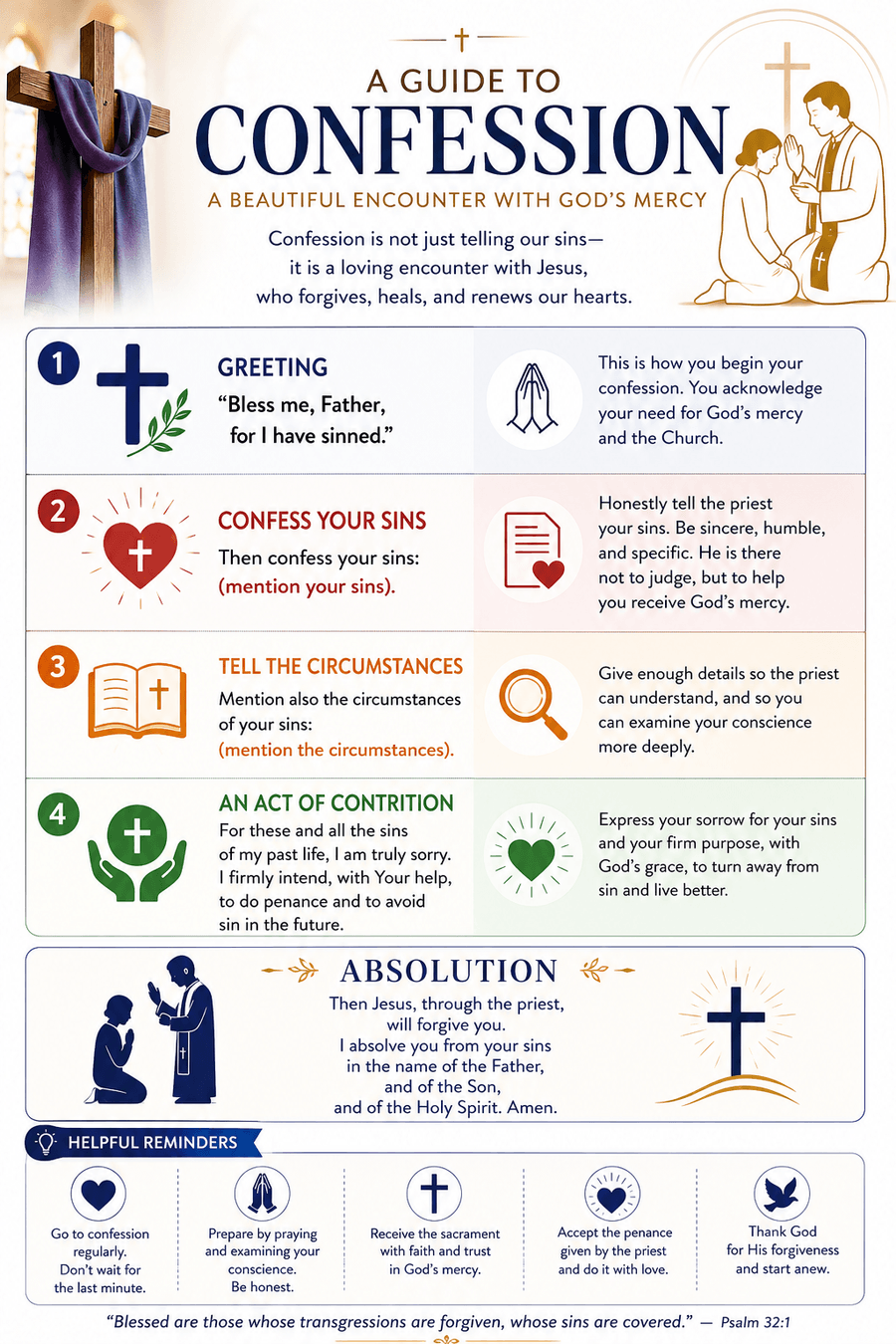
- Enter the confessional or reconciliation room and make the Sign of the Cross. The priest will usually greet you and may offer a short blessing.
- Say: "Bless me, Father, for I have sinned. It has been [amount of time] since my last confession." If it has been many years, or this is your first confession as an adult, just say so plainly — priests hear this often and will help you through it.
- Confess your sins. State what they were; for mortal sins, name the kind and approximately how many times. You don't need elaborate justification or backstory — state it, and let the priest ask if he needs more.
- The priest may ask a clarifying question, offer brief counsel, or simply listen. This is a normal and helpful part of the sacrament, not a sign anything is wrong.
- The priest assigns your penance — often a prayer or set of prayers, sometimes a concrete act (a phone call, a restitution, an act of charity).
- Pray an Act of Contrition (see the prayer below, or your own words expressing genuine sorrow).
- The priest extends his hand (or a hand gesture through the screen) and prays the prayer of absolution, concluding: "...I absolve you from your sins, in the name of the Father, and of the Son, and of the Holy Spirit." You respond, "Amen."
- The priest usually closes with something like "Go in peace" or "The Lord has freed you from your sins; go in peace." Your confession is complete.
- Complete your penance, ideally the same day.
3. A Guide to Examine Your Conscience — Listing Your Sins
The Ten Commandments remain the Church's own recommended framework (CCC 2054). Go through each one honestly and specifically — vague categories ("I wasn't very nice") are much harder to bring real contrition to than concrete ones ("I gossiped about my coworker on Tuesday").
- I am the Lord your God; you shall not have strange gods before me. Have I put anything — money, comfort, approval, a habit — ahead of God? Have I neglected daily prayer? Dabbled in the occult, horoscopes, or superstition?
- You shall not take the name of the Lord your God in vain. Have I used God's name carelessly, in anger, or as a curse? Have I been irreverent toward sacred things?
- Remember to keep holy the Sabbath. Have I missed Sunday Mass without a serious reason? Have I treated Sunday as an ordinary workday with no room for rest or worship?
- Honor your father and mother. Have I been disrespectful, resentful, or neglectful toward my parents, spouse, children, or legitimate authority?
- You shall not kill. Have I harbored hatred, sought revenge, or wished harm on anyone? Have I been reckless with my own health, or contributed to another's despair through cruelty or neglect?
- You shall not commit adultery. Have I been unfaithful in thought or act? Used pornography? Been impure alone or with another, inside or outside marriage's proper bounds?
- You shall not steal. Have I taken what isn't mine, cheated, failed to pay debts, or been dishonest in small transactions I told myself didn't matter?
- You shall not bear false witness. Have I lied? Gossiped? Damaged someone's reputation, even if what I said was technically true (detraction)?
- You shall not covet your neighbor's wife. Have I entertained lustful thoughts or desires toward someone I have no right to?
- You shall not covet your neighbor's goods. Have I been envious of what others have? Greedy, or ungrateful for what I've been given?
Add sins of omission as you go: prayers not prayed, kindnesses not offered, help not given when it was in your power to give it. These count too.
4. Prayers for After Confession — What to Have Ready
Your penance almost always includes prayer — a set number of Our Fathers or Hail Marys, a decade of the Rosary, or simply an Act of Contrition if you haven't already prayed one. Having the exact words ready means you can pray your penance with attention instead of trying to recall them from memory in the moment.
Act of Contrition:
O my God, I am heartily sorry for having offended you, and I detest all my sins because of your just punishments, but most of all because they offend you, my God, who are all good and deserving of all my love. I firmly resolve, with the help of your grace, to sin no more and to avoid the near occasions of sin. Amen.
Our Father:
Our Father, who art in heaven, hallowed be thy name; thy kingdom come; thy will be done on earth as it is in heaven. Give us this day our daily bread; and forgive us our trespasses as we forgive those who trespass against us; and lead us not into temptation, but deliver us from evil. Amen.
Hail Mary:
Hail Mary, full of grace, the Lord is with you; blessed are you among women, and blessed is the fruit of your womb, Jesus. Holy Mary, Mother of God, pray for us sinners now and at the hour of our death. Amen.
Glory Be:
Glory be to the Father, and to the Son, and to the Holy Spirit, as it was in the beginning, is now, and ever shall be, world without end. Amen.
For the fuller history and meaning behind each of these, see the companion prayer articles in this Faith Library: Act of Contrition, The Lord's Prayer, Hail Mary, and Glory Be. If your priest assigns a prayer you don't recognize or can't quite recall, it is always fine to simply ask him to repeat it — no one expects word-perfect recall in the moment.
A Visual Guide to Confession
Was this article helpful?
Help Us Keep Catholic Formation Faithful
Catholic clergy and qualified formation professionals are invited to review this article or recommend an authoritative source.

Grow closer to God.
Agnioz is here to walk with you.
Register for FREE and unlock more Catholic content, prayers, and reflections to help you become a more enlightened Catholic — FREE FOREVER.


Let's grow together in faith, hope, and love. 🙏