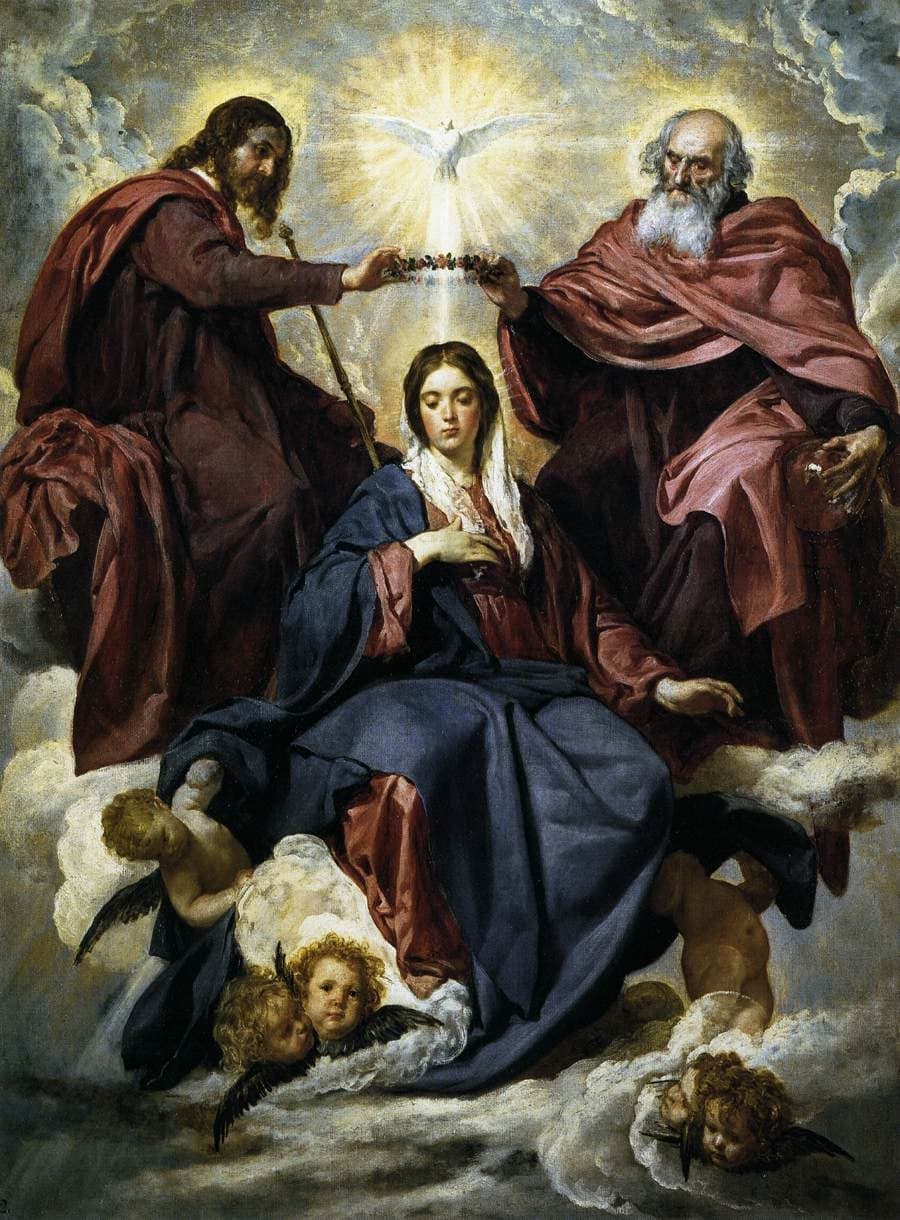
Mary, Queen
of Heaven: The Meaning of Her Queenship
“Behold, I am the handmaid of the Lord; let it be to me according to your word. — Luke 1:38”
Why She Matters
The Queenship of Mary reminds believers that true exaltation comes through total surrender to God, not through status sought on its own terms — a pattern Mary lived first and most completely.
Virtue for Today
Humility carried to its fullest — total, trusting obedience to God's will, without reservation or bargaining.
Try Today
Pray the Salve Regina today, slowly, noticing that it asks Mary to turn her eyes of mercy toward you rather than to rule over you.
A Queen Crowned Eight Days After Her Assumption
The Church keeps the Queenship of Mary on August 22, precisely eight days after the Solemnity of the Assumption on August 15 — and that placement is not an accident of the calendar. It is a theological argument in itself. First the Church proclaims that Mary, body and soul, was taken up into heaven; then, a week later, it proclaims what that means: she reigns there. The two feasts are really one continuous thought, spoken in two sentences a week apart.
Pope Pius XII instituted this feast formally in 1954 with the encyclical Ad Caeli Reginam ("To the Queen of Heaven"), but he was not inventing a new idea. He was giving a fixed date and a solemn liturgical voice to something Christians had been praying for over a thousand years already, every time they ended the day with the ancient hymn Salve Regina — "Hail, Holy Queen." The title was old. The feast was new.
Why Call Mary "Queen" at All?
The reasoning is direct, almost simple, once it is stated plainly: Scripture and tradition both call Jesus Christ King — King of kings, ruler of an everlasting kingdom (Revelation 19:16; Luke 1:32-33). In royal courts throughout the ancient Near East, including ancient Israel, the mother of the reigning king held a distinct, honored office of her own: the gebirah, the queen mother, who sat at the king's right hand and carried real influence precisely because of who her son was (1 Kings 2:19). Mary is the mother of the King of Kings. If Christ is King, the logic of centuries of Christian devotion runs, then his mother is Queen — not by any power or merit belonging to her independently, but entirely by her relationship to him.
This is worth being precise about, because it is easy to hear "Queen of Heaven" and imagine something closer to a goddess, a rival center of divine power alongside God. That is not Catholic teaching, and it never has been. Mary's queenship is entirely derivative. She reigns because she is the mother of the King, and because she said yes to becoming that mother in the first place — nothing more, nothing less, but nothing less either.
The Handmaid Who Became Queen
That "yes" is really the whole story, and it happened in the plainest possible way, in a small town, to an unmarried woman with no status at all. When the angel Gabriel came to Mary at the Annunciation, she did not answer with the language of royalty. She answered, "Behold, I am the handmaid of the Lord; let it be to me according to your word" (Luke 1:38) — the word for "handmaid" there is the word for a lowly female servant, the opposite of a queen in every earthly sense.
The Church's entire theology of Mary's queenship rests on the deliberate collision of those two words: handmaid and queen. She is exalted not despite her total self-emptying service but precisely because of it. Her own song of praise, the Magnificat, names this pattern outright: "He has regarded the low estate of his handmaiden... he has put down the mighty from their thrones, and exalted those of low degree" (Luke 1:48, 52). Mary is not merely an illustration of that pattern. She is its first and greatest instance. The Queenship of Mary is what total, humble obedience to God looks like when it is followed all the way to its true end.
Not a Throne Above Us, But a Mother Beside Us
This is why the Church has always been careful to describe Mary's queenship as a queenship of service and intercession, not distance and command. She is not pictured, in serious Catholic devotion, sitting apart from believers issuing orders. She is pictured — in the Church's oldest prayers, in the Salve Regina itself — as a mother still actively caring for the people under her, "turning her eyes of mercy toward us," pleading on behalf of "the poor banished children of Eve." A queen who spends her reign interceding for exiles is a very particular kind of queen: closer to a mother watching for her children to come home than a ruler collecting tribute.
Catholics do not worship Mary as Queen; worship belongs to God alone. They honor her, and specifically they ask her intercession — trusting that a mother so entirely surrendered to God's will in her own life will use whatever place she now holds to keep drawing her children back toward the same surrender. Her queenship exists for exactly the same purpose her whole earthly life did: to point toward her Son and help others reach him.
Helper
Reflection Questions:
- Mary's queenship comes entirely from her surrender — "let it be to me according to your word." Where is God asking a "yes" from you right now that feels more like a servant's answer than a triumphant one?
- The Magnificat says God "exalts those of low degree." Where in your own life have you seen humility, not achievement, quietly precede real growth?
- Catholic devotion pictures Mary's queenship as active intercession, not a throne held at a distance. Who in your life needs you to intercede for them today, rather than simply judge or advise them?
- If queenship, in Mary's case, is what obedience looks like carried all the way through, what would "carrying it all the way through" look like in the one area of your life where you tend to stop halfway?
Short Prayer
“Mary, Queen of Heaven, you were exalted because you first knelt as a handmaid. Obtain for me the grace to say yes to God as completely as you did. Amen.”
Prayer to Mary, Queen of Heaven
Mary, Queen of Heaven and Earth, you accepted the lowest place in Nazareth and were raised, body and soul, to reign beside your Son. Teach me that true greatness is found in surrender, not in status sought for its own sake. Watch over me as the mother you have always been to every believer who turns to you, and use whatever place you now hold to draw me, and all those I love, closer to Jesus Christ, your Son and our King. Amen.
Grow closer to God.
Agnioz is here to walk with you.
Register for FREE and unlock more Catholic content, prayers, and reflections to help you become a more enlightened Catholic — FREE FOREVER.


Let's grow together in faith, hope, and love. 🙏