
St. Agnes
of Rome: The Twelve-Year-Old Who Chose Death Over Compromise
291 – 304
“I am espoused to Him whom the angels serve, whose beauty the sun and moon admire.”
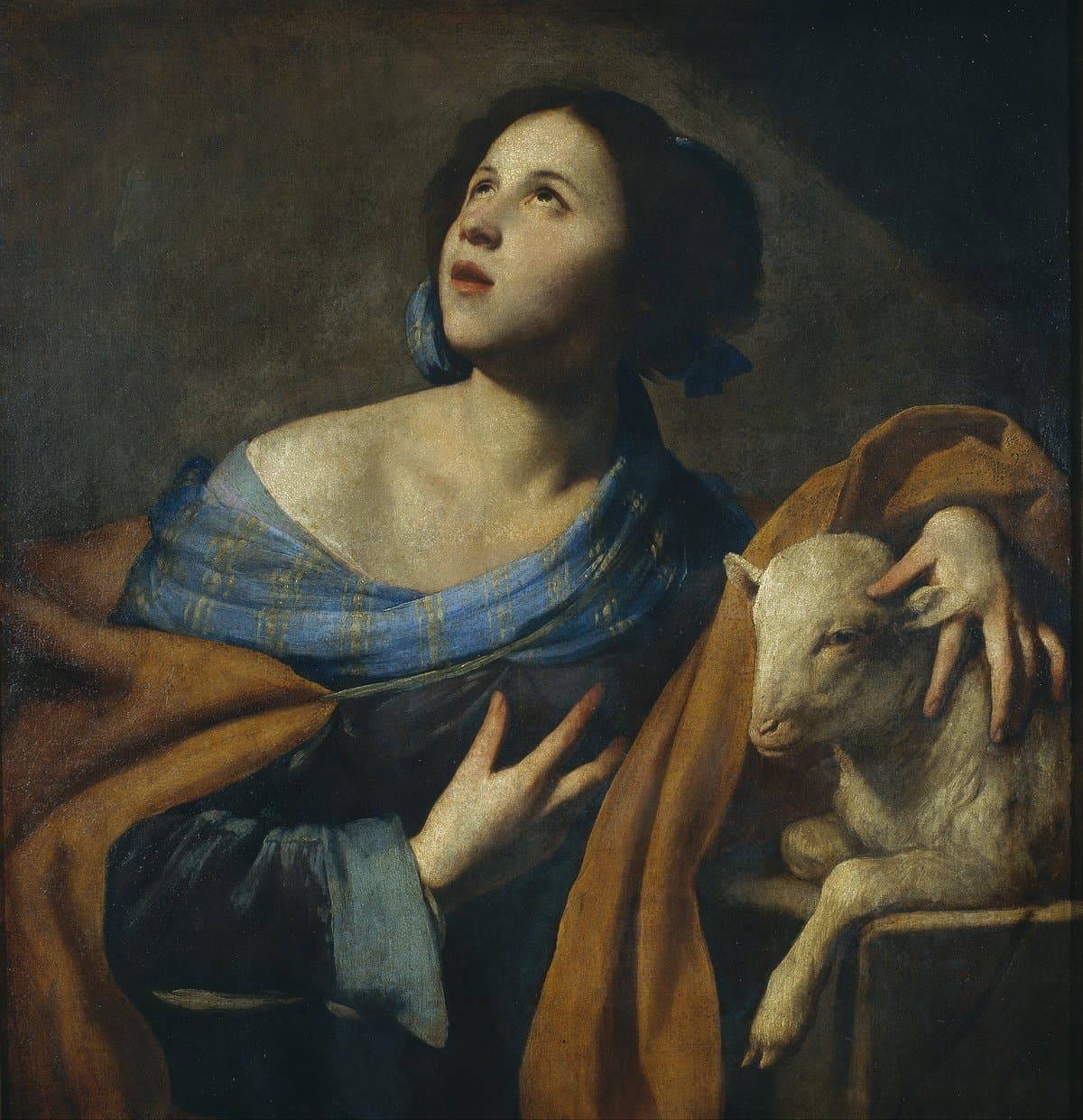
Saint Agnes, painting by Massimo Stanzione, c. 1635–1640 · Public Domain
Why She Matters
Agnes, not yet a teenager, refused marriage proposals from prominent Roman families because she had already consecrated her life to Christ, and was condemned to public humiliation and death rather than renounce that vow. She matters because, for over 1,700 years, the Church has held up her resolve — made at an age most people assume is too young for real conviction — as one of its clearest examples of faithfulness under real pressure to compromise.
Virtue for Today
Fidelity
Try Today
Recommit today, in one concrete way, to a promise or commitment that costs you something to keep.
A Consecration Made Early
Agnes was born around 291 AD into a noble Christian family in Rome, at a time when Christianity remained a capital offense under Roman law and persecutions flared periodically depending on the emperor in power. According to the early tradition preserved in the writings of St. Ambrose and St. Jerome among others, Agnes consecrated her virginity to God while still very young — traditional accounts place her around twelve or thirteen at the time of her death, which would place her private vow even earlier.
As she grew, several young men of prominent Roman families sought her in marriage. She refused each of them, explaining that she had already given herself to Christ. One suitor, spurned and reportedly aware of her Christian faith, denounced her to Roman authorities during a period of persecution — commonly associated with the reign of Diocletian, though some earlier sources place the events slightly before his formal edicts.
Condemned for Refusing to Yield
Roman authorities, seeking to break her resolve and shame her publicly, condemned Agnes to be dragged naked through the streets to a brothel. Tradition holds that her hair miraculously grew long enough to cover her, and that a young man who attempted to assault her there was struck blind — restored to sight only after Agnes prayed for him, an act often cited as evidence her resistance was rooted in mercy, not vengeance. When pressure to renounce her faith and offer sacrifice to Roman gods still failed to move her, she was ultimately executed — accounts vary between beheading and being stabbed in the throat, the method used for condemning criminals too young by Roman custom for the usual execution methods.
Enduring Veneration
Agnes was venerated almost immediately as one of the Church's most significant virgin martyrs; she is named in the Roman Canon, the first Eucharistic Prayer still used at Mass today, placing her among a small group of saints commemorated in the Mass itself since antiquity. Constantine's daughter built a basilica over her tomb along the Via Nomentana in Rome within a few decades of her death. To this day, on her feast day (January 21), two lambs are ceremonially blessed at the Church of Sant'Agnese fuori le Mura in Rome — a reference to her name's resemblance to the Latin agnus (lamb) — and their wool is later woven into the pallium, a vestment worn by archbishops as a sign of their office. She remains the patron saint of chastity, purity, young girls, and those recovering from sexual violence.
Helper
Reflection Questions:
- Agnes refused advantageous marriages that would have secured her safety and status, for the sake of a commitment others couldn't see the value of. What commitments of yours are hard for others to understand, and how do you stay firm in them anyway?
- She prayed for the healing of a man who had tried to harm her. What would it look like for you to extend that kind of mercy to someone who has wronged you?
- Her age — barely into adolescence — makes her resolve especially striking. Do you underestimate the depth of conviction young people are capable of, in yourself or others?
- Roman authorities specifically chose public humiliation to try to break her, not just execution. Have you ever faced pressure to compromise through shame rather than force, and how did you respond?
- She has been remembered in the Church's central prayer, the Mass, for over 1,700 years. What does it mean that a life cut short so young could still echo for so long?
Short Prayer
“St. Agnes, pray for us — that we may remain faithful to Christ, whatever the cost, and find courage in your example. Amen.”
Prayer to St. Agnes of Rome
Prayer to St. Agnes of Rome St. Agnes, barely into adolescence, you refused marriages that would have secured your safety and status because you had already given your life to Christ, and you faced public humiliation and death rather than take back that promise. Pray for young people navigating pressure to compromise what they believe, especially when that pressure comes disguised as belonging or safety. Intercede in a special way for survivors of sexual violence, that they may know the dignity no assault could take from you was never actually lost. Help us hold our own commitments with something of your resolve, even when keeping them costs us real comfort. St. Agnes, pray for us. Amen.
Ambrose of Milan, De Virginibus; Roman Canon

Grow closer to God.
Agnioz is here to walk with you.
Register for FREE and unlock more Catholic content, prayers, and reflections to help you become a more enlightened Catholic — FREE FOREVER.


Let's grow together in faith, hope, and love. 🙏