St. Andrew Kim Taegon: Korea's First Native Priest
1821 – 1846
“My brothers and sisters, my dearest friends, think again and again on this: God has ruled over all things in heaven and on earth from the beginning of time.”
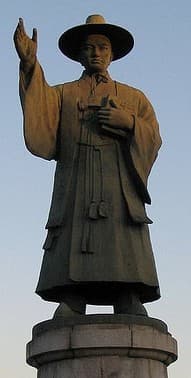
Statue of St. Andrew Kim Tae-gŏn, first Korean Catholic priest, photograph by Swiss James / derivative by Maliepa, 2012 · CC BY 2.0
Why He Matters
Andrew Kim shows that a Church can take root and endure through ordinary lay believers alone, and that formal ordination, when it finally came to Korea, was the fruit of decades of a community's courage rather than the cause of it.
Virtue for Today
Steadfastness
Try Today
Write a short note of encouragement to someone whose faith or courage you admire, and actually send it today.
Born Into Persecution
Andrew Kim Taegon was born on August 21, 1821, in Korea, into a Catholic family that already knew the cost of the faith firsthand: his own father, Ignatius Kim, would later be martyred for practicing Christianity, which the Joseon dynasty had outlawed as a threat to Confucian social order. Catholicism had entered Korea unusually — introduced not by foreign missionaries but by Korean scholars who encountered Christian texts brought back from China and converted themselves before any priest had ever set foot in the country. By the time Andrew was a teenager, the Korean Catholic community, though entirely lay-led and constantly at risk, had grown substantially and had begun requesting priests from abroad.
A 1,200-Mile Journey to the Priesthood
Baptized at fifteen, Andrew was among the first Koreans selected to travel abroad for seminary training, since no seminary yet existed inside Korea itself. He walked roughly 1,200 miles to Macau to begin his studies, enduring years of difficult travel, illness, and repeated attempts to reenter a closed and watchful Korea to maintain contact with missionaries and the underground Catholic community at home. He was ordained a priest in Shanghai in 1845, becoming the first native-born Korean Catholic priest in history, and then made his way back into Korea to minister to a Church that had to operate almost entirely in secret.
Arrest and Interrogation
Andrew's priestly ministry inside Korea lasted only about a year. In June 1846, while arranging a route for additional missionaries to enter the country by sea, he was arrested by a border patrol. Under interrogation and torture, he refused to renounce his faith or to identify other Christians. While imprisoned and awaiting execution, he wrote a final letter to the Catholic community he had served, urging them to remain steadfast: "My brothers and sisters, my dearest friends, think again and again on this: God has ruled over all things in heaven and on earth from the beginning of time."
Martyrdom and the Wider Persecution
Andrew Kim was beheaded outside Seoul on September 16, 1846, at the age of twenty-five. His death was one moment within a much larger, sustained persecution of Korean Catholics that stretched across most of the nineteenth century, killing an estimated 10,000 believers in total. On May 6, 1984, Pope John Paul II traveled to Seoul and canonized 103 of these Korean martyrs together — Andrew Kim among them, alongside bishops, priests, and lay men, women, and children as young as thirteen — in the first canonization Mass a pope had ever celebrated outside Vatican City. At the ceremony, John Paul II noted what made the Korean Church historically unusual: "The Korean Church is unique because it was founded entirely by lay people... in less than a century, it could boast of 10,000 martyrs."
A Church Built by Laypeople, Sealed by Martyrs
Andrew Kim is remembered today as the patron of the Korean clergy and a symbol of the wider Korean Catholic community's endurance — a Church that had no priests for its first decades, was repeatedly and violently suppressed, and nonetheless survived to become one of the most vibrant Catholic communities in Asia today.
Helper
Reflection Questions:
- The Korean Catholic Church began entirely through lay conversion, without a single missionary priest present at first. Where might your own witness matter more than you assume, even without formal training or authority?
- Andrew traveled 1,200 miles and endured years of hardship simply to be trained for a ministry he knew was illegal and dangerous in his home country. What difficult, long-odds preparation might God be asking of you for something you can't yet fully see the shape of?
- Under torture, Andrew refused to name other Christians, protecting his community at direct cost to himself. Who in your life depends on your discretion or loyalty, even when it would be easier to protect only yourself?
- His final letter encouraged others to stay faithful, written while he awaited his own execution. What would you want to say to the people you care about if you knew your time to say it was short?
- Pope John Paul II celebrated the first-ever canonization Mass outside Vatican City specifically to honor these martyrs in their own country. Whose faith and sacrifice, in your own family or community, deserves more honor than it currently receives?
Short Prayer
“St. Andrew Kim Taegon and the Korean Martyrs, pray for us — that we may remain steadfast in faith even under real pressure to abandon it. Amen.”
Prayer to St. Andrew Kim Taegon
Prayer to St. Andrew Kim Taegon and Companions St. Andrew Kim Taegon, you were born into a Church already marked by your own father's martyrdom, and you gave your life to becoming a priest for a community that had to worship in hiding. You traveled enormous distances, endured imprisonment and torture, and still used your final days to encourage others rather than despair for yourself. Pray for us, together with Paul Chong Hasang and all the Korean Martyrs, when our own faith feels costly or inconvenient. Give us a fraction of your steadfastness, and help us support quietly and faithfully those in our own lives who carry heavier burdens for their faith than we do. St. Andrew Kim Taegon and Companions, pray for us. Amen.
Vatican News — "Sts. Andrew Kim Taegŏn, Paul Chŏng Hasang and Companions"; Pope John Paul II, homily at the canonization of the 103 Korean Martyrs, Seoul, May 6, 1984; Franciscan Media — "Saints Andrew Kim Taegon, Paul Chong Hasang, and Companions"
Grow closer to God.
Agnioz is here to walk with you.
Register for FREE and unlock more Catholic content, prayers, and reflections to help you become a more enlightened Catholic — FREE FOREVER.


Let's grow together in faith, hope, and love. 🙏