St. Anthony
of Padua: Doctor of the Church, Finder of What Is Lost
1195 – 1231
“If you seek miracles, death, error, all calamities, the leprosy and demons flee, the sick rise up healed. (from the "Si Quaeris Miracula" responsory, composed by Julian of Speyer in 1233, two years after Anthony's death — a traditional liturgical text, not his own words)”
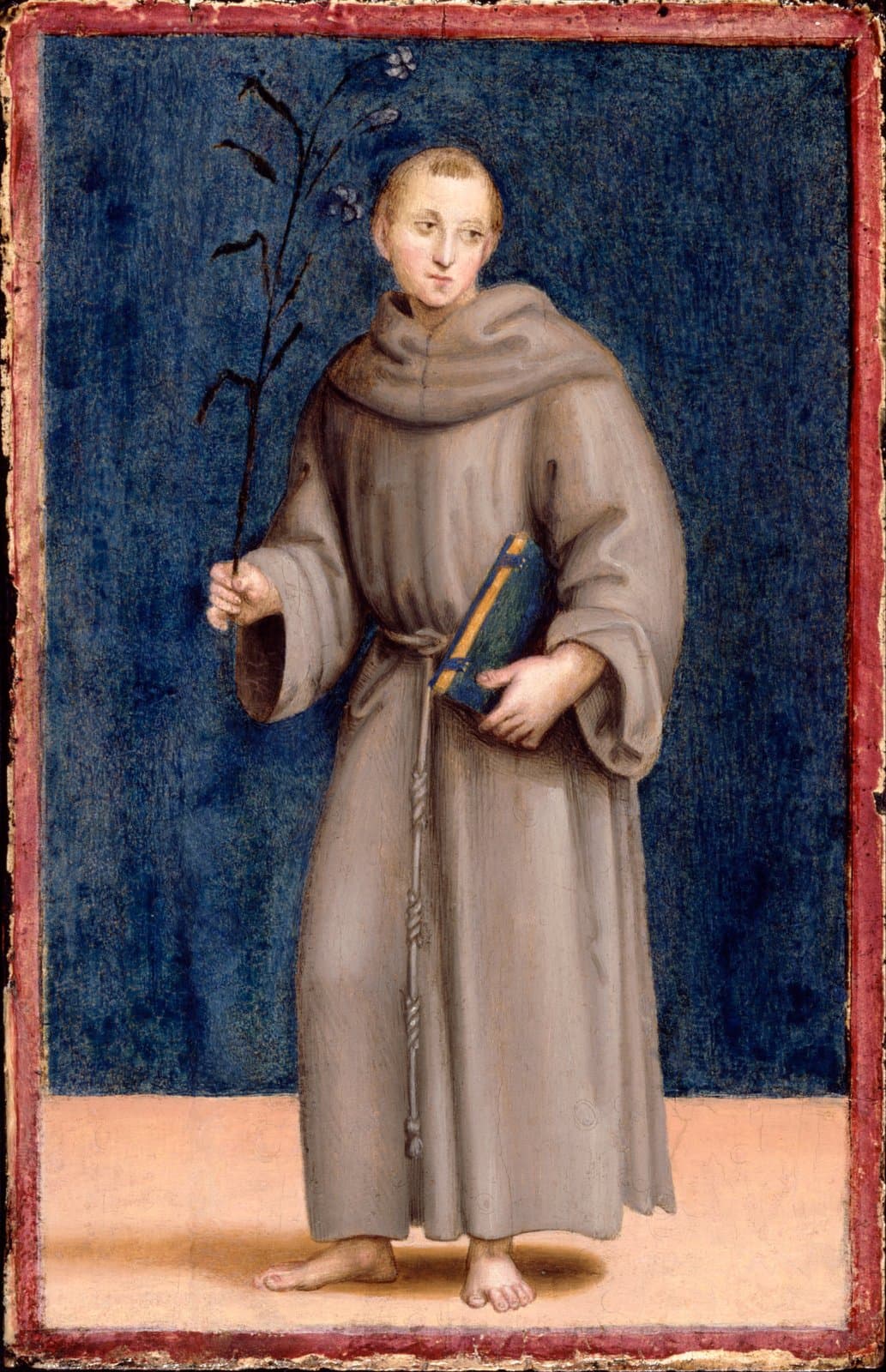
Saint Anthony of Padua, painting attributed to Raphael, c. 1502, Dulwich Picture Gallery (Google Art Project) · Public Domain
Why He Matters
Anthony shows that quietly developed gifts do not need to stay hidden forever, and that a life poured out completely, even a short one, can leave an outsized legacy of both preaching and practical mercy toward the poor and the lost.
Virtue for Today
Powerful Intercession
Try Today
Return or restore something you have that belongs to someone else, or spend a few minutes helping someone find something they have lost.
Fernando Becomes Anthony
Anthony of Padua was born Fernando Martins de Bulhões around 1195 in Lisbon, Portugal, to a noble family. At fifteen he entered the Augustinian Canons Regular, eventually transferring to their house at Coimbra to escape frequent visits from friends that he felt disrupted his studies and prayer. He spent nearly a decade there absorbing an unusually deep formation in Scripture and theology that would later mark all of his preaching.
A Turn Toward Martyrdom, and Toward Failure
In 1220, the bodies of five Franciscan friars, recently martyred while preaching in Morocco, were brought back to Coimbra for burial. Deeply moved, Fernando asked to join the still-new Franciscan order, taking the name Anthony, with the explicit hope of himself being sent to preach to Muslims in North Africa and, he hoped, dying as those five friars had. He was sent to Morocco in 1221, but fell seriously ill almost immediately and had to be sent home; the ship carrying him back to Portugal was blown off course by storms and landed instead in Sicily, leaving Anthony, sick, without funds, and apparently without any clear future, in Italy rather than Portugal.
An Accidental Discovery
Anthony made his way to a general chapter meeting of the Franciscans in Assisi in 1221, where he met Francis of Assisi himself, but he was assigned afterward to a small hermitage near Forlì with no particular distinction, having said nothing about his years of advanced theological training. The turning point came at an ordination ceremony when the friar scheduled to preach failed to prepare or appear, and Anthony, the only one present with formal theological training, was asked, reluctantly, to speak instead. His superiors and the assembled friars were stunned by the depth, fluency, and power of the impromptu sermon that followed. Word reached Francis of Assisi himself, who, unusually for the early Franciscan movement's suspicion of academic learning, personally authorized Anthony to teach theology to other friars — the first such formal license Francis is known to have granted.
Preacher and Wonder-Worker
For the rest of his short life, Anthony traveled and preached across Italy and southern France, drawing enormous crowds — accounts describe congregations so large that no church could hold them, forcing him to preach outdoors, and shops reportedly closing so that whole towns could hear him. He preached forcefully against usury and on behalf of the poor and was renowned in his own lifetime for reconciling enemies and securing debt relief for the desperate. Numerous miracles were attributed to him even before his death, and a great many more afterward; the most famous later legend, of him preaching to fish who gathered at the water's edge to listen when local heretics refused to hear him, along with his enduring role as the saint most invoked for lost objects — a devotion traced to a thirteenth-century story of a novice who stole and then remorsefully returned Anthony's prayer book — spread his popular cult across the entire Catholic world within a generation of his death.
Doctor of the Church
Anthony died near Padua on June 13, 1231, at only thirty-five, exhausted by his relentless preaching schedule. He was canonized less than a year later, in 1232, one of the fastest canonizations in Church history, a reflection of how immediately and widely his sanctity was recognized. In 1946, Pope Pius XII declared him a Doctor of the Church, one of only a small number of saints given that title, in recognition of the enduring theological depth of his preaching, still collected and studied under the title "Doctor Evangelicus," the Evangelical Doctor.
Helper
Reflection Questions:
- Anthony spent years quietly discovering his gifts had no obvious use, until an unplanned moment forced them into the open. Is there a talent you've kept hidden, waiting for a "right" moment that hasn't come?
- He originally wanted to be a missionary martyr in Morocco and was instead blown off course into an unglamorous hermitage. How do you respond when your specific hopes for how to serve God are redirected somewhere you didn't choose?
- Francis of Assisi's Franciscans were initially suspicious of advanced learning, yet Francis himself made an exception for Anthony's gifts. Where might you need to set aside a general principle to recognize a specific person's genuine calling?
- Anthony's popular devotion today (finding lost objects) grew out of one very specific, personal story about a returned book. What small, concrete act of restitution or honesty might matter more than you think?
- He preached relentlessly until his body gave out at thirty-five. What would balanced, sustainable zeal look like for you, short of Anthony's total self-expenditure but still genuinely wholehearted?
Short Prayer
“St. Anthony of Padua, pray for us — that what is lost, within us or around us, may be found. Amen.”
Prayer to St. Anthony of Padua
Prayer to St. Anthony of Padua St. Anthony of Padua, you preached with a depth and power that surprised even those who knew you, and you spent your short life restoring what was lost, whether debts, reconciliations, or a single stolen book. Pray for us when we have lost something we desperately need to find, whether an object, a relationship, or our own sense of direction. Help us trust that nothing entrusted to your intercession is too small to matter. St. Anthony of Padua, pray for us. Amen.
Julian of Speyer, Officium Rhythmicum S. Antonii, 1233; EWTN — St. Anthony of Padua

Grow closer to God.
Agnioz is here to walk with you.
Register for FREE and unlock more Catholic content, prayers, and reflections to help you become a more enlightened Catholic — FREE FOREVER.


Let's grow together in faith, hope, and love. 🙏