
St. Anthony the Great: Father
of All Monks
251 – 356
“I no longer fear God, but I love Him. For love casts out fear.”
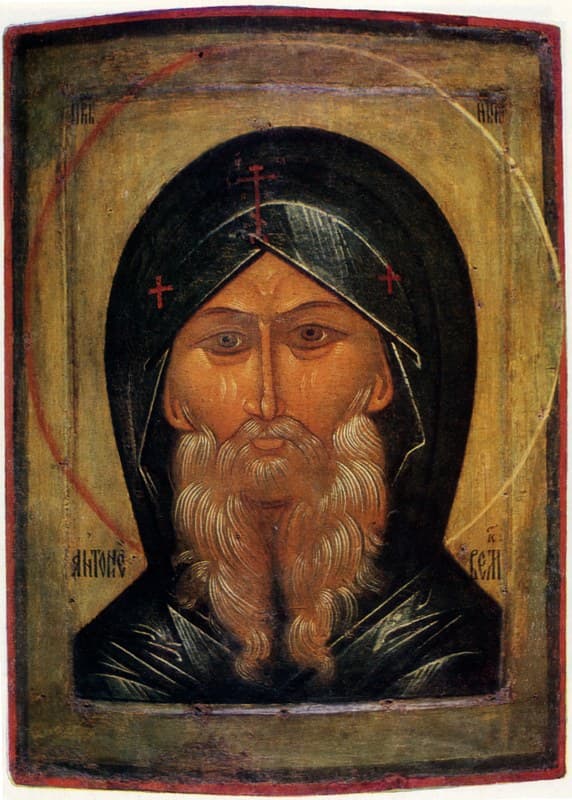
Icon of Saint Anthony the Great, unknown iconographer, mid-16th century · Public Domain (PD-old-100)
Why He Matters
Anthony showed that ordinary Christians, not just clergy, could pursue radical holiness through prayer, discipline, and direct spiritual combat, founding a monastic tradition that has shaped Christian spirituality in both East and West for over 1,700 years.
Virtue for Today
Spiritual Warfare
Try Today
Spend fifteen minutes today in deliberate silence and prayer, resisting whatever distraction first tries to pull you away from it.
An Inheritance Given Away
Anthony was born around 251 in Coma, a village in Middle Egypt, to prosperous Christian landowners. He was orphaned in his late teens, left responsible for a large estate and a younger sister. According to Athanasius of Alexandria, whose Life of Antony (written shortly after Anthony's death) is the primary source for his biography, Anthony was struck one day on entering church by the Gospel reading in which Jesus tells the rich young man, "If thou wilt be perfect, go, sell what thou hast, and give to the poor... and come, follow me" (Matthew 19:21). Anthony took the words as addressed to him personally, sold his land, distributed the proceeds, placed his sister with a community of Christian women, and left ordinary life behind entirely.
Into the Desert
Anthony first apprenticed himself to older ascetics living near his village, then moved progressively farther into solitude — first to tombs outside Coma, then to a remote fortress at Pispir on the edge of the desert, where he lived alone for some twenty years, and finally deep into the Eastern Desert near the Red Sea. Athanasius describes this withdrawal not as escape from struggle but as a deliberate search for it: Anthony went into the wilderness specifically to confront, in solitude and silence, the temptations Christians ordinarily face muffled by the noise of daily life.
Spiritual Warfare in the Wilderness
The most famous and most frequently painted episodes of Anthony's life are his temptations. Athanasius records the devil assailing him first with memories of family, wealth, and comfort, then with despair and boredom, then with terrifying visions of wild beasts and demons that left him physically battered. Anthony's response, as Athanasius records it, was not despair but combative confidence: he mocked the demons for their weakness before God, insisted on continuing his prayer and manual work regardless of what he saw or felt, and later told the monks who gathered around him not to fear demons, since a Christian filled with the Holy Spirit had nothing ultimately to dread from them. This portrait of a spiritual athlete who went looking for the fight became the founding image of what later ages called "spiritual warfare."
Father of Monks
As Anthony's reputation for holiness spread, disciples began seeking him out, until loose communities of hermits had formed around his cells at Pispir and later near the Red Sea, at the site of the still-active Monastery of St. Anthony, the oldest continuously inhabited Christian monastery in the world. He did not organize a formal monastic rule as later figures like Pachomius and Benedict would, but his example — total renunciation, manual labor, unceasing prayer, and warfare against temptation understood as the central work of a Christian life — became the template all later Christian monasticism, East and West, traced back to him. He twice left his solitude to defend the faith publicly: once during the persecution under Emperor Maximinus in 311, ministering to imprisoned Christians in Alexandria at real risk to his life, and again around 338 to oppose the Arian heresy at the invitation of his friend and biographer, Athanasius.
Death at a Great Age
Anthony died around 356, reportedly at the age of 105, having asked that his grave be kept secret to avoid becoming an object of a cult of relics. Word of his life spread rapidly through Athanasius's biography, translated into Latin within Anthony's own lifetime; it directly inspired, among many others, the conversion of St. Augustine, who records hearing Anthony's story read aloud as one of the turning points before his own baptism.
Helper
Reflection Questions:
- Anthony heard one Gospel line and took it as spoken directly to him, then acted immediately rather than waiting. Is there a piece of Scripture or teaching you have let stay comfortably general rather than letting it address you personally?
- He went looking for temptation in solitude rather than waiting for it to find him in ordinary life, believing the fight itself would make him stronger. What spiritual "desert" — silence, fasting, deliberate discomfort — have you been avoiding?
- Athanasius records Anthony responding to frightening visions with mockery of the enemy's weakness before God rather than despair. How do you typically respond to fear or discouragement — do you treat it as more powerful than it is?
- Anthony never organized a religious order, yet his example alone shaped monasticism for centuries. What is one small, faithful example you could set today without needing to build anything formal around it?
- He interrupted decades of solitude twice, when he believed the wider Church genuinely needed him. Is there a comfort or routine you would be willing to set aside if someone truly needed you?
Short Prayer
“St. Anthony the Great, father of monks, pray for us — that we may face temptation with your courage and trust in God's strength rather than our own. Amen.”
Prayer to St. Anthony the Great
Prayer to St. Anthony the Great St. Anthony the Great, you left comfort and wealth behind to seek God alone in the wilderness, and you faced temptation and fear directly rather than running from them, trusting that Christ's strength in you was greater than anything the enemy could bring against you. Pray for us when we are tempted to despair, to give up on prayer, or to believe that evil is stronger than grace. Teach us to meet our own struggles the way you met yours: with confidence, patience, and total reliance on God rather than on our own strength. St. Anthony, father of monks, pray for us. Amen.
Athanasius of Alexandria, Life of Antony, c. 360 (Church Fathers, New Advent)
Grow closer to God.
Agnioz is here to walk with you.
Register for FREE and unlock more Catholic content, prayers, and reflections to help you become a more enlightened Catholic — FREE FOREVER.


Let's grow together in faith, hope, and love. 🙏