
St. Apollonia: The Aged Virgin Who Would Not Blaspheme
? – 249
“She leapt into the fire and was consumed. (Bishop Dionysius of Alexandria's contemporary eyewitness account of her death, preserved by Eusebius — a genuine primary source describing her, not her own recorded words)”
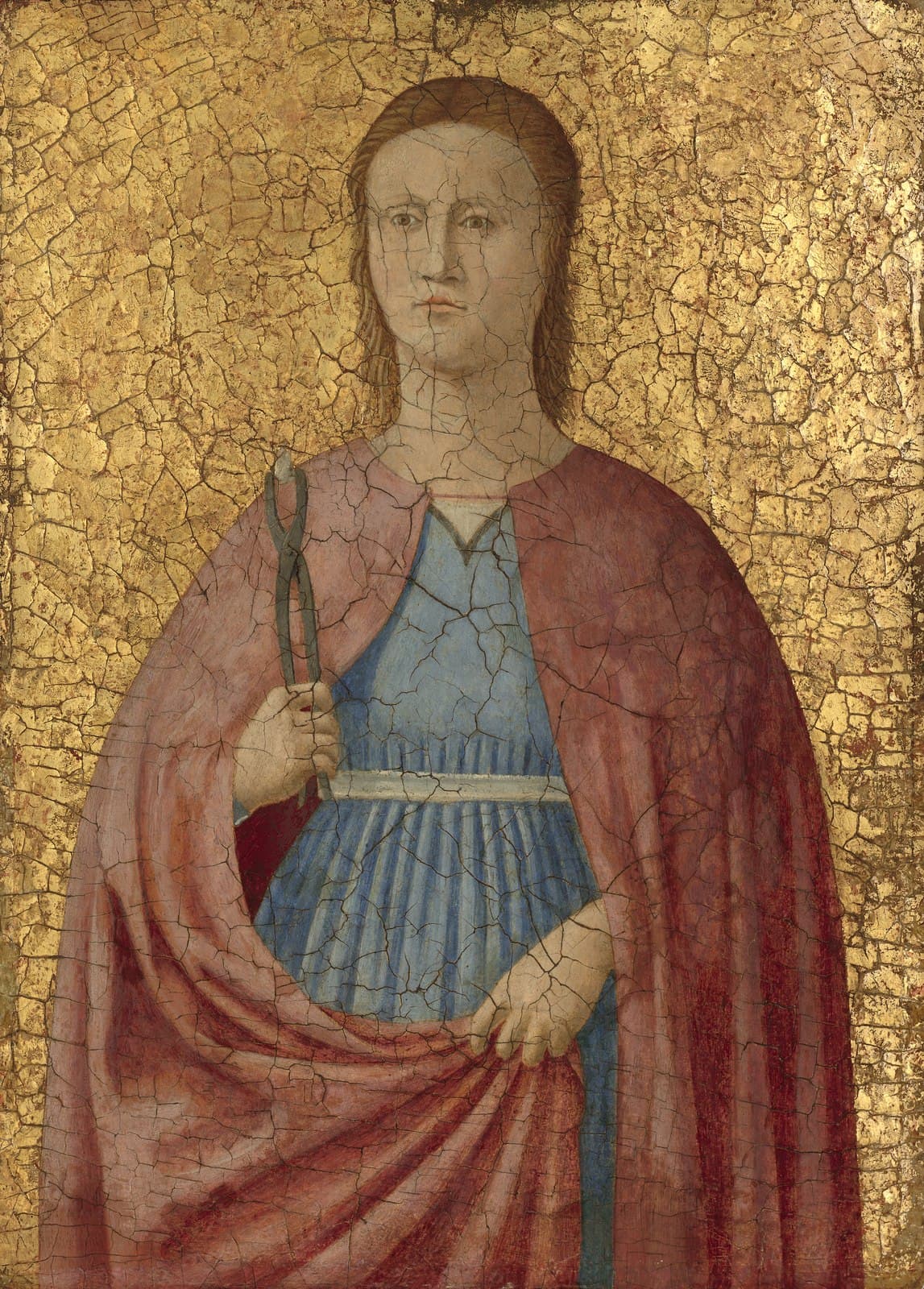
Saint Apollonia, painting attributed to Piero della Francesca, c. 1455–1460, National Gallery of Art, Washington · CC0 (National Gallery of Art Open Access)
Why She Matters
Apollonia is documented by one of the strongest surviving eyewitness accounts of any early Christian martyr, and her death prompted real, serious theological reflection, by Augustine himself, about the moral weight of choosing faithfulness even at ultimate cost.
Virtue for Today
Unshaken Faith
Try Today
Reach out to someone dealing with physical pain or fear today, whether medical, dental, or otherwise, and let them know they are not facing it alone.
An Eyewitness Account, Not a Later Legend
Apollonia stands apart from several other saints in this collection because her martyrdom is documented in an unusually strong, near-contemporary source. Bishop Dionysius of Alexandria, who led the Christian community there during her lifetime, wrote a letter to Bishop Fabius of Antioch describing a violent local uprising against Christians in Alexandria, which took place just before the formal empire-wide persecution under Emperor Decius began, in either late 248 or early 249. That letter survives today because the fourth-century historian Eusebius of Caesarea preserved long extracts from it in his Ecclesiastical History, making it one of the closest things to a genuine eyewitness record available for any martyr from this early period.
What Dionysius Actually Wrote
Dionysius describes a mob, agitated by a local pagan prophet's warning of coming disaster, turning violently on Alexandria's Christians while the city's authorities did nothing to stop it. Among those seized, Dionysius specifically names "the marvelous aged virgin Apollonia," recording that the mob knocked out all her teeth by striking her repeatedly on the jaw, then built a pyre and threatened to burn her alive unless she joined them in blaspheming against God. Dionysius records that Apollonia asked for a brief moment, seemingly to be given a chance to comply, and then, unexpectedly, leapt into the fire herself and was consumed, choosing death over renouncing her faith even under threat rather than direct compulsion.
A Real Theological Question Her Death Raised
Apollonia's voluntary leap into the flames, as Dionysius describes it, raised a genuine and serious question for later Christian theologians: does choosing one's own death, even to avoid being forced into blasphemy, count as suicide, which Christian teaching has consistently condemned, or as a distinct category of martyrdom? St. Augustine, writing more than a century later in The City of God, addresses Apollonia's case directly, suggesting that she may have acted not on ordinary human presumption but in response to what he calls a "secret command" of God, a case he treats as a possible narrow exception rather than a general license. This is a real, substantive theological discussion recorded in a major work of Christian thought, not an invented detail, and it reflects the seriousness with which the early and later Church took the moral complexity of her death rather than simply celebrating it uncritically.
Patron of a Very Specific, Very Human Fear
Apollonia's connection to dentistry and toothache follows directly and plausibly from Dionysius's description of her teeth being broken; she is traditionally depicted in art holding pincers gripping a tooth, and her feast, February 9, has been marked for centuries by prayers specifically for relief from dental pain, a patronage resting on a documented physical detail of her martyrdom rather than on later invented legend. The Roman Church has kept her memory continuously since antiquity on the strength of Dionysius's letter, one of the more solidly attested martyrdom accounts to survive from the pre-Constantinian Church.
Helper
Reflection Questions:
- Apollonia's story survives through an actual eyewitness letter, rare for this period. How does knowing a story rests on strong evidence, rather than later legend, change how you receive it?
- Augustine wrestled seriously with the moral complexity of her final act rather than simply praising it uncritically. Where in your own faith do you resist easy answers and sit with a harder, more honest question instead?
- Apollonia faced physical violence and a direct threat rather than a quiet, hidden test of faith. How do you imagine you would respond under that kind of immediate, visible pressure to deny what you believe?
- She is remembered for a very specific, almost mundane form of suffering, damaged teeth, that most people can somewhat relate to physically even without facing anything like martyrdom. Where might God be present in your own smaller, everyday physical pain or fear?
- Dionysius calls her "the marvelous aged virgin," suggesting she was elderly and long faithful, not young and untested, when she was killed. How do you think about faithfulness sustained over an entire long life, rather than proven in one dramatic moment?
Short Prayer
“St. Apollonia, pray for us — that no fear or pain may shake our faith as yours was tested and held firm. Amen.”
Prayer to St. Apollonia
Prayer to St. Apollonia St. Apollonia, your own bishop wrote down what happened to you while the memory was still fresh: violence meant to force you to deny your faith, met instead with a fidelity that chose death over blasphemy. Pray for us in our own moments of real physical fear and pain, that we might hold on to what we believe even when holding on costs us something. Watch especially over those suffering pain in their teeth or jaw, and over anyone facing pressure to abandon what they know to be true. St. Apollonia, pray for us. Amen.
Dionysius of Alexandria, Letter to Fabius of Antioch, preserved in Eusebius, Ecclesiastical History VI.41; Catholic Encyclopedia — "St. Apollonia"
Grow closer to God.
Agnioz is here to walk with you.
Register for FREE and unlock more Catholic content, prayers, and reflections to help you become a more enlightened Catholic — FREE FOREVER.


Let's grow together in faith, hope, and love. 🙏