
St. Augustine
of Hippo: From Restless Sinner to Doctor of the Church
354 – 430
“You have made us for yourself, O Lord, and our heart is restless until it rests in you.”
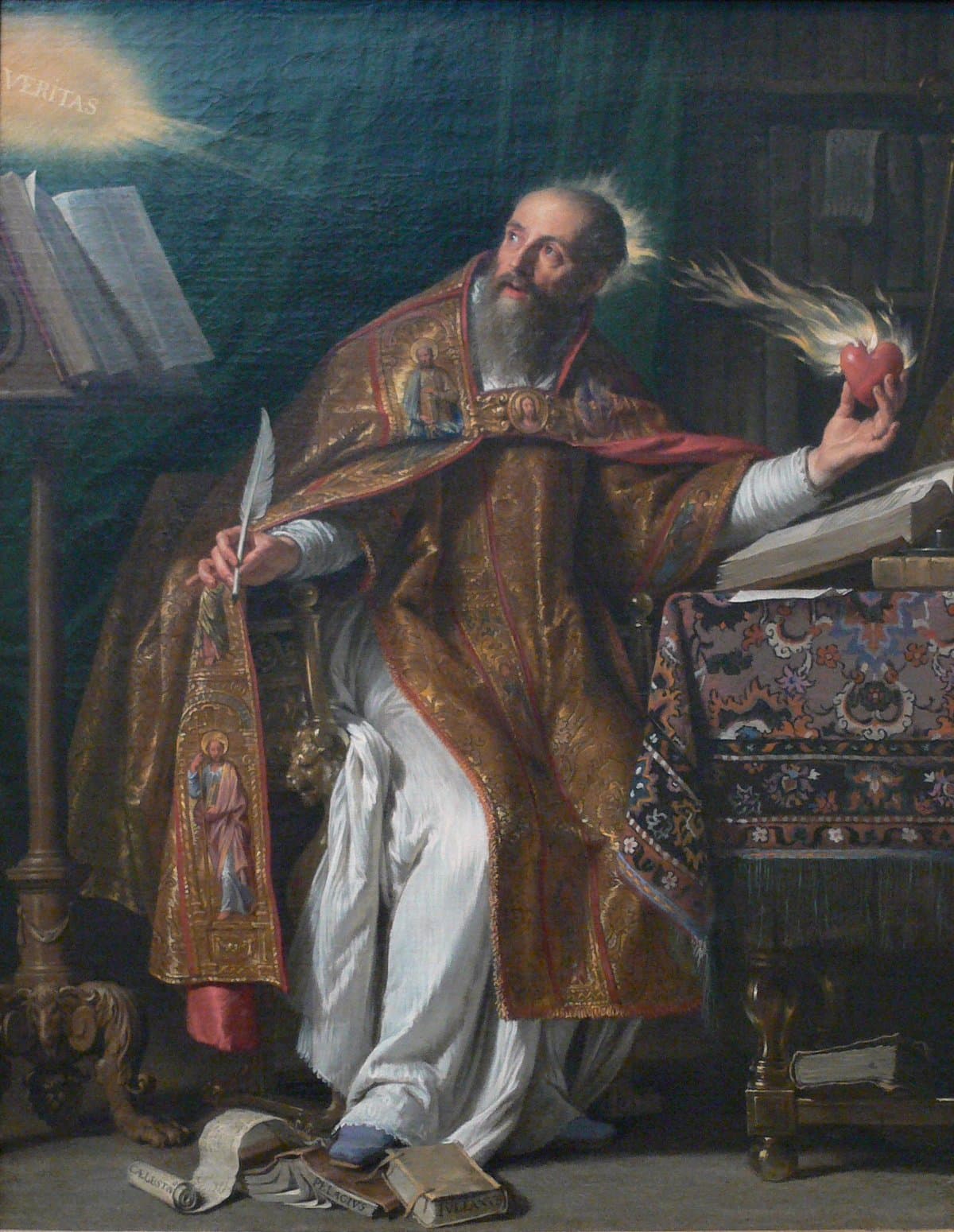
Saint Augustine, painting by Philippe de Champaigne, c. 1645–1650, Los Angeles County Museum of Art (LACMA) · Public Domain
Why He Matters
Augustine spent nearly a decade searching for truth in the wrong places before a dramatic conversion in a Milan garden reordered his entire life. He matters because his writings on grace, sin, and restless desire for God have shaped Western theology for sixteen centuries, and because his own honesty about a messy, sinful youth gives permission to anyone who feels too far gone to come back.
Virtue for Today
Conversion
Try Today
Name one place you are still "restless," and bring that specific restlessness to God in prayer today.
Restlessness Before Rome
Augustine was born in 361 in Thagaste, in modern-day Algeria, to Patricius, a pagan official, and Monica, a devout Christian who prayed for her son's conversion for decades (she is honored as a saint in her own right). As a young man, Augustine pursued a career in rhetoric, fathered a son, Adeodatus, with a woman he never married, and spent nearly a decade drawn to Manichaeism, a dualistic religious philosophy — restlessly, in his own later telling, searching for truth in the wrong places.
He moved to Milan in 384 to teach rhetoric, where he encountered Bishop Ambrose, whose preaching began to dismantle his intellectual objections to Christianity. Augustine described the turning point in the garden at Milan in 386: overwhelmed by inner conflict, he heard a child's voice repeating "take up and read," opened a book of Paul's letters at random, and read a passage from Romans that resolved his indecision. He was baptized by Ambrose the following Easter, 387.
Bishop of Hippo
Augustine returned to North Africa, was ordained a priest in 391, and became Bishop of Hippo Regius in 395 — a position he held for the rest of his life, presiding over a small provincial see while producing a body of theological writing that would shape Western Christianity for the next 1,600 years. He wrote extensively against the heresies of his time — Manichaeism, Donatism, Pelagianism — developing doctrines on original sin, grace, and the nature of the Church that remain foundational in both Catholic and Protestant theology.
Confessions and The City of God
His Confessions, written around 397–400, is widely considered the first true autobiography in Western literature — an unsparing, prayer-form account of his sins and conversion addressed directly to God, containing the famous line: "You have made us for yourself, O Lord, and our heart is restless until it rests in you."
After the sack of Rome by the Visigoths in 410 shocked the Roman world, Augustine spent over a decade writing The City of God, arguing that Rome's fall was not the failure of Christianity but a call to recognize that no earthly city — however great — can be humanity's final home. He died in 430 as Hippo itself was under siege by the Vandals, and was later declared a Doctor of the Church for the sheer scale of his theological influence.
Helper
Reflection Questions:
- Augustine spent years searching for truth in the wrong places before his conversion. What "wrong places" have you searched in, and what did that search teach you?
- His mother Monica prayed for his conversion for decades without seeing results for most of that time. Is there someone you're praying for whose change you may never see?
- His conversion came through an ordinary, almost accidental moment — a child's voice, a random passage. Where might God be speaking through the ordinary details of your life?
- Augustine wrote "our heart is restless until it rests in you." What are you currently restless for, and where are you actually looking for rest?
- He wrote The City of God after his world was, quite literally, falling apart. How do you respond when the institutions or securities you counted on prove fragile?
Short Prayer
“Late have I loved you, O Beauty ever ancient, ever new, late have I loved you! (St. Augustine, Confessions, Book X)”
Prayer to St. Augustine of Hippo
Prayer to St. Augustine of Hippo St. Augustine, you spent years chasing truth in philosophy, ambition, and disordered love before a voice in a garden turned your whole life toward God. You did not hide your sins when you wrote your Confessions; you offered them honestly, trusting that a God who could redeem your restless heart could redeem anyone's. Pray for us in whatever we are still searching for in the wrong places, and for anyone who feels too far gone to come back. Help us believe, as you came to believe, that our hearts truly are restless until they rest in God — and that rest is still offered to us today. St. Augustine, pray for us. Amen.
Confessions (Augustine of Hippo, trans. Henry Chadwick, Oxford)
Grow closer to God.
Agnioz is here to walk with you.
Register for FREE and unlock more Catholic content, prayers, and reflections to help you become a more enlightened Catholic — FREE FOREVER.


Let's grow together in faith, hope, and love. 🙏