St. Barbara: A Cult Older Than Her Story
“Santa Bárbara bendita, que en el cielo estás escrita, con papel y agua bendita. — "Blessed Saint Barbara, who are written in heaven, with paper and holy water." (a centuries-old traditional Hispanic folk invocation recited during thunderstorms; not a recorded quotation from Barbara herself)”
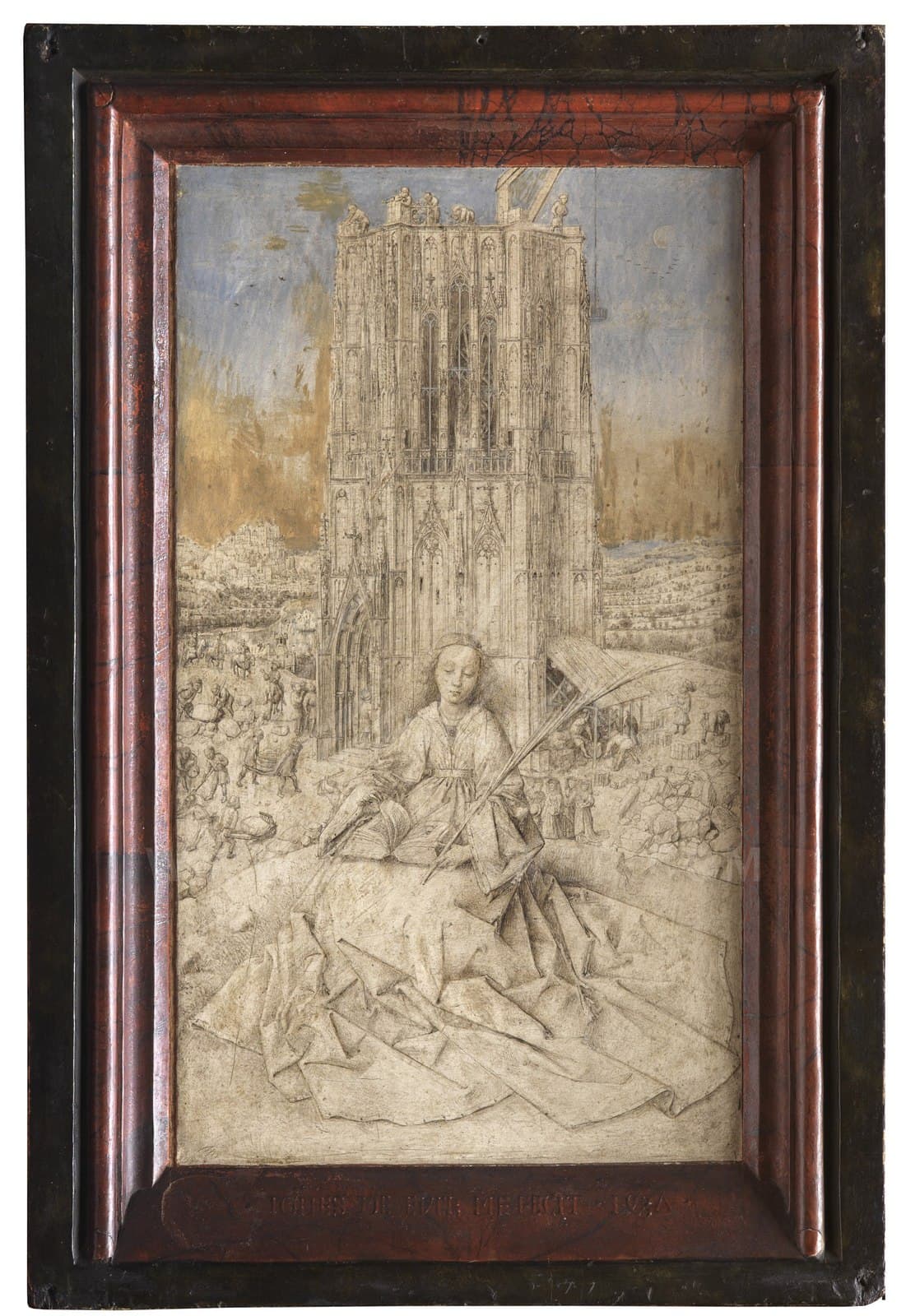
Saint Barbara, painting by Jan van Eyck, 1437, Royal Museum of Fine Arts Antwerp · Public Domain
Why She Matters
Barbara shows, more starkly than almost any other saint, how a devotional tradition can take on a life entirely its own, shaping real prayer, real naval and military custom, and real comfort for people facing sudden danger, even where no verifiable history stands behind the name.
Virtue for Today
Steadfast Under Threat
Try Today
The next time you face a sudden fear, a storm, bad news, an emergency, pause for one deliberate moment of prayer rather than only reacting, the way centuries of tradition have turned to Barbara in exactly those moments.
No Trace in the Earliest Sources
Of every saint in this collection, Barbara presents the starkest gap between the strength of her later cult and the weakness of her historical foundation. The Catholic Encyclopedia states this directly: "there is no reference to St. Barbara contained in the authentic early historical authorities for Christian antiquity," and her name does not even appear in the original version of St. Jerome's martyrology, one of the Church's oldest and most careful early records of the martyrs. Her legendary Acts do not surface anywhere in the historical record until the seventh century, meaning that if she died during the persecutions of the early fourth century, as later tradition claims, more than three hundred years pass with no mention of her at all before her story appears from nowhere. Because of this total absence of independent evidence, both her birth year and death year are left unset here rather than repeating the legend's traditional dates as though they were established fact.
The Legend, Presented as Legend
According to the story that eventually spread widely across both Eastern and Western Christianity, Barbara was the daughter of a wealthy pagan named Dioscorus, who kept her secluded in a tower to shield her from outside influence and prevent her marrying. While isolated there, she secretly became a Christian and, in one version of the story, had a third window added to a bathhouse being built for her, a private declaration of faith in the Trinity that her father did not immediately understand. When Dioscorus discovered her conversion, he denounced her to Roman authorities; she was tortured and, in the story's grimmest detail, ultimately beheaded by her own father's hand. The legend concludes with Dioscorus struck dead by lightning immediately afterward, understood as divine punishment for killing his own daughter. None of this can be verified as historical event; it is presented here as the received legend that shaped centuries of devotion, not as documented biography.
A Genuine Cult Without a Verified Origin
What is real, even amid the total absence of early historical evidence, is that public veneration of Barbara was clearly widespread in both the Eastern and Western Church well before the ninth century, when her legendary Acts were incorporated into major collections of saints' lives circulating across Europe. In other words, the devotion came first and spread widely; the specific biographical explanation for it appeared only later and cannot be independently confirmed. This pattern, real early veneration attached to a name with no verifiable underlying history, closely parallels the situation of St. Christopher elsewhere in this collection.
Patroness of Sudden, Violent Death
Because the legend associates her father's death with a sudden lightning strike, Barbara became, by long custom, the saint most invoked against sudden violent death, particularly death by fire, explosion, or storm. This is the direct root of her enduring patronage of miners, artillery crews, military engineers, and firework makers, all trades historically carrying a high risk of sudden, violent death by explosion. The tradition runs deep and remains genuinely alive today: the compartment on a ship or in a fortress used to store gunpowder has been called, in Spanish, Italian, and formerly French naval and military usage, the "Santa Bárbara," a real, well-documented linguistic and devotional practice centuries old, and artillery units across several nations still formally celebrate her feast, December 4, with a shared meal and toast in her honor, even though the woman being toasted has no confirmed historical existence at all. Because of this same lack of verifiable evidence, her feast was removed from the Church's General Roman Calendar in 1969, the same revision that affected St. Christopher and St. Valentine.
Helper
Reflection Questions:
- Barbara's devotion is real and centuries old, yet her underlying biography has no confirmed historical basis whatsoever. How do you personally hold devotion and historical honesty together, without needing one to fully validate the other?
- In the legend, Barbara's faith develops in secret, hidden even from her own father, before it is ever discovered. Is there a part of your own faith you keep hidden from people close to you, and why?
- She became patroness of people in trades with high, sudden physical risk: miners, gunners, engineers. Who in your own life works in danger you rarely think about, and how might you support or pray for them specifically?
- The legend's most disturbing detail, a father killing his own daughter for her faith, reflects how seriously early Christians understood family opposition to conversion could become. Has your own faith ever created real tension or conflict with people close to you?
- Barbara's cult spread for centuries before anyone wrote down a story to explain it. Where in your own life have you experienced or witnessed devotion, loyalty, or love that came first, before anyone could fully explain or justify it?
Short Prayer
“St. Barbara, pray for us — that we may keep our faith steady in moments of sudden fear or danger. Amen.”
Prayer to St. Barbara
Prayer to St. Barbara St. Barbara, no confirmed record of your life survives, yet for well over a thousand years Christians facing sudden danger, storms, explosions, and violent death have called on your name for protection and courage. Pray for us in whatever sudden fear or crisis comes upon us without warning, that we might meet it with steady faith rather than panic. Watch over those who work each day in real physical danger, in mines, on ships, in the military, and in any trade that risks sudden harm, and help all of us keep our trust fixed on God when the ground feels like it is shifting beneath us. St. Barbara, pray for us. Amen.
Catholic Encyclopedia (New Advent) — "St. Barbara"; the naval and artillery "Santa Bárbara" tradition
Grow closer to God.
Agnioz is here to walk with you.
Register for FREE and unlock more Catholic content, prayers, and reflections to help you become a more enlightened Catholic — FREE FOREVER.


Let's grow together in faith, hope, and love. 🙏