St. Basil the Great: The Bishop Who Built the First Hospital
329 – 379
“The bread which you do not use is the bread of the hungry; the garment hanging in your wardrobe is the garment of him who is naked.”
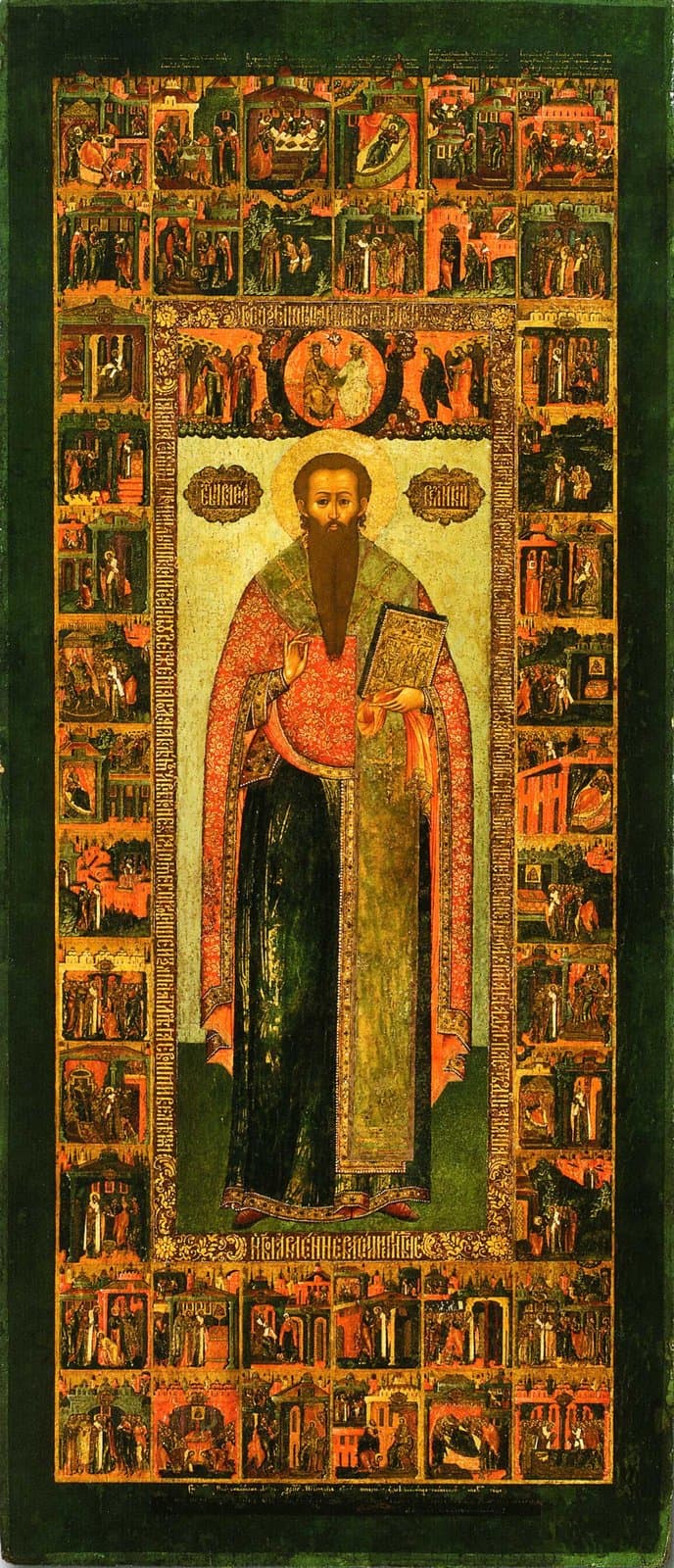
Saint Basil the Great, icon by Semyon Spiridonov Kholmogorets, 1674 · Public Domain
Why He Matters
Basil turned a theological conviction about justice and surplus into one of history's earliest hospitals, while also defending the Church's core Trinitarian teaching during a period of severe political pressure. He matters because he shows that serious theology and serious, organized charity belong together, not in competition.
Virtue for Today
Generosity
Try Today
Give away one usable item you own but do not need, in the spirit of Basil's teaching on surplus.
A Family Full of Saints
Basil was born around 329 in Caesarea, in the region of Cappadocia in modern-day Turkey, into a remarkable Christian family: his grandmother Macrina the Elder, his mother Emmelia, his siblings Macrina the Younger and Gregory of Nyssa, and his brother Peter of Sebaste are all venerated as saints in their own right. He received an outstanding classical education in Caesarea, Constantinople, and Athens, where he formed a close, lifelong friendship with a fellow student, Gregory of Nazianzus — a friendship that would shape both men's theological careers and, together with Basil's brother Gregory of Nyssa, produce the trio later known as the Cappadocian Fathers.
From Rhetoric to the Monastic Life
After finishing his education, Basil briefly taught rhetoric before undergoing what he later described as a genuine spiritual awakening, prompted partly by his sister Macrina's example of radical Christian commitment. He gave away much of his inheritance, traveled to visit monastic communities in Egypt, Palestine, and Syria, and then returned home to found his own monastic community in Cappadocia, writing rules for communal monastic life that emphasized shared prayer, work, and obedience — rules that would influence Eastern monasticism profoundly and, through later adaptation, Western monasticism as well.
The Basiliad: A Hospital Before Hospitals Existed
Basil was ordained a priest and became bishop of Caesarea in 370, at a time of severe famine and social crisis in the region. He preached forcefully against the hoarding of wealth by the well-off while others starved, insisting that surplus goods belonged, by justice rather than mere charity, to those in need: the bread you do not use, he taught, is already the bread of the hungry; the coat hanging unused in your closet already belongs to the person who has none. He backed this teaching with action, using his own resources and pressing the wealthy of Cappadocia to fund an extensive charitable complex just outside Caesarea's walls that came to be called the Basiliad — a combination hospice, poorhouse, and infirmary with facilities and staff, including physicians, dedicated to treating the sick, including those with leprosy. Historians of medicine generally regard it as among the earliest institutions recognizable as a hospital in anything like the modern sense.
Defender of the Nicene Faith
Like Athanasius before him, Basil spent much of his episcopate defending the full divinity of the Holy Spirit and the Son against ongoing Arian pressure, which remained politically powerful in the East during his lifetime. He wrote extensively on the Trinity, including a major treatise on the Holy Spirit, and worked to hold together an often fractured and politically pressured Eastern Church. His correspondence, sermons, and monastic rules survive in significant volume and remain foundational texts of Eastern Christian spirituality and theology.
Doctor of the Church
Basil died in 379, exhausted by decades of demanding administrative, pastoral, and theological work, just two years before the Council of Constantinople formally vindicated the Nicene theology he had spent his life defending. He was declared a Doctor of the Church for his theological writing and is remembered, alongside his charitable works, as one of the great architects of organized Christian monasticism and charity in the ancient world.
Helper
Reflection Questions:
- Basil taught that unused surplus already belongs, in justice, to those who lack it. How does that reframe how you think about what you own but don't use?
- He didn't just preach about caring for the poor — he built an actual institution to do it systematically. Is there a need you see regularly that you could respond to with more than just good intentions?
- His close friendship with Gregory of Nazianzus shaped both of their lives and their theology. What friendships have most shaped your own faith?
- He gave up a promising career in rhetoric after witnessing his sister's radical commitment to Christ. Who in your life has challenged you toward deeper faith by their example?
- Basil spent his final energy on both institution-building and theological defense simultaneously. Where in your life are practical service and pursuing truth both calling for your attention right now?
Short Prayer
“St. Basil the Great, pray for us — that we may see what we do not need as already belonging to those who do. Amen.”
Prayer to St. Basil the Great
Prayer to St. Basil the Great St. Basil, you taught that what sits unused in our homes already belongs, in justice, to those who have nothing, and you did not stop at preaching that truth — you built an entire community of care to live it out, treating the sick and sheltering the poor at a scale your era had never seen. You also spent yourself defending the truth about who God is, exhausted by decades of theological and pastoral labor. Pray for us in our own comfort, that we might hold our resources more loosely and give more readily. Help us see clearly, as you did, that love of God and practical love of neighbor are never actually separate. St. Basil the Great, pray for us. Amen.
Britannica — St. Basil the Great
Grow closer to God.
Agnioz is here to walk with you.
Register for FREE and unlock more Catholic content, prayers, and reflections to help you become a more enlightened Catholic — FREE FOREVER.


Let's grow together in faith, hope, and love. 🙏