St. Benedict
of Nursia: The Saint Behind the Medal Against Evil
480 – 547
“Listen carefully, my child, to your master's precepts, and incline the ear of your heart.”
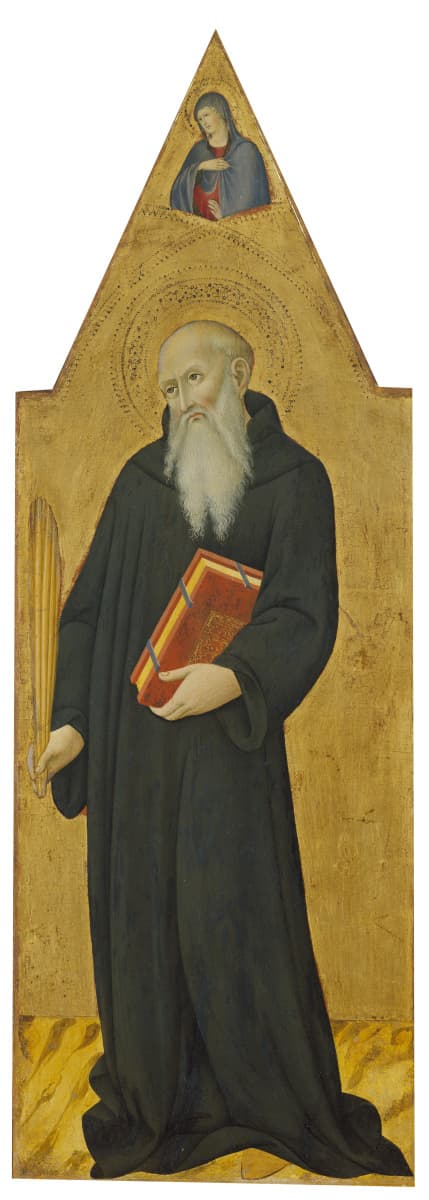
Saint Benedict, painting by Sano di Pietro, c. 1470 · Public Domain
Why He Matters
Benedict was twice nearly poisoned by monks resentful of the discipline he introduced, yet the Rule of Life he went on to write at Monte Cassino became the foundation of Western monasticism for over a thousand years. He matters because he shows that patient, balanced structure — prayer and work, held in ordinary rhythm — can outlast even those who resist it most.
Virtue for Today
Balance
Try Today
Set one simple daily rhythm today — a fixed block for prayer and a fixed block for work — and hold to it, even briefly.
From Hermit to Founder
Benedict was born around 480 AD in Nursia, in central Italy, the twin brother of St. Scholastica. Sent to study in Rome, he was reportedly so troubled by the moral decay he witnessed there that he abandoned his studies and withdrew to live as a hermit in a cave near Subiaco for roughly three years, sustained by a monk named Romanus who lowered bread to him on a rope.
Word of his holiness spread, and a nearby community of monks eventually asked him to become their abbot. According to Pope Gregory the Great's Dialogues — the primary early source for Benedict's life — the monks, unhappy with the strict discipline he introduced, twice attempted to poison him: once by poisoning his bread, which a raven he had tamed carried away when he blessed it before eating; and once by poisoning his wine cup, which shattered the moment he made the sign of the cross over it. Benedict left the community rather than continue governing men who wished him dead, and went on to found twelve monasteries in the Subiaco region before establishing his most famous foundation, Monte Cassino, around 529.
The Rule That Shaped the West
At Monte Cassino, Benedict wrote the Rule of St. Benedict, a relatively short, practical guide to communal monastic life built around the balance of ora et labora — prayer and work. Rather than the extreme austerity practiced by some earlier monks, Benedict's Rule emphasized stability, humility, moderation, and ordered common life, with detailed provisions for everything from the daily prayer schedule to the treatment of the sick and the elderly. It became the foundational text for Western monasticism, adopted directly or adapted by the vast majority of monastic communities in Europe for over a millennium, earning Benedict recognition centuries later as a principal architect of Western civilization's monastic and educational institutions.
The Medal Against Evil
The events of the poisoning attempts, along with Benedict's broader reputation as a spiritual protector against evil, gave rise to the Saint Benedict Medal, which bears an inscription including the Latin abbreviation for "Begone, Satan; never tempt me with your vanities — what you offer me is evil; drink your own poison." The medal has long been used by Catholics as a sacramental for protection against temptation, evil influence, and, in some pastoral practice, in prayers of deliverance. Pope Paul VI declared Benedict the patron protector of Europe in 1964, and he is formally recognized as a patron against poison and witchcraft.
Helper
Reflection Questions:
- Benedict was nearly killed twice by people resentful of the discipline he tried to bring them. Have you ever paid a real cost for holding a standard others resented?
- He chose to leave rather than keep leading people who wished him harm — not out of despair, but discernment. How do you know the difference between quitting and rightly walking away?
- His Rule prized balance and moderation over extreme austerity. Where in your own spiritual life might steady, ordinary faithfulness serve you better than dramatic gestures?
- The medal associated with him is still used today as a prayer against evil, centuries later. What ordinary, repeated practices anchor you against temptation?
- Benedict's influence outlasted him by over a thousand years through a document, not a miracle. What are you building now whose value might only be clear generations later?
Short Prayer
“Begone, Satan! Never tempt me with your vanities! What you offer me is evil; drink your own poison. (Traditional inscription on the Saint Benedict Medal)”
Prayer to St. Benedict of Nursia
Prayer to St. Benedict of Nursia St. Benedict, twice the men you led tried to poison you for the discipline you asked of them, yet you went on to write a Rule of balanced, ordinary faithfulness that shaped Western monastic life for fifteen centuries. Pray for us in every place where evil disguises itself as harmless, that we might see clearly and refuse it, as your Rule and your medal have long taught the faithful to do. Obtain for us the patience to build steady rhythms of prayer and work rather than relying only on dramatic effort. Protect us, our families, and our homes from the influence of evil in all its forms. St. Benedict, pray for us. Amen.
Gregory the Great, Dialogues, Book II
Grow closer to God.
Agnioz is here to walk with you.
Register for FREE and unlock more Catholic content, prayers, and reflections to help you become a more enlightened Catholic — FREE FOREVER.


Let's grow together in faith, hope, and love. 🙏