
St. Boniface: The Monk Who Felled the Thunder Oak
675 – 754
“Let us not be dumb dogs, nor silent watchmen.”
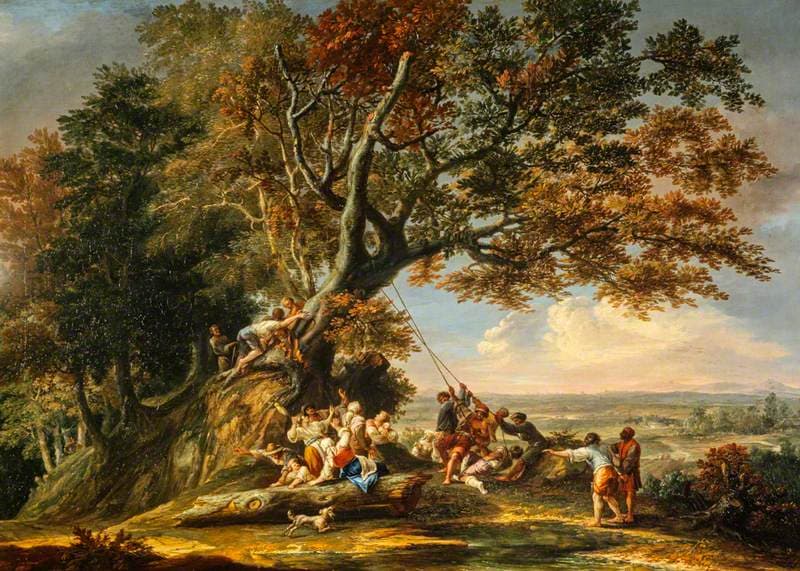
Saint Boniface Felling the Sacred Oak, painting by Christian Wilhelm Ernst Dietrich, 18th century, National Galleries of Scotland · Public Domain
Why He Matters
Boniface shows what decades of patient, organized missionary work can accomplish — not a single dramatic conversion, but an entire regional Church built diocese by diocese, monastery by monastery, confrontation by confrontation, sustained until his death at nearly eighty.
Virtue for Today
Missionary Zeal
Try Today
Say something true and necessary today that you have been staying silent about out of caution.
A Comfortable Life Given Up
Boniface was born Winfrid around the year 675 in Wessex, in Anglo-Saxon England, to a family of some standing. He entered monastic life as a boy, was well educated, and by his thirties had already become a respected teacher and writer within English monasticism — he was even offered leadership positions that would have kept him safely and prominently at home. Instead, around age forty, he asked permission to become a missionary on the European continent, first attempting to evangelize in Frisia in 716, a mission that failed within the year amid local political opposition.
Commissioned by Rome
Rather than give up, Boniface traveled to Rome in 719, where Pope Gregory II commissioned him directly for missionary work among the Germanic peoples east of the Rhine, giving him the name Bonifatius ("doer of good") and, later, consecrating him a bishop with authority answerable directly to the papacy. Over the following decades, Boniface worked methodically across what is now Germany — preaching, founding monasteries, and reorganizing an often disorganized or lapsed regional Church into a structured network of dioceses tied to Rome.
Felling the Sacred Oak
Boniface's most famous act came around 723, near Geismar, in front of a crowd of pagan Hessians who venerated an enormous oak tree — the "Thunder Oak" — sacred to the god Thor. Boniface, in a direct and public challenge, cut the tree down himself. According to the earliest surviving accounts, when the god failed to strike him down, the felling itself became a powerful catalyst for local conversions, and Boniface reportedly used the tree's own timber to build a chapel on the site. The episode captures the pattern of his whole ministry: confronting entrenched belief directly, publicly, and without violence.
Reformer and Correspondent
Boniface was not only a missionary preacher but an organizer and reformer, founding the influential monastery of Fulda in 744 and working to correct corruption and disorder among the Frankish clergy. A substantial body of his personal letters survives — correspondence with popes, English abbesses, and fellow missionaries — giving historians an unusually direct window into his convictions. In one surviving letter he urged his fellow clergy toward courage rather than complacency, writing that they must not be "dumb dogs, nor silent watchmen" in the face of what needed correcting.
Martyred at Pentecost
In 754, though nearly eighty years old, Boniface set out on one more missionary journey into Frisia, the region of his earliest failed mission decades before. On June 5, while preparing a group of converts for confirmation near Dokkum, his camp was attacked by a band of hostile local raiders. Boniface reportedly told his companions not to resist, and he was killed along with several companions. He was buried at the monastery he had founded at Fulda, which remains an important pilgrimage site. He is remembered as the "Apostle of Germany" for having done more than any other single figure to establish an organized, Rome-connected Christian Church across the Germanic regions of early medieval Europe.
Helper
Reflection Questions:
- Boniface gave up a secure, respected position in England to begin missionary work as a middle-aged man, after his first attempt had already failed. What comfortable security might God be asking you to risk for something less certain but more important?
- He confronted a deeply held false belief directly and publicly, rather than working around it quietly. Is there a hard conversation or confrontation you've been avoiding out of caution?
- His surviving letters show a leader worried about silence and complacency among his own colleagues. Where do you stay quiet when speaking up, even at some cost, is what's actually needed?
- Boniface returned, at nearly eighty, to the very region where his ministry had first failed decades earlier. What past failure might be worth trying again, later in life, with more experience behind you?
- He was killed while preparing new converts for confirmation — actively serving at the moment of his death. What would it look like for you to stay engaged in service rather than easing back as you age?
Short Prayer
“St. Boniface, apostle to the Germans, pray for us — that we may have your courage to confront falsehood and your patience to build what lasts. Amen.”
Prayer to St. Boniface
Prayer to St. Boniface St. Boniface, you left a secure and respected life in England to spend thirty-six years doing difficult, often unglamorous missionary work among people who had never heard the Gospel clearly proclaimed. You confronted false worship directly, organized a scattered Church into lasting structure, and kept working into old age, dying at last while preparing new converts for confirmation. Pray for us when caution tempts us into silence about what matters. Give us your patience for slow, structural work, and your courage to keep serving even in the years when retreat would be easier. St. Boniface, pray for us. Amen.
Catholic Encyclopedia (New Advent) — "St. Boniface"; The English Correspondence of Saint Boniface, trans. Edward Kylie (1911); Britannica — "St. Boniface"
Grow closer to God.
Agnioz is here to walk with you.
Register for FREE and unlock more Catholic content, prayers, and reflections to help you become a more enlightened Catholic — FREE FOREVER.


Let's grow together in faith, hope, and love. 🙏