St. Brigid
of Ireland: The Abbess Who Built a Church Under an Oak
451 – 525
“Muire na nGael — "Mary of the Gael," Brigid's ancient traditional Irish title”
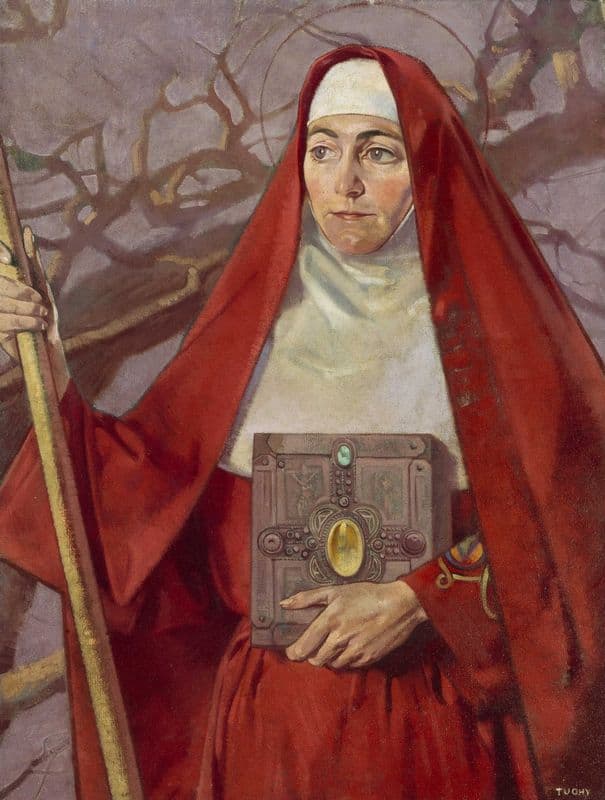
Saint Brigid, painting by Patrick Joseph Tuohy, before 1930 · Public Domain
Why She Matters
Brigid shows that a life begun in genuine hardship and social disadvantage can still become one of extraordinary leadership and influence, and that hospitality toward the poor — practiced consistently, not just occasionally — can define an entire community's identity for over a thousand years.
Virtue for Today
Generosity
Try Today
Give away something useful — food, clothing, or time — to someone in need today, without waiting to be asked.
A Childhood Between Two Worlds
Brigid was born around 451, near Faughart in present-day County Louth, Ireland. Her father, Dubthach, was a pagan chieftain; her mother, Broicsech, was a Christian woman enslaved in his household. Brigid herself grew up partly enslaved as a result, raised largely by her mother and absorbing Christian faith from her, and — according to enduring Irish tradition — was later baptized in the growing Christian community that St. Patrick's mission had begun to establish across Ireland during roughly the same period.
Refusing the Expected Path
As a young woman, Brigid was strikingly generous, repeatedly giving away her father's food, livestock, and possessions to the poor without asking permission, to Dubthach's growing frustration. When her father arranged a marriage for her, Brigid refused, determined instead to consecrate her life to God. Tradition holds that Dubthach, exasperated, even tried to sell her into service to the King of Leinster — who, recognizing her extraordinary character, refused to buy her and instead helped secure her freedom to pursue a religious vocation.
Founding Kildare
Brigid took vows and eventually gathered a community of women around her, and around the year 480 founded a monastery at Kildare — "Cill Dara," the church of the oak — reportedly built beside or beneath a large oak tree sacred in pre-Christian Irish tradition, deliberately placing the new Christian community at a site that already carried spiritual significance for the people around it. Kildare grew into something unusual for its time: a "double monastery," housing a community of women under Brigid alongside a community of men under a bishop, Conleth, whom Brigid invited to lead the monks and share pastoral care of the surrounding region.
Abbess and Regional Leader
Under Brigid's leadership, Kildare became a center of learning, craftsmanship, and charity, and the settlement that grew up around the monastery eventually developed into the town of Kildare itself. Brigid is remembered in the earliest surviving accounts of her life — written by the monk Cogitosus roughly a century after her death — as an exceptionally practical, hands-on leader: tending livestock and dairy work herself, negotiating with regional kings on behalf of the poor, and building a reputation for hospitality so consistent that later Irish tradition made her, alongside Patrick and Columba, one of Ireland's three national patron saints.
Mary of the Gael
Brigid died at Kildare around the year 525. So deep was her association with maternal care and hospitality in the Irish popular imagination that she came to be known by the title "Muire na nGael" — "Mary of the Gael" — an honor reflecting how completely she had become identified, in the memory of the Irish people, with tenderness toward the poor. Her feast day, February 1, coincides with the ancient Irish festival of Imbolc, and she remains one of the most beloved and widely invoked saints in Irish devotional life to this day.
Helper
Reflection Questions:
- Brigid grew up between two worlds — enslaved in some respects, yet raised in genuine faith. Have you ever found unexpected spiritual strength in a difficult or constrained circumstance?
- She gave away her father's goods to the poor even when it angered him, trusting that generosity mattered more than approval. Where do you hold back generosity out of fear of someone else's reaction?
- Brigid refused a marriage that would have secured her socially, choosing an uncertain religious vocation instead. What secure, expected path might God be asking you to set aside for something less certain but more faithful?
- She built Kildare as a "double monastery," bringing men's and women's communities into shared, complementary service rather than separate isolation. Where in your own life could collaboration replace unnecessary separation?
- Brigid became known above all for hospitality — feeding, tending, and welcoming those around her. Who could you welcome or feed, literally or figuratively, this week?
Short Prayer
“St. Brigid of Ireland, Mary of the Gael, pray for us — that we may be as generous with what we have as you were. Amen.”
Prayer to St. Brigid of Ireland
Prayer to St. Brigid of Ireland St. Brigid, you were born into hardship and grew up giving away everything you were entrusted with to those who had less, even when it cost you your father's approval. You refused a secure marriage to build instead a community of faith and service that became a refuge for the poor of your region for generations. Pray for us when we are tempted to hoard what we have out of fear or caution. Help us practice the same hospitality you did: practical, immediate, and unconcerned with whether we will be thanked for it. St. Brigid, Mary of the Gael, pray for us. Amen.
Catholic Encyclopedia (New Advent) — "St. Brigid of Ireland"; EWTN — "St. Brigid of Ireland"; Britannica — "St. Brigid of Ireland"
Grow closer to God.
Agnioz is here to walk with you.
Register for FREE and unlock more Catholic content, prayers, and reflections to help you become a more enlightened Catholic — FREE FOREVER.


Let's grow together in faith, hope, and love. 🙏