
St. Catherine Labouré: The Novice Who Kept a Secret for Forty-Six Years
1806 – 1876
“I seemed to hear on the right hand side of the sanctuary something like the rustling of a silk dress. Glancing in that direction, I perceived the Blessed Virgin standing near St. Joseph's picture.”
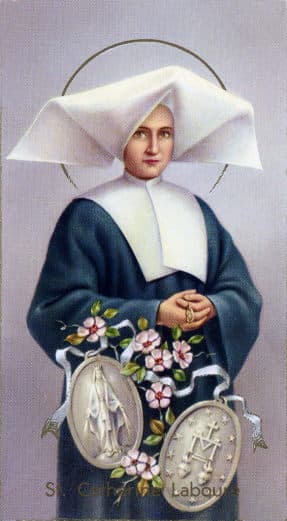
Devotional portrait of St. Catherine Labouré with the Miraculous Medal, artist unknown, early 20th century · Public Domain (PD-Art)
Why She Matters
Catherine Labouré shows that a person can be at the center of an extraordinary spiritual event and still choose complete anonymity, measuring a life not by recognition but by decades of quiet, faithful service afterward.
Virtue for Today
Hidden Faithfulness
Try Today
Do something genuinely good today and deliberately let someone else receive the credit for it.
A Farm Girl Who Chose the Convent
Catherine Labouré was born on May 2, 1806, in Fain-lès-Moutiers, France, the ninth of eleven children in a farming family. Her mother died when Catherine was only nine, and, according to family accounts, the young girl reportedly took a statue of Mary from the household and held it, saying she would now be her mother — an early sign of the intense devotion to the Blessed Virgin that would define the rest of her life. Catherine ran much of the family household after her mother's death and did not receive much formal education, but felt a persistent call to religious life, entering the Daughters of Charity of St. Vincent de Paul in Paris in 1830, at age twenty-three.
The Rue du Bac Apparitions
Only months into her novitiate, in the convent chapel on the Rue du Bac in Paris, Catherine reported a series of visions of the Virgin Mary. In the first, on the night of July 18-19, 1830, she said a child woke her and led her to the chapel, where Mary appeared and spoke with her at length. The most significant vision came on November 27, 1830. Catherine later dictated a detailed account of it to her spiritual director: she described hearing "something like the rustling of a silk dress," then seeing Mary standing on a globe, with rays of light streaming from her outstretched hands, framed by the words, "O Mary, conceived without sin, pray for us who have recourse to thee." According to Catherine's account, Mary then instructed her plainly: "Have a medal struck upon this model. All who wear it will receive great graces."
A Medal, Not a Reputation
Catherine reported the vision to her confessor, Father Jean-Marie Aladel, but insisted from the beginning on remaining anonymous — she wanted the medal made and distributed, but had no interest in being known as the visionary behind it. Aladel was initially skeptical, delaying for two years before finally seeking ecclesiastical approval. The medal was struck in 1832 and spread with extraordinary speed across France and beyond, quickly becoming known as the "Miraculous Medal" after widespread reports of graces and healings attributed to its use. Throughout this entire period of rapid, international devotion growing up around her private vision, almost no one — including most of the other sisters in her own community — knew that Catherine Labouré was the novice to whom Mary had appeared.
A Hidden Life of Ordinary Service
After her novitiate, Catherine was assigned to a hospice in Reuilly-sur-Marne, on the outskirts of Paris, where she spent the following forty-six years caring for elderly and infirm residents, working largely in obscurity: tending livestock, managing the hospice's linens, and caring for the sick and dying, in the same quiet, practical way she had once run her family's household as a girl. She revealed her role in the apparitions only near the end of her life, in 1876, to her religious superior, feeling that the full account needed to be preserved before her death.
Death and Canonization
Catherine Labouré died on December 31, 1876. When her body was exhumed in 1933 as part of the process toward her beatification, it was found to be incorrupt, and it remains on display in the chapel at Rue du Bac to this day. She was beatified in 1933 and canonized by Pope Pius XII on July 27, 1947. The medal she asked to have struck remains one of the most widely worn Catholic sacramentals in the world.
Helper
Reflection Questions:
- Catherine insisted on anonymity even as devotion to the medal she requested spread rapidly across the world around her. Where do you feel pressure to take credit for something good you had a hand in, rather than letting the good stand on its own?
- She spent forty-six years afterward doing quiet, largely unnoticed work caring for the elderly and infirm. Does a "hidden" life of ordinary service feel like a lesser calling to you, or an equally valid one?
- Her confessor was skeptical of her account for two years before acting on it. How do you respond when people you trust are slow to believe something important you're telling them?
- Catherine only revealed her full story near the very end of her life, once she felt it needed to be preserved. Is there something true about your own life you are holding onto that eventually needs to be told, even if not yet?
- She turned to caring for her siblings and household as a child after her mother's death, and spent her adult life caring for others in much the same quiet, practical way. What early experience of responsibility in your own life still shapes how you serve others today?
Short Prayer
“St. Catherine Labouré, pray for us — that we may serve faithfully and quietly, without needing recognition for the good we do. Amen.”
Prayer to St. Catherine Labouré
Prayer to St. Catherine Labouré St. Catherine Labouré, you received a vision that changed how millions of people pray, and you asked for almost nothing in return except that the medal itself be made and given away. You spent the following forty-six years in quiet, unglamorous care for the elderly and the sick, known to almost no one as the novice from the Rue du Bac. Pray for us when we do good and immediately want it noticed or credited. Help us find the same peace you found in hidden, faithful, ordinary service, trusting that God sees what others never will. St. Catherine Labouré, pray for us. Amen.
EWTN — "St. Catherine Labouré and the Miraculous Medal"; Association of the Miraculous Medal — "Story of the Miraculous Medal"; Catherine Labouré's own account of the November 27, 1830 apparition, Daughters of Charity archives

Grow closer to God.
Agnioz is here to walk with you.
Register for FREE and unlock more Catholic content, prayers, and reflections to help you become a more enlightened Catholic — FREE FOREVER.


Let's grow together in faith, hope, and love. 🙏