
St. Catherine
of Siena: The Laywoman Who Moved a Pope
1347 – 1380
“You are rewarded not according to the work you do, but according to the love with which you do it.”
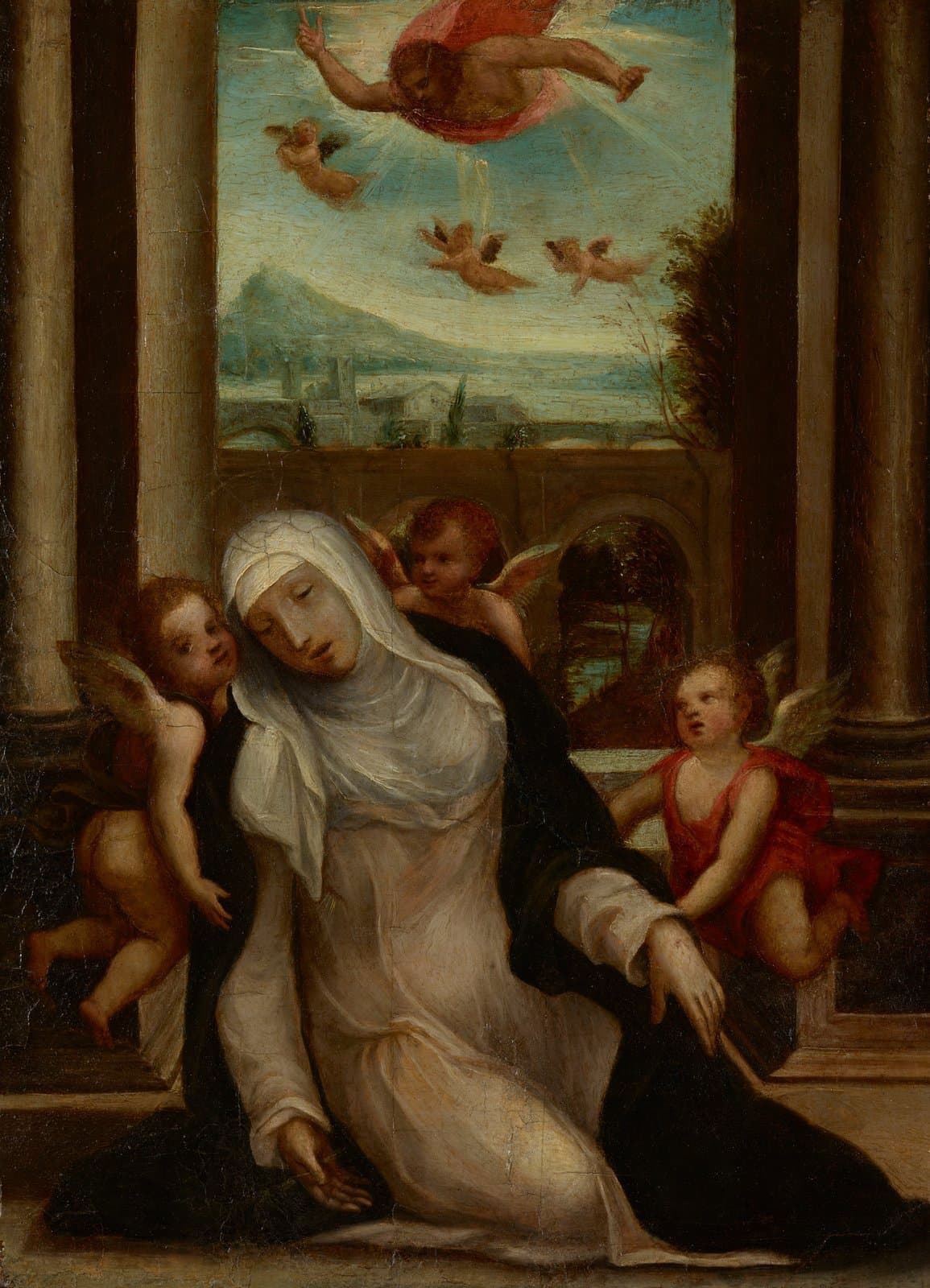
The Ecstasy of Saint Catherine of Siena, painting by Il Sodoma, c. 1530-1535, Yale University Art Gallery · Public Domain
Why She Matters
Catherine, an uneducated laywoman with no official standing in the Church, personally persuaded a pope to end nearly seventy years of papal exile and return to Rome. She matters because she shows that holiness and courage are not limited by education, gender, or formal position, and that persistent, respectful truth-telling can change the course of the Church.
Virtue for Today
Fearless Truth-Telling
Try Today
Write an honest, respectful message to someone in authority about something that genuinely needs to change.
The Twenty-Fourth of Twenty-Five Children
Catherine was born in Siena in 1347, one of twenty-five children of a wool dyer, Giacomo Benincasa, and his wife Lapa — most of Catherine's siblings did not survive to adulthood, a common tragedy in fourteenth-century Italy, which was also devastated by the Black Death during her lifetime. From a young age Catherine experienced vivid spiritual visions and resisted her family's efforts to arrange a marriage for her, eventually cutting off her hair as a sign of her resolve. She joined the Sisters of Penance of St. Dominic, a lay Dominican group known as the Mantellate, which allowed her to live a life of intense prayer and asceticism while remaining in her family's house rather than entering a convent.
An Uneducated Woman Who Taught Herself to Write
Catherine had no formal education and could not initially write; she dictated her many letters to secretaries for most of her life and reportedly learned to write herself only later, as an adult. Despite this, she became one of the most prolific and influential correspondents of her century, exchanging letters with popes, cardinals, kings, and ordinary people alike, on subjects ranging from personal spiritual direction to the Church's most pressing political crises. Her theological reflections, later gathered into a work known as The Dialogue, present a rich mystical treatise on divine providence, obedience, and the nature of the Church, striking for its depth given her complete lack of formal theological training.
Confronting the Avignon Papacy
For most of Catherine's life, the popes had lived not in Rome but in Avignon, in southern France, under heavy French political influence — an arrangement that had lasted, by the time Catherine reached adulthood, for nearly seven decades and was widely seen as a scandal damaging the Church's independence and credibility. Catherine wrote urgently and repeatedly to Pope Gregory XI, respectfully but without any hesitation, insisting he return the papacy to Rome as an act of obedience to what she believed was God's clear will. In 1376, she traveled in person to Avignon and spent months pressing her case directly. Gregory XI ultimately agreed, moving the papacy back to Rome in January 1377 — a decision historians generally credit at least in significant part to Catherine's persistent, fearless intervention.
Peacemaker in a Fractured Church
Catherine spent her final years working, largely in vain, to heal the Western Schism that erupted shortly after Gregory XI's death in 1378, when rival claimants to the papacy divided the Church's loyalty across Europe. She continued writing forcefully to political and religious leaders urging unity and reform, even as her own health, weakened by decades of extreme fasting, began to fail. She died in Rome in 1380 at only thirty-three years old.
Doctor of the Church
Catherine was canonized in 1461 and declared a Doctor of the Church in 1970 by Pope Paul VI — one of only a small number of women to hold that title — recognized for the theological depth of The Dialogue and for a body of letters remarkable both for their insight and for the sheer boldness of a laywoman addressing the highest authorities of her era without formal standing to do so.
Helper
Reflection Questions:
- Catherine had no formal education or official position, yet she wrote directly and firmly to the pope about a matter of real Church importance. Where do you hold back from speaking up because you don't feel qualified?
- She resisted significant family pressure to pursue the vocation she believed God was calling her toward. What pressure from people close to you makes it hard to follow your own convictions?
- She spent her final years working for unity in a divided Church, even though she didn't live to see that unity achieved. What is worth working for even without a guarantee you'll see the result?
- Her theological insight in The Dialogue came primarily through prayer and contemplation rather than formal study. How do you make space for God to teach you outside of reading or study alone?
- She taught that we are rewarded not by the size of our work but by the love behind it. Does that change how you view a task you consider too small to matter?
Short Prayer
“St. Catherine of Siena, pray for us — that we may speak truth boldly and love faithfully, whatever our position or standing. Amen.”
Prayer to St. Catherine of Siena
Prayer to St. Catherine of Siena St. Catherine, you had no formal education, no official title, and no worldly standing, yet you wrote to popes and princes without hesitation when you believed the truth needed to be spoken, and a pope finally listened. Your holiness was built not on position but on deep prayer and even deeper love. Pray for us when we feel unqualified to speak up for what is right, or too small to make a difference. Help us trust, as you did, that God can use anyone willing to love and to tell the truth, and that we are measured in the end not by how much we accomplish but by how much love we bring to it. St. Catherine of Siena, pray for us. Amen.
Catholic Answers Magazine — "How St. Catherine Ended the Avignon Papacy"
Grow closer to God.
Agnioz is here to walk with you.
Register for FREE and unlock more Catholic content, prayers, and reflections to help you become a more enlightened Catholic — FREE FOREVER.


Let's grow together in faith, hope, and love. 🙏