
St. Cecilia: The Silent Song
of the Patroness of Music
“Cantantibus organis, Caecilia Domino decantabat, dicens: Fiat cor meum immaculatum, ut non confundar. — "While the instruments played, Cecilia sang in her heart to the Lord, saying: Let my heart be undefiled, that I not be confounded." (the traditional antiphon for her feast, not a recorded first-person quotation)”
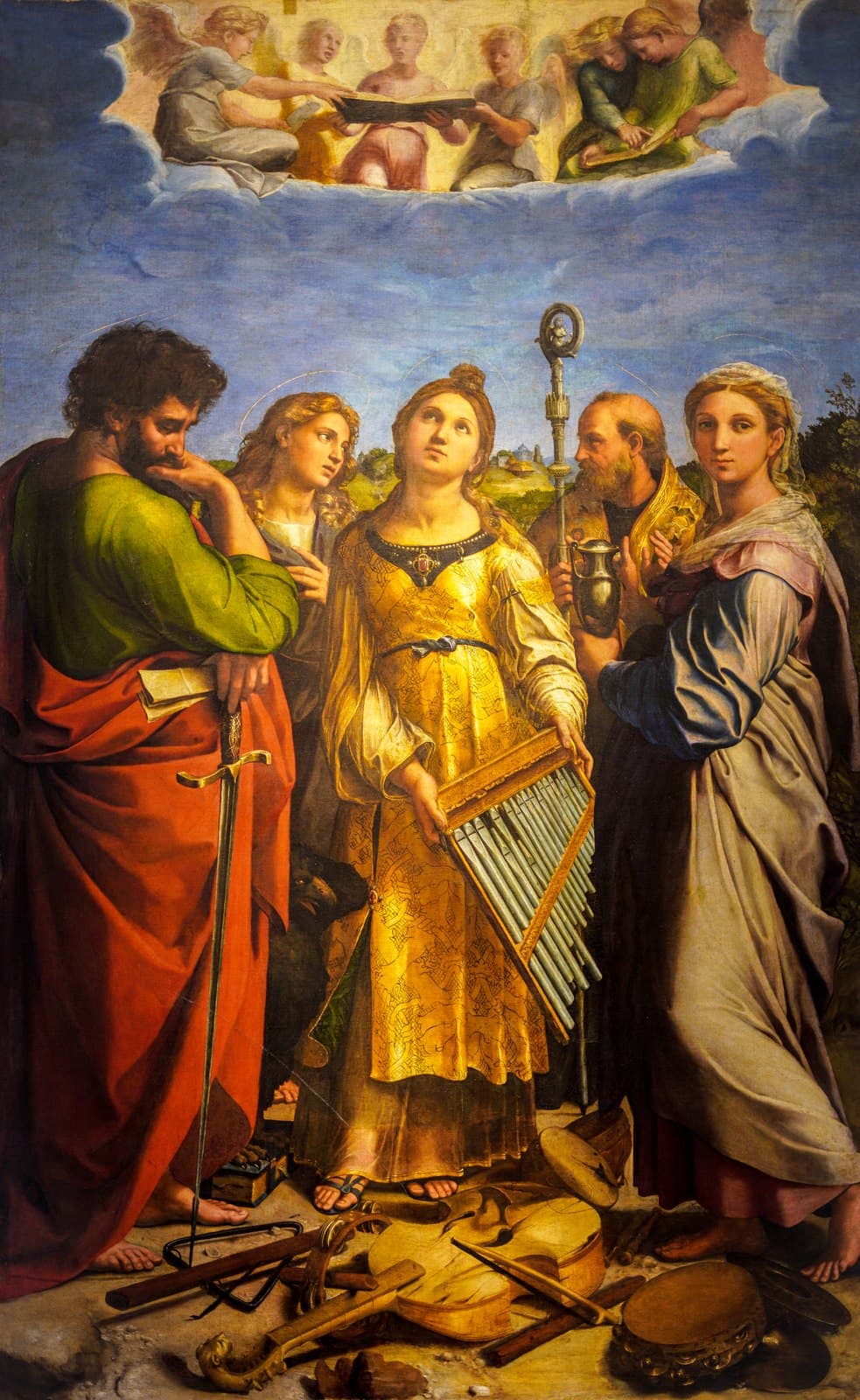
The Ecstasy of Saint Cecilia, painting by Raphael, 1514, Pinacoteca Nazionale di Bologna · Public Domain (PD-old-100-expired)
Why She Matters
Cecilia shows how a single, quietly interior act of prayer can, centuries later and through legend rather than record, shape an entire tradition of sacred art and music that still forms believers today.
Virtue for Today
Interior Prayer
Try Today
Listen to or take part in sacred music today as a deliberate act of prayer, the way Cecilia's legend describes her turning her heart to God even while the music played around her.
A Cult Older Than Its Story
Cecilia is venerated as one of the great virgin martyrs of the early Roman Church, but almost nothing about her life can actually be verified. The earliest solid evidence is liturgical rather than biographical: the fourth-century Martyrologium Hieronymianum records her feast, and her name is associated with a burial site in the Catacomb of San Callisto on the Via Appia, near the crypt of the popes. That burial, confirmed by archaeologist Giovanni Battista de Rossi and again during Cardinal Paolo Sfondrati's 1599 restoration of her church, when workers reportedly found sarcophagi matching an early ninth-century account of Pope Paschal I moving her relics there, is the strongest physical anchor for her cult. Scholars have proposed martyrdom dates ranging from the late second century to the mid-third, with no agreement and no year that can be stated with confidence; both birth_year and death_year are left unset here rather than assigning her a precision the evidence does not support.
A Legend Written Centuries Later
The vivid narrative most people know — a Roman noblewoman married against her will to a pagan named Valerian, who converts him and his brother Tiburtius, all three martyred together along with a Roman officer named Maximus — comes from a Passio composed around the middle of the fifth century, roughly two and a half centuries after any plausible date for her death. The Catholic Encyclopedia states plainly that this text has no historical value as a narrative of actual events, though the associated names, Valerianus, Tiburtius, and Maximus, do correspond to genuine early Roman martyrs known independently through burial records, suggesting the legend grew up around real names even if the connecting story cannot be verified.
An Accidental Patroness of Music
Cecilia's enormous later reputation as patroness of music rests on a small, almost accidental detail. Her Passio describes her praying silently in her heart during her wedding while instruments played around her, asking to be kept pure. By the fifteenth century, the antiphon written for her feast, "Cantantibus organis, Caecilia Domino decantabat" ("While the instruments played, Cecilia sang in her heart to the Lord"), was increasingly read as describing Cecilia herself singing or playing rather than praying quietly against the music around her. Artists ran with the reinterpretation: Raphael's famous 1514 painting shows her holding an organ, and by the time the Academy of Music was founded in Rome in 1584 and placed under her patronage, the association was permanent. Cecilian musical societies exist across the world today, all resting on that one reread line.
Patroness Despite the Uncertainty
None of this uncertainty has diminished Cecilia's place in Catholic devotion. She remains one of only a small number of early Roman martyrs named in the Roman Canon of the Mass, her feast (November 22) has been kept continuously since antiquity, and her patronage of Church music, however it developed, has shaped centuries of sacred art and composition, including works by Purcell, Handel, and Britten written expressly in her honor. The Church's own scholarship on her is a useful model of how devotion and historical caution can coexist: real veneration, built on a real early burial and a real ancient feast, wrapped around a narrative that later centuries added and that cannot be verified as fact.
Helper
Reflection Questions:
- Cecilia's legend describes her praying silently in her heart even while surrounded by celebration and noise. Where in your life could you cultivate that kind of quiet, interior prayer amid distraction?
- Her association with music grew from a single reread phrase, not a documented fact. Where else in your own faith life have you accepted a comforting story without checking what actually stands behind it?
- Despite the uncertainty around her biography, Cecilia inspired centuries of real sacred music and art. Can something be spiritually fruitful and formative even where the facts underneath it are genuinely unclear? Where do you draw that line for yourself?
- The antiphon that shaped her whole later patronage was originally about resisting distraction, not making music. Is there music, entertainment, or noise in your own life that competes with prayer rather than serving it?
- Cecilia is remembered as someone who kept her heart fixed on God regardless of what was happening around her. What one practice could help you do the same today?
Short Prayer
“St. Cecilia, pray for us — that amid whatever noise surrounds us, our hearts may stay quietly fixed on God. Amen.”
Prayer to St. Cecilia
Prayer to St. Cecilia St. Cecilia, tradition remembers you keeping your heart turned toward God even while the world celebrated loudly around you, and the Church has honored that quiet interior fidelity for centuries by placing all sacred music under your patronage. Pray for us when the noise of our lives, entertainment, obligation, distraction, threatens to crowd out our prayer. Help us learn, as your legend teaches, to keep something undefiled and quiet within us regardless of what surrounds us outwardly, and to offer whatever art or music we make or love back to God as prayer. St. Cecilia, pray for us. Amen.
Catholic Encyclopedia (New Advent) — "St. Cecilia"; Martyrologium Hieronymianum, 4th century

Grow closer to God.
Agnioz is here to walk with you.
Register for FREE and unlock more Catholic content, prayers, and reflections to help you become a more enlightened Catholic — FREE FOREVER.


Let's grow together in faith, hope, and love. 🙏