St. Charbel Makhlouf: The Hermit Whose Body Would Not Decay
1828 – 1898
“Holiness is not the luxury of the few; it is a simple duty for you and for me.”
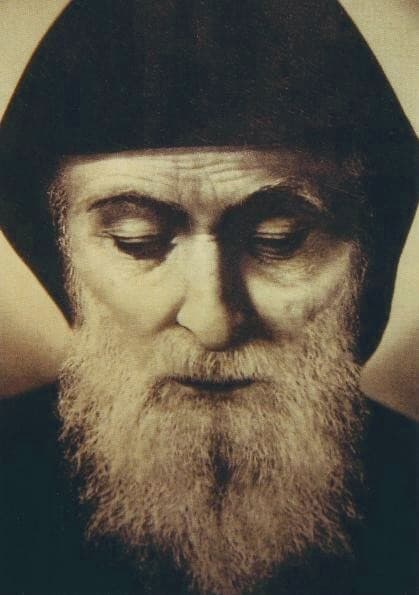
St. Charbel Makhlouf, photograph, before 1898 · Public Domain (PD-old, assumed published before 1930)
Why He Matters
Charbel spent twenty-three years alone in near-total silence in a mountain hermitage, with no public ministry and no writings of his own — yet after his death, his incorrupt body and thousands of reported healings made him one of the most visited saints in the modern Church, venerated even by many non-Christians in Lebanon. He matters because he shows that a life hidden from the world is not a life wasted.
Virtue for Today
Silence
Try Today
Spend fifteen unhurried, silent minutes today in prayer before the Blessed Sacrament, or simply in a quiet room without checking your phone.
A Vocation Toward Silence
Youssef Antoun Makhlouf was born in 1828 in Bekaa Kafra, a mountain village in Lebanon, the youngest of five children in a poor Maronite Catholic family. At twenty-three, without informing his family in advance, he left home to join the Lebanese Maronite Order, taking the name Charbel after an early Christian martyr. He was ordained a priest in 1859.
After sixteen years in monastic community life, Charbel requested and received permission in 1875 to live as a hermit at the Hermitage of Saints Peter and Paul, near the monastery of Annaya. He remained there in near-total silence and extreme simplicity — sleeping little, eating sparingly, spending long hours in prayer before the Blessed Sacrament — for the next twenty-three years, until his death on Christmas Eve, 1898, from a stroke suffered while celebrating Mass.
A Body That Defied Explanation
What followed his death became central to his story. Witnesses reported a bright light around his grave in the days after burial. When his body was exhumed months later at his community's request, it was found incorrupt — not decomposed — and reportedly continued exuding a mysterious fluid, sometimes described as blood and sweat, for decades afterward, requiring his habit to be changed regularly. The tomb became a site of pilgrimage almost immediately, with thousands of healings attributed to his intercession recorded by the monastery and independently investigated over the following century.
From Local Devotion to Universal Saint
Devotion to Charbel remained largely confined to Lebanon and the Maronite diaspora for decades before drawing wider Vatican attention. Pope Paul VI beatified him in 1965 and canonized him in 1977 — the first Lebanese and Maronite saint formally recognized by Rome. His popularity has only grown since, including remarkable reports of favors attributed to him among non-Christians and Muslims in Lebanon and beyond, making him one of the rare saints whose veneration crosses religious lines in his home region.
Helper
Reflection Questions:
- Charbel chose silence and solitude over any public ministry or visible achievement. What does a life essentially hidden from the world still have to teach us about holiness?
- His impact became most visible only after his death. Are you willing to plant something whose fruit you may never personally witness?
- Devotion to him has crossed religious and cultural lines in ways few saints achieve. What does that suggest about the reach of a genuinely holy life?
- He left ordinary community life for something more demanding, not less. Is there a comfortable "good enough" you're being called to leave for something harder but truer?
- Pilgrims still travel to his hermitage seeking healing. Where do you currently seek healing, and what would it mean to bring that need to prayer rather than carry it alone?
Short Prayer
“St. Charbel Makhlouf, pray for us — that we may find God in silence and offer our hidden, hardest days with love. Amen.”
Prayer to St. Charbel Makhlouf
Prayer to St. Charbel Makhlouf St. Charbel, you left ordinary community life for twenty-three years of near-total silence in a mountain hermitage, seeking nothing the world could see or reward. Long after your death, your incorrupt body and the healings reported at your tomb drew a devotion that has crossed even religious lines in your native Lebanon. Pray for us in our noise and distraction, that we might learn to seek God in silence rather than only in activity. Intercede for those who feel hidden or forgotten in their present circumstances, that they might trust their hidden faithfulness is not wasted. St. Charbel, pray for us. Amen.
Congregation for the Causes of Saints — Positio, 1977
Grow closer to God.
Agnioz is here to walk with you.
Register for FREE and unlock more Catholic content, prayers, and reflections to help you become a more enlightened Catholic — FREE FOREVER.


Let's grow together in faith, hope, and love. 🙏