
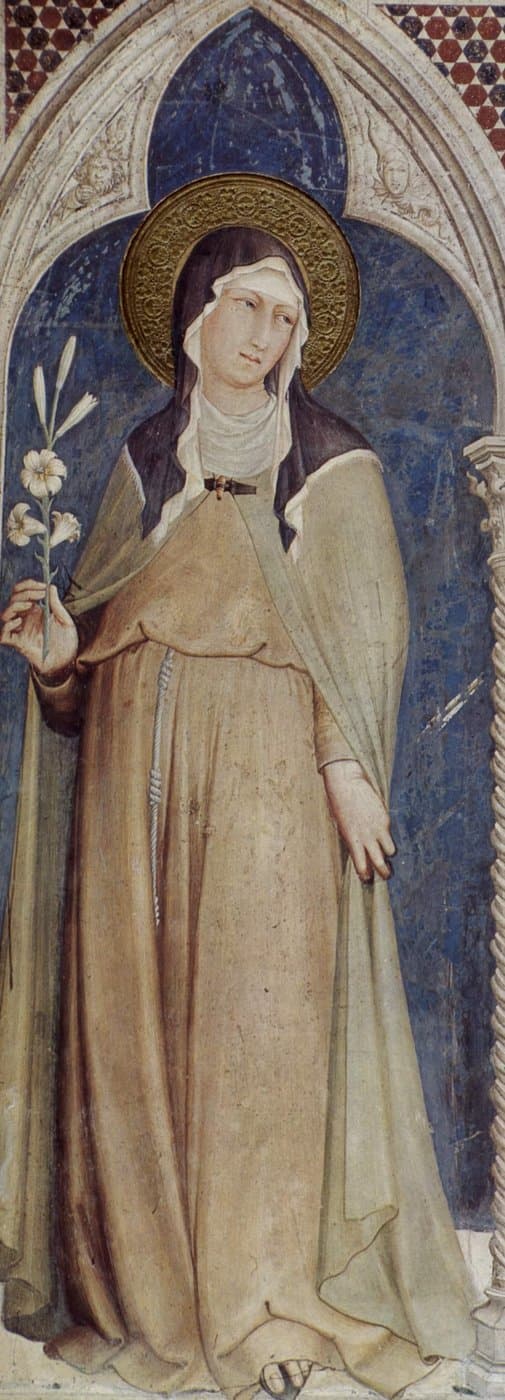
St. Clare
of Assisi: The Noblewoman Who Chose Poverty on Purpose
1194 – 1253
“Place your mind before the mirror of eternity! Place your soul in the brilliance of glory!”
Santa Chiara d'Assisi, fresco detail by Simone Martini, Lower Basilica of San Francesco, Assisi, c. 1312-1320s · Public Domain
Why She Matters
Clare chose radical poverty as a young noblewoman and then spent decades defending that choice against popes who thought it was unsustainable. She matters because she shows that simplicity of life, chosen deliberately and defended patiently, can be its own form of freedom rather than mere deprivation.
Virtue for Today
Simplicity
Try Today
Choose one comfort or convenience to go without today, on purpose, as a small act of trust in God's providence.
A Noblewoman's Escape
Chiara Offreduccio was born on July 16, 1194, in Assisi, into a wealthy and powerful noble family. As a young woman she was already known for her devotion and generosity to the poor, and she had heard the preaching of a former townsman named Francis, who had renounced his own family's wealth to live in radical poverty and rebuild the Church one small act at a time (see St. Francis of Assisi in this library). On the night of Palm Sunday, March 18, 1212, at eighteen years old, Clare secretly left her family's home, met Francis and his brothers at the small chapel of the Porziuncola, and had her hair cut and her fine clothes exchanged for a plain habit — a decisive, irreversible break from the marriage and social position her family had expected of her.
San Damiano and the Poor Clares
Clare's family attempted to physically remove her and bring her home, but she resisted, and within days her younger sister Agnes joined her as well. Francis placed the small community of women at San Damiano, a church he had earlier repaired with his own hands, and around 1216, when Clare was about twenty-two, he appointed her abbess — a role she held for the rest of her life. The community that grew around her became known as the Order of Poor Ladies, later renamed the Poor Clares in her honor.
The Privilege of Poverty
Clare's defining conviction, shared with Francis, was that owning nothing — individually or as a community — was not a hardship to be minimized but a positive good, a way of depending entirely on God's providence and standing in solidarity with the truly poor. This put her in direct, sustained conflict with a series of popes and cardinals who worried that a community with no guaranteed income was unsustainable and pressed her to accept property or a fixed endowment. Clare refused for decades, petitioning repeatedly for what became known as the "Privilege of Poverty" — formal permission for her community to own nothing at all. She also became the first woman in Church history to write a religious rule of life for a community of women, which Pope Innocent IV approved just two days before her death, confirming her vision in the last possible moment.
Decades of Illness, Undiminished Authority
Clare suffered from serious illness for much of her adult life, largely confined to bed for her final decades, yet she continued to govern San Damiano and correspond with other religious women seeking her guidance, most notably Agnes of Prague, a Bohemian princess who founded a similar community and exchanged a series of surviving letters with Clare discussing poverty, contemplation, and union with Christ. During a siege of Assisi by imperial troops in 1234, tradition holds that Clare, though gravely ill, had herself carried to the convent's entrance with the Blessed Sacrament, and the attacking soldiers withdrew — an episode that later led to her being named patron saint of television, since Pope Pius XII pointed to another tradition that she once "saw and heard" a Mass she was too sick to attend in person, projected as if on the wall of her room.
Lady of Perfect Poverty
Clare died at San Damiano on August 11, 1253, and was canonized just two years later, in 1255, by Pope Alexander IV. Her insistence on total poverty, sustained against real institutional pressure for over forty years, became a permanent part of the Franciscan tradition and a lasting witness that simplicity of life is a choice worth defending, not merely a circumstance to be endured.
Helper
Reflection Questions:
- Clare gave up guaranteed wealth and status as a young woman because she believed dependence on God mattered more than security. What security do you cling to that might be worth loosening your grip on?
- She spent decades petitioning popes for the right to own nothing, refusing an easier, wealthier path repeatedly offered to her. Where in your life do you take the easier option instead of the one you actually believe in?
- She led her community with real authority for nearly forty years, much of it spent seriously ill. What does she teach you about leading or serving faithfully even when your body or circumstances are working against you?
- Her friendship with Agnes of Prague, sustained through letters across an entire continent, shaped both women's spiritual lives. Who is a distant friend you could reconnect with over something more than small talk?
- She is remembered for insisting that poverty, chosen freely, could be a source of freedom rather than only hardship. Where in your own life might "owning less" actually mean "living freer"?
Short Prayer
“St. Clare of Assisi, pray for us — that we may hold what we own loosely and trust God's providence as completely as you did. Amen.”
Prayer to St. Clare of Assisi
Prayer to St. Clare of Assisi St. Clare, you left a life of comfort and security as a young woman, convinced that owning nothing and depending entirely on God was not a burden but a freedom worth defending. You spent decades governing your community faithfully even through long illness, and you fought for your sisters' right to a life of total poverty until your very last days. Pray for us when security and comfort tempt us to settle for less than what we actually believe. Help us hold what we own loosely, trust God's providence the way you did, and defend the truths we believe in even when it would be easier to give in. St. Clare, pray for us. Amen.
Encyclopaedia Britannica, "St. Clare of Assisi"; Regis Armstrong (ed.), Clare of Assisi: Early Documents
Grow closer to God.
Agnioz is here to walk with you.
Register for FREE and unlock more Catholic content, prayers, and reflections to help you become a more enlightened Catholic — FREE FOREVER.


Let's grow together in faith, hope, and love. 🙏