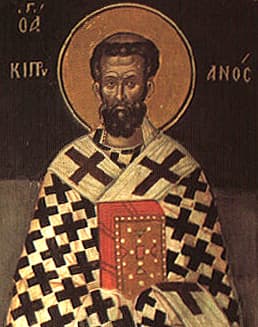
Traditional icon of St. Cyprian of Carthage, artist unknown, pre-modern · Public Domain (PD-old)
Why He Matters
Cyprian led the Church through two waves of Roman persecution and a citywide plague, organizing relief for Christians and pagans alike, and his writing on Church unity and forgiveness of the lapsed shaped how the Church handled sin and reconciliation for centuries. He matters because he shows a leader making hard, contested judgment calls in real time, defending them honestly, and dying at peace with the outcome.
Virtue for Today
Pastoral Courage
Try Today
Extend one act of practical care today to someone outside your own faith community, the way Cyprian organized plague relief for Christians and pagans alike.
From Rhetorician to Bishop
Thascius Caecilius Cyprianus was born around AD 200–210 in Carthage, in Roman North Africa, into a wealthy pagan family, and trained as a rhetorician and lawyer — a respected, comfortable profession. Sometime in his forties, around 245–246, he converted to Christianity, a decision that led him to sell a significant part of his property to give to the poor, following the counsel of the priest who had guided his conversion, Caecilius, whose name Cyprian took as his own in gratitude. His transformation from a prominent pagan professional to committed Christian was rapid and total.
An Unusually Fast Rise
Remarkably, only a year or two after his conversion, Cyprian was elected bishop of Carthage by popular acclaim — a rise so swift that it drew real criticism from some senior clergy who felt a recent convert had been elevated over more experienced candidates. Cyprian would spend much of his decade as bishop navigating exactly the kind of crises that test a leader's legitimacy, and largely earned the confidence that had been placed in him.
Persecution, Flight, and Return
In 250, the emperor Decius launched an empire-wide persecution requiring all citizens to sacrifice to the Roman gods and obtain a certificate proving it. Rather than remain in Carthage and be captured, Cyprian went into hiding, continuing to direct his church secretly through letters — a decision some contemporaries criticized as cowardice, but which Cyprian defended as a legitimate way to preserve leadership for a church that would need it. When the persecution eased, he returned to Carthage and faced its aftermath directly.
The Crisis of the Lapsi
That aftermath centered on the lapsi — Christians who had complied with the order to sacrifice rather than face martyrdom, and who now sought to be readmitted to the Church. Opinion in the African church split sharply between those who wanted to readmit them immediately and those who wanted to bar them permanently. Cyprian charted a middle path: real, serious penance was required, but reconciliation was possible. His reasoning became foundational for how the Church would handle questions of sin and readmission for centuries afterward, articulated at length in his influential treatise De ecclesiae catholicae unitate ("On the Unity of the Catholic Church"), still read today as a foundational text on church unity and the role of bishops.
Plague Relief for Friend and Enemy Alike
Starting around 249, a severe plague swept the Roman world — later called the Plague of Cyprian, after his own vivid description of its effects. Rather than limit care to Christians, Cyprian organized the community to nurse and bury the dead of pagans and Christians alike, a departure from common practice at the time that left a lasting impression on the wider city and is cited by later historians as one of the ways early Christian charity distinguished itself in the ancient world.
A Disagreement With Rome
Late in his life, Cyprian became embroiled in a significant dispute with Pope Stephen I over whether baptisms performed by heretics or schismatics were valid. Cyprian argued they were not, and that such converts needed to be rebaptized; Rome held that the baptism itself was valid regardless of who performed it. The disagreement was sharp and, within Cyprian's lifetime, unresolved — though the Church later settled definitively on Rome's position. Even in disagreement, Cyprian remained within the Church's unity, never breaking communion over the dispute.
"Deo Gratias"
Persecution resumed under the emperor Valerian in 257. Cyprian was arrested, briefly exiled, and then in September 258 brought back to Carthage, tried, and sentenced to death by beheading. The surviving trial record, the Acta Proconsularia, states that upon hearing his sentence pronounced, Cyprian responded simply: "Deo gratias" — "Thanks be to God." He was executed on September 14, 258, one of the most prominent bishops martyred in the early centuries of the Church.
Helper
Reflection Questions:
- Cyprian sold much of his wealth after his conversion and was elected bishop within a year or two. Has your own faith ever asked something of you that quickly or that costly?
- He organized care for pagans and Christians alike during the plague, breaking from common practice. Who is it hardest for you to extend real care to right now?
- He chose a middle path on forgiving the lapsi — neither easy readmission nor permanent exclusion — that required real discernment rather than a simple rule. Where in your own life is a firm rule less helpful than careful, prayerful judgment?
- He disagreed sharply with the pope on a serious question and still remained in communion with the wider Church. How do you handle disagreement with people you're still committed to staying in relationship with?
- His last recorded words, on hearing his death sentence, were simply "Thanks be to God." What would it take for you to be able to respond to bad news that way?
Short Prayer
“St. Cyprian, pray for us — that we may lead and serve with the same steady courage you showed to the very end. Amen.”
Prayer to St. Cyprian of Carthage
Prayer to St. Cyprian of Carthage St. Cyprian, you gave up wealth and status to follow Christ, and were quickly entrusted with leading your church through persecution, plague, and painful division over how to treat those who had faltered under pressure. You organized care for friend and stranger alike when the city was dying around you, and you held firm to your convictions even in disagreement with Rome, without ever breaking the Church's unity. When your own death sentence was finally read, you answered with gratitude rather than fear. Pray for us in our own hard decisions, that we might lead with the same combination of conviction, charity, and peace. St. Cyprian, pray for us. Amen.
Cyprian of Carthage, De ecclesiae catholicae unitate; Acta Proconsularia Sancti Cypriani (contemporary trial record); Britannica, "Saint Cyprian"; Catholic Encyclopedia (New Advent), "St. Cyprian of Carthage"
Grow closer to God.
Agnioz is here to walk with you.
Register for FREE and unlock more Catholic content, prayers, and reflections to help you become a more enlightened Catholic — FREE FOREVER.


Let's grow together in faith, hope, and love. 🙏