
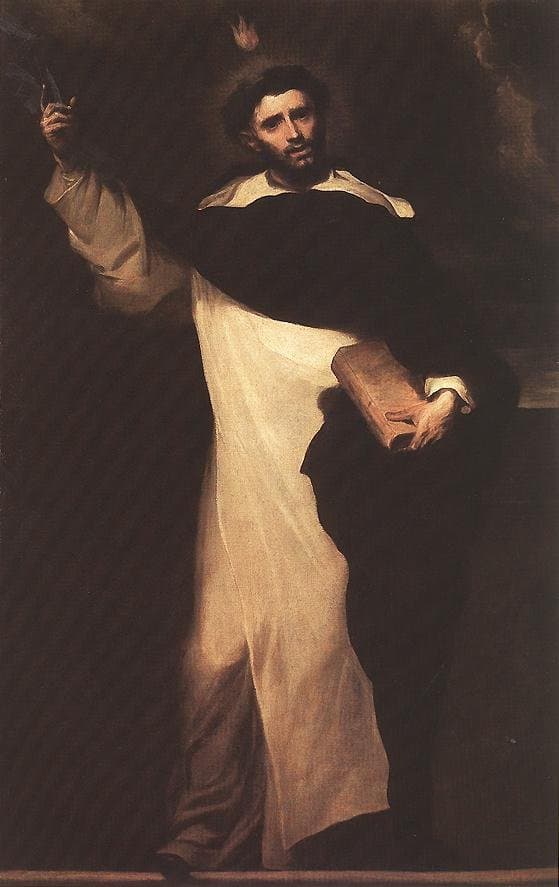
St. Dominic
de Guzmán: The Preacher Who Founded an Order of Truth
1170 – 1221
“Have charity for one another, guard humility, and make a treasure of voluntary poverty.”
St Dominic, painting by Claudio Coello, 1691 · Public Domain
Why He Matters
Dominic founded an order built on the conviction that truth wins arguments better than force does — and that preachers earn the right to be heard by living what they teach. He matters because he shows that serious study and radical simplicity of life can go together, and that both are forms of love for the people you are trying to reach.
Virtue for Today
Truth in Charity
Try Today
Prepare — even just for a few minutes — before the next conversation where your faith might come up, so you can explain it clearly and gently rather than react.
From Castile to a Cathedral Chapter
Domingo de Guzmán was born around 1170 in Caleruega, in the Castile region of Spain, to a family of local nobility — his father a landowner, his mother later beatified in her own right as Blessed Jane of Aza. He studied the liberal arts and theology at the University of Palencia, and while still a student he reportedly sold his books and possessions to feed the poor during a regional famine, an early sign of the priorities that would define his life. Around 1196 he joined the community of Augustinian canons attached to the cathedral of Osma, rising within a few years to sub-prior.
Confronting the Cathars
Everything changed around 1203, when Dominic accompanied his bishop, Diego of Osma, on a diplomatic journey through southern France. There he encountered the Cathar (Albigensian) heresy in full strength — a movement that had won wide popular support in Languedoc partly because its traveling preachers lived visibly austere lives, in contrast to some of the local Catholic clergy. Dominic and Diego concluded that heresy would not be defeated by force or wealth, but by preachers willing to match the Cathars' poverty and match their arguments with sound theology. In 1206, they helped establish a community of nuns at Prouille to house women converts from Catharism — the first seed of what would become the Dominican family.
Founding the Order of Preachers
Diego died in 1207, and Dominic continued the preaching mission largely alone for several years, walking the roads of Languedoc on foot, debating Cathar teachers in public, and living without money or a fixed household. By 1215 he had gathered a small band of like-minded preachers under the Bishop of Toulouse, and in 1216 Pope Honorius III formally approved them as the Order of Friars Preachers — the Dominicans. Dominic's key strategic insight was to place the order's earliest houses next to the universities of Paris and Bologna, insisting that his preachers be rigorously educated in theology before they were sent out, so that they could answer error with real argument rather than mere denunciation.
A Life Given to the Order
Dominic spent his final years traveling constantly between the order's growing houses across Europe, presiding over its first general chapters at Bologna in 1220 and 1221, where the friars adopted a constitution built on corporate poverty, communal governance, and a mission of preaching and teaching that set the order apart from older monastic communities bound to a single monastery. He died in Bologna on August 6, 1221, reportedly still giving instructions to his brothers from his deathbed about how the order should live after he was gone.
Preacher of Grace
Dominic was canonized remarkably quickly, in 1234, by Pope Gregory IX, who had known him personally. The order he founded went on to produce some of the Church's greatest theologians, including St. Thomas Aquinas, and remains devoted to study, preaching, and the Rosary — a devotion long associated with the Dominican tradition. The Church's liturgy for his feast still calls him "Preacher of Grace," a title that captures what he believed above all: that truth, patiently and rigorously taught, is what actually changes minds.
Helper
Reflection Questions:
- Dominic believed heresy spread partly because its preachers seemed more sincere and self-sacrificing than some of the clergy opposing them. Where does your own example either strengthen or undercut what you say you believe?
- He insisted his preachers be seriously educated before they argued matters of faith with anyone. How well do you actually understand what you believe, versus simply repeating it?
- He walked from town to town for years with no guaranteed income, trusting the mission mattered more than his comfort. What comfort might God be asking you to set aside for something that matters more?
- He placed his order's houses next to universities on purpose, valuing serious study as part of holiness, not opposed to it. Do you treat learning as part of your faith life, or separate from it?
- He is remembered as "Preacher of Grace" — someone who spoke the truth in a way meant to draw people toward God, not just win an argument. When did you last try to persuade someone with real gentleness rather than just being right?
Short Prayer
“St. Dominic, Preacher of Grace, pray for us — that we may seek and speak the truth with real charity, and live simply enough that our words are believed. Amen.”
Prayer to St. Dominic de Guzmán
Prayer to St. Dominic de Guzmán St. Dominic, you walked the roads of southern France for years with nothing guaranteed but your next meal, convinced that the truth of the Gospel deserved preachers who had studied it deeply and lived it honestly. You founded an order that still teaches the Church how to think clearly and preach charitably centuries later. Pray for us when we are tempted to argue faith without understanding it, or to win a debate while losing a person. Help us pursue truth the way you did: patiently, rigorously, and always in charity. St. Dominic, pray for us. Amen.
Encyclopaedia Britannica, "St. Dominic"; Jordan of Saxony, Libellus de principiis Ordinis Praedicatorum
Grow closer to God.
Agnioz is here to walk with you.
Register for FREE and unlock more Catholic content, prayers, and reflections to help you become a more enlightened Catholic — FREE FOREVER.


Let's grow together in faith, hope, and love. 🙏