St. Edith Stein: From Philosopher to Martyr
of Auschwitz
1891 – 1942
“Come, we are going for our people.”
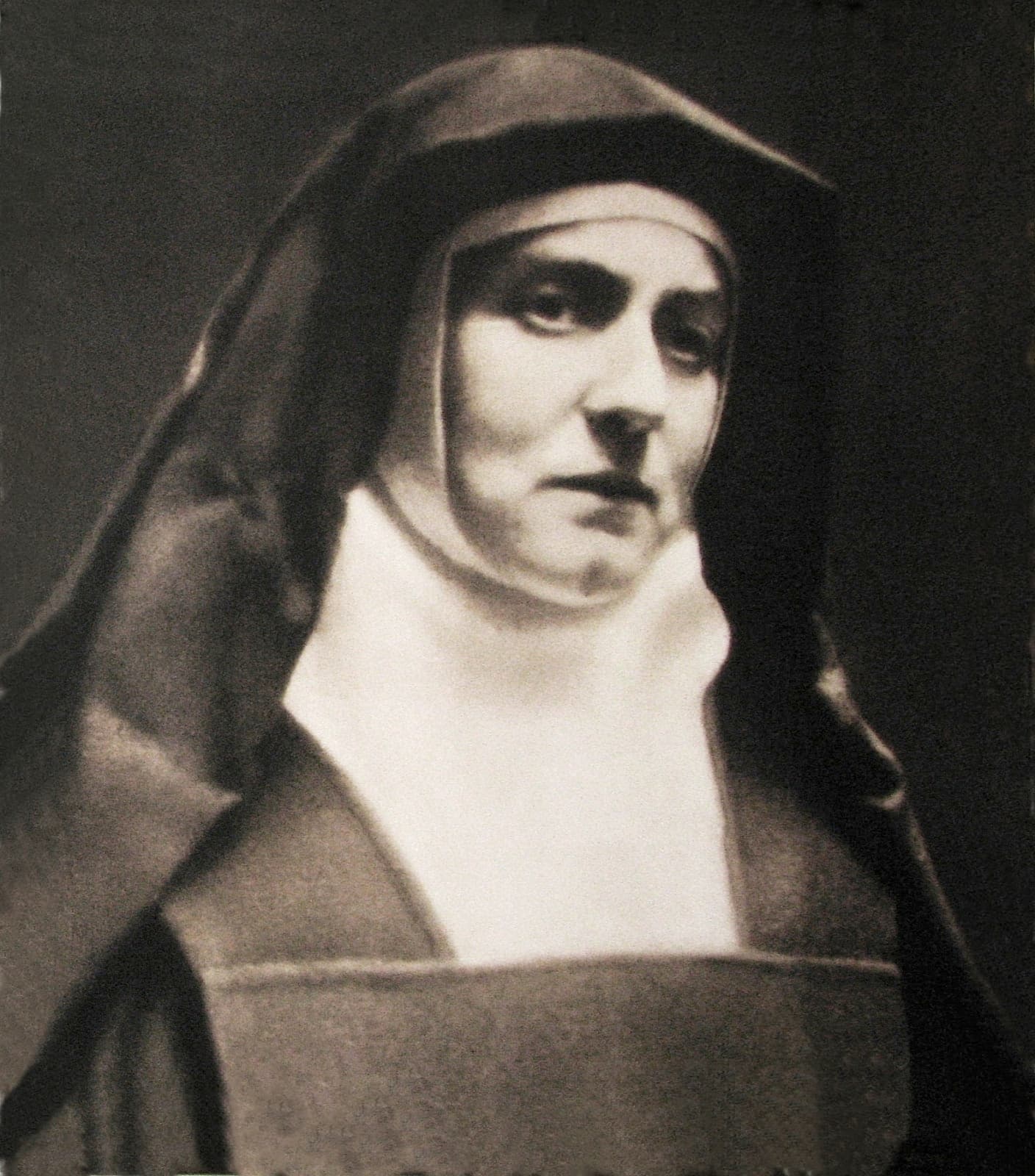
St. Edith Stein (St. Teresa Benedicta of the Cross), passport photograph, Cologne Carmel Archives, c. 1938–1939 · Public Domain
Why She Matters
Edith Stein shows that rigorous intellectual honesty and deep faith can coexist, and that solidarity with a suffering people can be a specifically Christian act, not a contradiction of it. She is a patroness of Europe and a witness against every ideology that treats human dignity as negotiable.
Virtue for Today
Solidarity
Try Today
Learn one new fact about the Holocaust today, and say a deliberate prayer for victims of religious or ethnic persecution happening right now.
Edith Stein was born on October 12, 1891, in Breslau, Germany (now Wrocław, Poland), the youngest of eleven children in a devout Jewish family. Her father died when she was two, and her mother, a woman of deep faith, ran the family timber business alone while raising the children. Edith was a gifted, restless student, and by her teenage years she had abandoned the Jewish faith of her childhood and declared herself an atheist.
A Philosopher Among Philosophers
Stein studied philosophy at the University of Göttingen and later Freiburg under Edmund Husserl, the founder of phenomenology, becoming one of his most capable doctoral students and, for a time, his personal academic assistant. She earned her doctorate summa cum laude in 1916 with a dissertation on empathy. As a woman in early twentieth-century German academia, she was repeatedly denied a professorship for which she was clearly qualified, a barrier she met with disappointment but not despair.
Conversion
In the summer of 1921, staying with friends, Stein picked up the autobiography of St. Teresa of Ávila and read through the night. "This is the truth," she reportedly said when she finished. She was baptized into the Catholic Church on January 1, 1922, a decision that cost her her closest relationship with her mother, who never stopped grieving what she saw as her daughter's abandonment of their people's faith. Stein spent the next decade teaching and writing, developing a body of philosophical and spiritual work that tried to bring the rigor of phenomenology into dialogue with Catholic thought.
The Carmelite
In 1933, as the Nazi regime's antisemitic laws forced her from her teaching post at the Institute for Pedagogy in Münster, Stein entered the Discalced Carmelite convent in Cologne, taking the religious name Teresa Benedicta of the Cross. She continued to write, including major theological and philosophical work, while living the austere, hidden life of a cloistered nun. As Nazi persecution intensified, her order transferred her in 1938 to a convent in Echt, in the Netherlands, hoping she would be safer there. She was not.
Arrest and Auschwitz
On July 26, 1942, the Dutch Catholic bishops publicly condemned the deportation of Jews in a pastoral letter read in every parish. In direct retaliation, the Nazis ordered the arrest of all Catholics of Jewish descent in the Netherlands, a category that had previously been left alone. On August 2, 1942, the Gestapo came for Stein at the Echt convent. She turned to her sister Rosa, also a convert living at the convent, and said simply: "Come, we are going for our people." She was transported first to the Westerbork transit camp and then, on August 7, to Auschwitz. She was murdered in the gas chambers at Auschwitz-Birkenau on or around August 9, 1942, along with Rosa.
Patron of Europe
Pope John Paul II canonized Edith Stein in 1998 and named her, along with Bridget of Sweden and Catherine of Siena, a co-patroness of Europe in 1999 — a continent she had experienced at both its intellectual heights and its moral catastrophe. Her final words to Rosa remain the clearest statement of how she understood her own death: not as a Catholic fleeing her Jewish identity, but as a woman who considered herself bound to the Jewish people to the very end, dying in solidarity with them even as a baptized nun.
Helper
Reflection Questions:
- Stein spent years as a searching atheist before her conversion, and never treated her Jewish upbringing as something to be erased. Where in your own life have big changes required you to hold seemingly opposite parts of your story together, rather than discard one for the other?
- She was repeatedly denied positions she had earned because she was a woman. How do you respond when a door closes for reasons that have nothing to do with your ability or effort?
- Facing arrest, she chose the words "we are going for our people" rather than words of despair or fear. What does it look like for you to claim solidarity with people who are suffering, even at personal cost?
- Stein's academic brilliance did not shield her from the Holocaust; her holiness was not separate from her intellect but grew alongside it. Do you tend to treat faith and serious thinking as being in tension, or as partners?
- She is a patroness of Europe, a continent scarred by the very violence that killed her. Where do you see a call today to help heal a wound in your own community rather than look away from it?
Short Prayer
“St. Edith Stein, St. Teresa Benedicta of the Cross, pray for us — that we may seek truth honestly and stand in solidarity with those who suffer. Amen.”
Prayer to St. Edith Stein
Prayer to St. Edith Stein St. Teresa Benedicta of the Cross, you spent your early life in tireless pursuit of truth and found it, unexpectedly, in the Catholic faith, without ever abandoning your bond to the Jewish people who formed you. You walked willingly toward Auschwitz, choosing solidarity with your people over safety. Pray for us in our own search for truth, that we would follow it wherever it leads, even when it costs us comfort or family peace. Pray for us, too, in our comfort, that we would never stand silent while others are persecuted for who they are. St. Edith Stein, pray for us. Amen.
Vatican.va — Homily of Pope John Paul II at the Canonization of Edith Stein, October 11, 1998; Britannica — "Edith Stein"
Grow closer to God.
Agnioz is here to walk with you.
Register for FREE and unlock more Catholic content, prayers, and reflections to help you become a more enlightened Catholic — FREE FOREVER.


Let's grow together in faith, hope, and love. 🙏