
St. Elizabeth
of Hungary: The Princess Who Built a Hospital at the Foot of Her Castle
1207 – 1231
“Patroness of Catholic Charities”
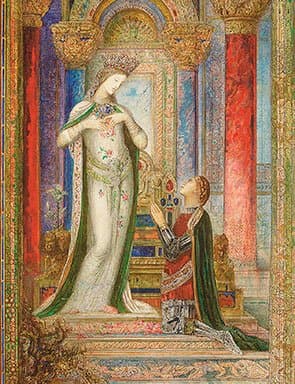
Saint Elizabeth of Hungary, watercolor by Gustave Moreau, 1882, private collection · Public Domain
Why She Matters
Elizabeth shows that royal status and genuine, hands-on service to the poor and sick are not incompatible, and that living out that conviction can cost real social and financial security — a cost she accepted without retreating from it. She matters to anyone balancing privilege or resources against a call to give more of themselves away than is comfortable or expected.
Virtue for Today
Radical Charity
Try Today
Give away something of real value today — not just spare change — to someone in genuine need.
A Political Marriage at Fourteen
Elizabeth was born in 1207, the daughter of King Andrew II of Hungary. As was common among medieval royal families, she was betrothed in infancy for political reasons and sent, at around age four, to be raised at the court of Thuringia in central Germany, where she was formally married to Louis IV of Thuringia in 1221, at age fourteen. Unusually for an arranged royal marriage of the period, contemporary accounts describe the marriage as genuinely affectionate; Louis is recorded as supporting, rather than restraining, Elizabeth's increasingly intense devotion to charity and to the newly emerging Franciscan spirituality reaching Germany from Italy during her lifetime.
A Household of Radical Charity
Elizabeth used her position as landgravine to fund extensive relief for the poor and sick around the Thuringian court, reportedly feeding over a thousand people daily during a famine and epidemic that struck the region in 1226, while her husband was away. She had a twenty-eight-bed hospital built near the base of Wartburg Castle and personally visited and tended patients there herself, work considered strikingly humble, even scandalous, for a woman of her royal rank at the time. She and Louis had three children together during this period, and by all surviving accounts she managed both her royal household duties and an expanding personal ministry to the poor simultaneously.
Widowed and Cast Out
In 1227, Louis died of illness while traveling with a Crusade expedition, leaving Elizabeth a widow at twenty. What followed was a sharp and painful reversal: Louis's family, and by some accounts his brother acting as regent, viewed Elizabeth's charitable spending and her plain, penitential style of life as an embarrassment or a financial threat to the Thuringian court, and she was effectively driven from Wartburg Castle along with her young children. She spent a difficult period in near-poverty before eventually securing support to establish an independent life, formally joining the Third Order of St. Francis — becoming, in effect, one of its most prominent early lay members — and placing her own inheritance toward continued charitable work rather than reclaiming her former royal comfort.
The Hospital at Marburg
With the resources she retained, Elizabeth built a hospital in Marburg dedicated to St. Francis, where she lived out her final years caring personally for the sick, the disabled, and the poor, often performing the most physically demanding and socially degrading tasks herself rather than delegating them. She died there on November 17, 1231, not yet twenty-four years old, worn down by the combination of grief, hardship, and the physical toll of her own austere and demanding way of life. Reports of miracles at her tomb multiplied quickly, and she was canonized remarkably fast for the era — only four years after her death, in 1235, by Pope Gregory IX. She is venerated today as patroness of hospitals, nurses, the sick, the homeless, widows, and — since Pope Leo XIII placed Catholic women's charitable societies under her patronage — of Catholic charitable work broadly.
Helper
Reflection Questions:
- Elizabeth's charitable spending was treated by her own husband's family as an embarrassment once she no longer had his protection. Has generosity or conviction of yours ever cost you standing with people who once supported it?
- She personally performed the most physically demanding and degrading tasks of caring for the sick, rather than only funding others to do it. Where in your life do you delegate care you could, at some real cost, provide yourself?
- Elizabeth's marriage was arranged for political reasons in infancy, yet by most accounts became a source of real mutual support. Has a relationship or circumstance you did not choose for yourself turned out better than you expected?
- She was effectively driven from her own home for her way of life, and had to rebuild an independent life from very little afterward. Have you ever had to start over after losing security you assumed was permanent?
- Elizabeth died before turning twenty-four, having accomplished, in a very short life, work that is still remembered and imitated nearly eight centuries later. Does the shortness of a life necessarily limit its lasting impact — and what does that suggest about how you are using your own time?
Short Prayer
“St. Elizabeth of Hungary, patroness of the sick and homeless, pray for us — that we may give generously, even when it costs us. Amen.”
Prayer to St. Elizabeth of Hungary
Prayer to St. Elizabeth of Hungary St. Elizabeth, born a princess and married at fourteen, you used your position not for comfort but to build a hospital, feed the hungry, and nurse the sick with your own hands, work so committed that your own family eventually cast you out for it. You rebuilt a smaller, harder life afterward without ever abandoning the poor you had already chosen to serve. Pray for anyone who has lost security or status because of their convictions, and for every hospital worker, caregiver, and volunteer who serves the sick directly rather than from a comfortable distance. Help us hold whatever privilege or resources we have loosely, ready to give more of ourselves away than feels safe or convenient. St. Elizabeth of Hungary, pray for us. Amen.
Franciscan Media — Saint of the Day: Saint Elizabeth of Hungary; USCCB — Memorial of St. Elizabeth of Hungary

Grow closer to God.
Agnioz is here to walk with you.
Register for FREE and unlock more Catholic content, prayers, and reflections to help you become a more enlightened Catholic — FREE FOREVER.


Let's grow together in faith, hope, and love. 🙏