
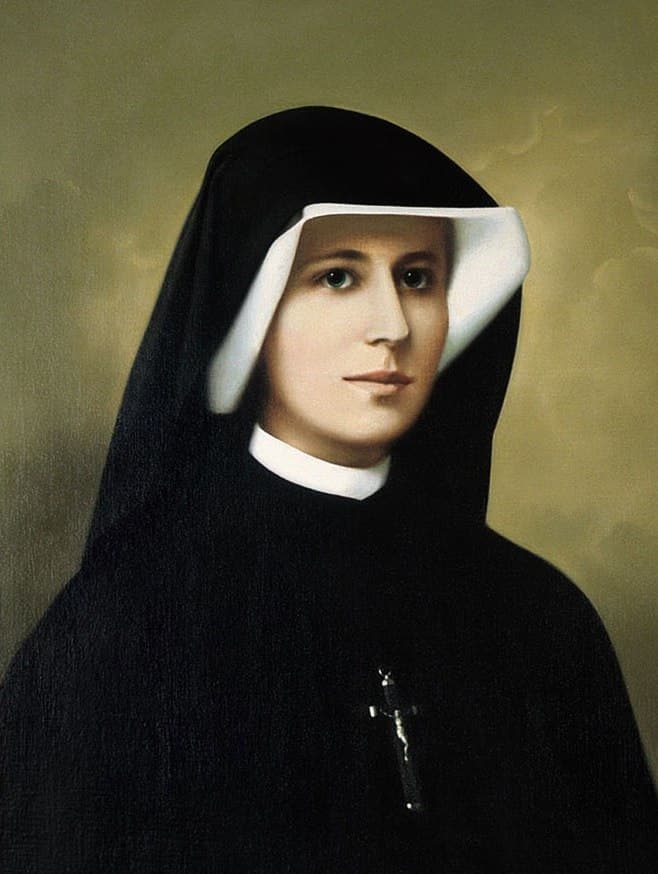
Portrait of St. Faustina Kowalska, painting by Stanisław Sztama · Public domain (released by copyright holder, Wikimedia VRT-confirmed permission)
Why She Matters
Faustina, a barely-educated Polish nun, recorded private revelations of Christ's mercy in a diary that became the foundation of the worldwide Divine Mercy devotion and feast. She matters because her message — that no sin is beyond God's mercy — reaches people who feel too far gone to be forgiven.
Virtue for Today
Mercy
Try Today
Show mercy today to someone who has not asked for it or earned it.
A Farm Girl's Vocation
Helena Kowalska was born in 1905 in Głogowiec, Poland, the third of ten children in a poor farming family. She left school after less than three years of formal education to work as a domestic servant, helping support her family, but felt drawn to religious life from childhood. Her parents initially refused permission for her to enter a convent; she worked for several more years before finally being accepted by the Congregation of the Sisters of Our Lady of Mercy in Warsaw in 1925, taking the name Sister Maria Faustina.
Within the convent, Faustina held ordinary, low-status assignments — cook, gardener, doorkeeper — work she carried out largely unnoticed by her community, which knew little of the extraordinary mystical experiences she recorded in a private diary at the direction of her confessors.
The Diary and the Image
Beginning in 1931, Faustina reported a series of visions of Jesus, who she said appeared to her with one hand raised in blessing and rays of red and pale light streaming from his heart, and asked that this image be painted with the inscription "Jesus, I Trust in You." She recorded these experiences, along with an extensive theology of God's mercy, in a diary eventually published as Diary: Divine Mercy in My Soul — over 600 pages, remarkable given her minimal formal education.
Central to what she recorded was a message that God's mercy is available to every sinner regardless of the gravity of their sin, and a request for a Feast of Divine Mercy to be celebrated on the Sunday after Easter, along with a Chaplet of Divine Mercy prayer to be prayed especially at three o'clock in the afternoon — the hour she identified with Christ's death — and for the dying.
From Suspicion to Sainthood
After Faustina's death from tuberculosis in 1938 at age thirty-three, her writings were initially viewed with suspicion by Church authorities, partly due to translation errors, and the Holy See banned distribution of Divine Mercy devotional materials from 1959 to 1978. The ban was lifted after a more accurate Polish-language review of her diary — a review overseen, notably, by Karol Wojtyła, then Archbishop of Kraków, who had grown up in the same region and would later become Pope John Paul II.
As pope, John Paul II canonized Faustina in 2000 — the first canonization of the new millennium — and formally established the Feast of Divine Mercy for the universal Church that same day. He died on the vigil of that same feast in 2005.
Helper
Reflection Questions:
- Faustina's convent assignments were ordinary and largely invisible — cook, gardener, doorkeeper. How do you find meaning in unnoticed, unglamorous work?
- Her writings were initially misunderstood and banned before being vindicated decades later. Have you ever had to wait a long time to be understood or believed?
- The central message she recorded is that God's mercy has no limit for those who ask. Is there a sin or failure you find hard to believe is actually forgivable?
- She came from minimal formal education yet produced a spiritually rich diary. Where do you underestimate what you have to offer because of a lack of credentials?
- The devotion she promoted asks people to pause at 3pm and remember Christ's death. What small, repeated practice could root your day more deeply in faith?
Short Prayer
“Jesus, I trust in You. St. Faustina, pray for us, that we may trust in God's mercy as completely as you did. Amen.”
Prayer to St. Faustina Kowalska
Prayer to St. Faustina Kowalska St. Faustina, in years of hidden convent life you received and recorded a message the world badly needed to hear: that God's mercy is greater than any sin, and that it is offered freely to anyone who asks for it with trust. You wrote those words down at great personal cost, facing doubt and suspicion before your diary was ever accepted. Pray for us when we feel unworthy of forgiveness, or when we withhold mercy from someone who has wronged us. Help us say, and mean, the words you were given: Jesus, I trust in You. St. Faustina, pray for us. Amen.
Diary: Divine Mercy in My Soul (Marian Press)

Grow closer to God.
Agnioz is here to walk with you.
Register for FREE and unlock more Catholic content, prayers, and reflections to help you become a more enlightened Catholic — FREE FOREVER.


Let's grow together in faith, hope, and love. 🙏