
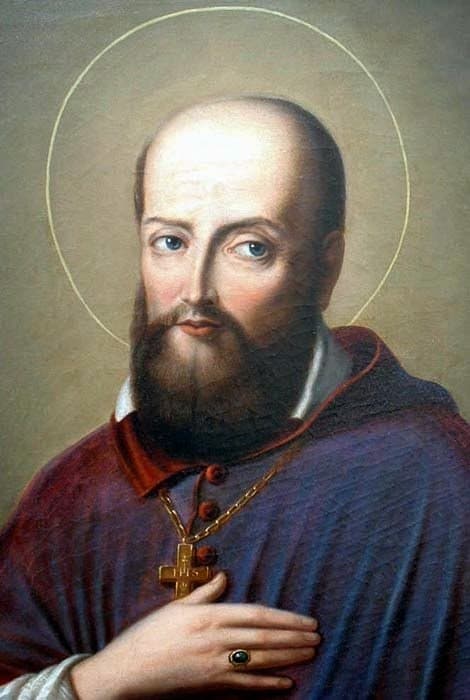
St. Francis
de Sales: The Bishop Who Fought His Own Temper With Gentleness
1567 – 1622
“Nothing is so strong as gentleness, nothing so gentle as real strength.”
Saint François de Sales, painting by an unknown artist, before 1850 · Public Domain
Why He Matters
Francis de Sales had to work deliberately to overcome his own quick temper, and turned that hard-won self-mastery into a whole spiritual teaching that gentleness is a form of strength, not weakness. He matters because he insisted that real holiness was possible for ordinary laypeople living ordinary lives, not reserved only for monks and nuns.
Virtue for Today
Gentleness
Try Today
The next time you feel frustration rising, deliberately choose a gentle response instead of a sharp one, and notice the difference it makes.
A Reluctant Lawyer
Francis de Sales was born on August 21, 1567, at the family château near Annecy in the Duchy of Savoy, the eldest son of a noble family that expected him to pursue law and public office. He was educated first at Annecy, then at the Jesuit-run Collège de Clermont in Paris, and finally completed rigorous legal studies at the University of Padua, earning a doctorate in law at twenty-four — exactly the credential his father wanted for the career he had planned for his son. Francis, however, had secretly resolved on the priesthood since his student years in Paris, and after a prolonged and difficult confrontation with his father, he was eventually permitted to be ordained in 1593.
A Temper He Had to Learn to Master
Contemporary accounts and Francis's own later writings make clear that gentleness did not come naturally to him — he had a quick, forceful temper as a younger man and worked deliberately, over years, to master it, a struggle that gave his later teaching on patience and self-control real, lived credibility rather than abstract theory. He became known specifically for the discipline of responding to provocation and failure, including his own, without harshness, a virtue he had to build rather than one he was simply born with.
The Chablais Mission
In 1594, Francis undertook a dangerous missionary assignment: preaching Catholicism in the Chablais region near Lake Geneva, an area that had turned almost entirely Protestant under Calvinist influence and was openly hostile to Catholic clergy. He traveled largely on foot, faced real physical danger including reported assassination attempts and wolves in the winter countryside, and adopted an unusually patient strategy — writing and distributing short, accessible pamphlets explaining Catholic teaching clearly and respectfully rather than preaching only from pulpits few Protestants would enter. By 1598, remarkably, the region had substantially returned to Catholicism, a result contemporaries attributed directly to his patience and his refusal to rely on coercion or contempt for his opponents.
Bishop and Spiritual Director
Francis became Bishop of Geneva in 1602 (administering from Annecy, since Geneva itself remained under Protestant control) and proved to be an energetic, hands-on bishop, personally preaching, teaching catechism to children, and making himself available for spiritual direction to an unusually wide range of people, not only clergy and nobility. In 1604, while preaching in Dijon, he met Jane Frances de Chantal, a widowed baroness who became his close friend, spiritual directee, and eventual collaborator; their extensive surviving correspondence records some of his clearest spiritual teaching. Together they founded the Order of the Visitation in 1610, deliberately designed to accept women — including widows and those in fragile health — who could not meet the physical demands of stricter religious orders of the time.
Introduction to the Devout Life
Francis's most influential book grew out of ordinary pastoral letters he wrote to a laywoman seeking spiritual guidance. Published in 1608 as An Introduction to the Devout Life, it argued for something genuinely unusual at the time: that serious, deep holiness was possible for ordinary laypeople living in the world — married people, tradespeople, court officials — not only for monks and nuns behind convent or monastery walls. The book was translated into multiple languages within his own lifetime and remains widely read today.
Doctor of the Church
Francis de Sales died in Lyon on December 28, 1622. He was canonized in 1665 and declared a Doctor of the Church in 1877 by Pope Pius IX, in recognition of the lasting theological and spiritual value of his writing on gentleness, patience, and holiness accessible to ordinary life. His teaching that "nothing is so strong as gentleness, nothing so gentle as real strength" remains one of the most quoted lines in Catholic spiritual writing.
Helper
Reflection Questions:
- Francis had to work deliberately over years to master a naturally quick temper. What flaw in yourself have you had to work at consciously, rather than simply being naturally good at self-control?
- He converted a hostile region largely through patient, respectful written explanation rather than confrontation. Where in your own life could patient explanation work better than arguing?
- He believed serious holiness was possible for ordinary people living ordinary lives, not just for those in religious life. Do you sometimes treat holiness as if it were only for "religious" people, rather than for your actual daily life?
- He and Jane Frances de Chantal built a religious order specifically for women other orders would not accept because of health or circumstance. Who around you has been excluded from something because they did not fit the usual mold?
- He taught that gentleness is a form of real strength, not weakness. Where in your life might gentleness actually accomplish more than force or anger would?
Short Prayer
“St. Francis de Sales, pray for us — that we may answer frustration with gentleness, and grow in real strength of character. Amen.”
Prayer to St. Francis de Sales
Prayer to St. Francis de Sales St. Francis de Sales, gentleness did not come naturally to you — you had a quick temper you had to master deliberately, year after year, until patience became your defining trait instead of anger. You showed a hostile region and a skeptical Church that holiness was possible not just in a monastery but in ordinary daily life, lived attentively and well. Pray for us in the moments when our own temper or frustration threatens to take over. Help us believe, as you taught, that real strength looks like gentleness, not force, and that a holy life is available to us exactly where we are. St. Francis de Sales, pray for us. Amen.
EWTN, "Saint Francis de Sales, Bishop, Doctor of the Church"; Francis de Sales, Introduction to the Devout Life

Grow closer to God.
Agnioz is here to walk with you.
Register for FREE and unlock more Catholic content, prayers, and reflections to help you become a more enlightened Catholic — FREE FOREVER.


Let's grow together in faith, hope, and love. 🙏