
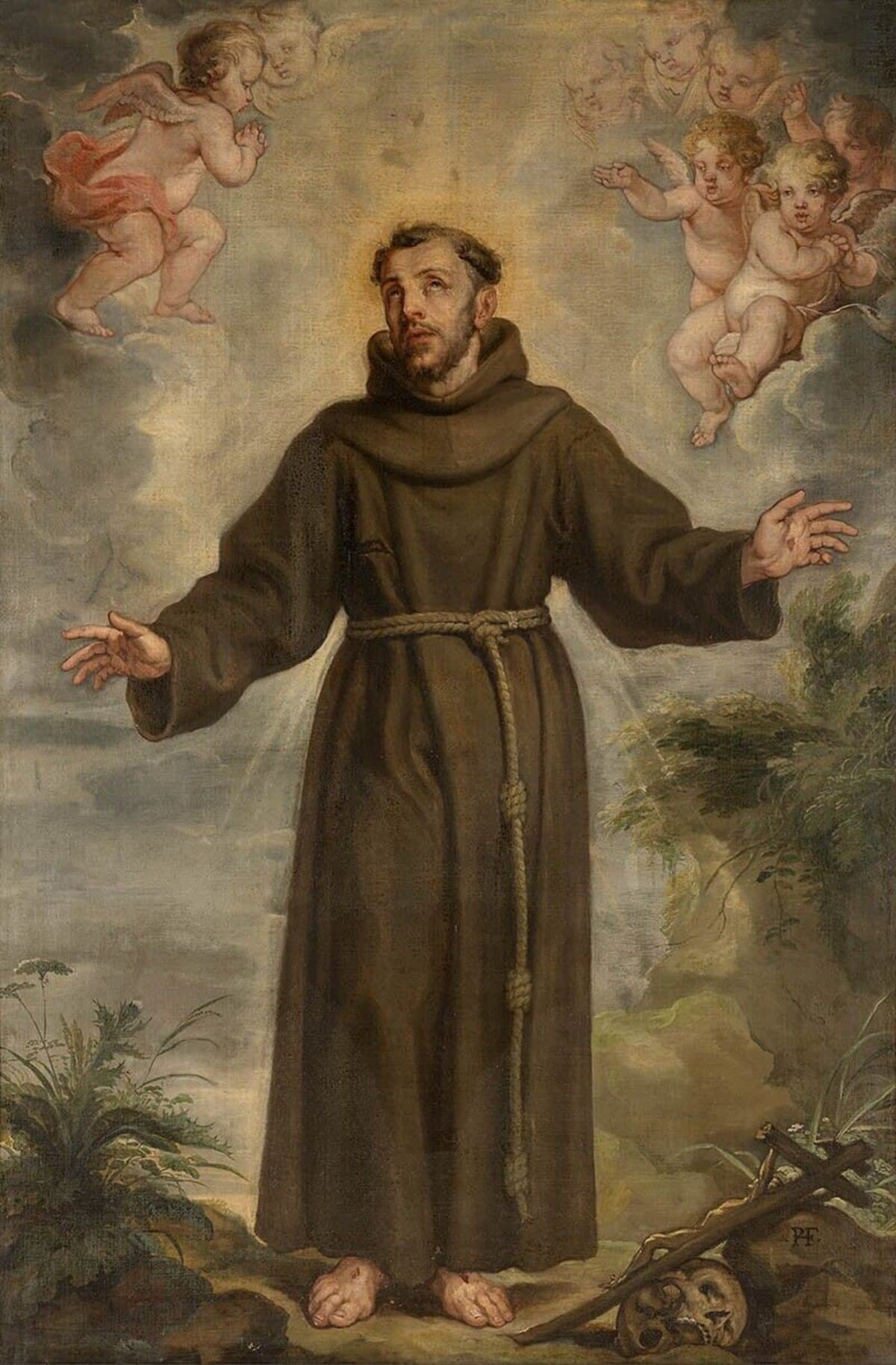
St. Francis of Assisi, painting by Philip Fruytiers, 17th century · Public Domain (PD-old-100-expired)
Why He Matters
Francis gave up a wealthy family inheritance to live in total poverty and rebuild the Church from the ground up, one small act of humility at a time. He matters because he shows that renewal in the Church and in a single life often starts by letting go of comfort, not adding to it.
Virtue for Today
Simplicity
Try Today
Give away, or set aside to give away, one thing you own but do not need.
The Moment Everything Changed
In 1209, a young Italian merchant's son wandered into a small chapel outside Assisi and heard a priest read aloud from Matthew 10:9: "Take nothing for your journey — no staff, no bag, no bread, no money, no extra tunic." Most medieval Christians heard those words as metaphor. Francis of Assisi heard them as instruction.
He stripped off his shoes, traded his belt for a rope, and walked out to preach repentance to anyone who would listen. This moment — not his famous prayer before the crucifix at San Damiano, not his sermon to the birds — was the hinge on which his entire vocation turned.
Scandalizing the Establishment
The medieval Church was not poor. By 1200, monasteries held vast landholdings, abbots lived like lords, and the clergy were exempt from civil taxation. Into this world Francis introduced something disorienting: a friar who meant it. His earliest Rule demanded that brothers own nothing — not books, not a house, not a personal coin. They would beg. They would work with their hands. They would tend lepers.
Pope Innocent III did not immediately celebrate this vision. According to The Legend of the Three Companions, he initially dismissed Francis before a dream in which the small friar propped up the collapsing Lateran Basilica with his shoulder. Approval came in 1209, but remained contested; later popes and church lawyers steadily softened the poverty requirement. By Francis's death, the order he founded was already in tension with what he had intended.
Francis never sought to destroy the institution he loved. He sought to remind it of what it claimed to believe.
Clare, the Canticle, and the Wounds of Christ
Two other realities define Francis that sentiment tends to obscure. The first is Clare of Assisi, a noblewoman who fled her family in 1212 to join his movement. Francis supported her founding of the Order of Poor Ladies — the Poor Clares — who embraced the same radical poverty he demanded of men, an almost unheard-of provision for women in medieval religious life.
The second is the Canticle of the Sun, composed around 1225 when Francis was nearly blind and in severe pain. It is among the earliest poems written in Italian vernacular, praising God through Brother Sun, Sister Moon, Sister Water, and — in a final verse added when he learned his death was near — "Sister Bodily Death." It is not a sentimental nature hymn. It is the prayer of a man who had spent two decades learning to receive everything as gift and release anything he might cling to. The text is preserved and translated at Vatican.va.
In September 1224, on Mount La Verna, Francis received the stigmata — the five wounds of Christ — becoming the first person in recorded Church history to bear them visibly on his body. The marks remained until his death in 1226. As historian Augustine Thompson, O.P., documents in Francis of Assisi: A New Biography (Cornell University Press, 2012), the stigmata were attested by multiple contemporaries including Brother Elias and Clare herself — not legendary accretions but eyewitness testimony from people who knew him.
What His Radicalism Produced
Francis did not intend to found a movement. He intended to follow Jesus. The movement arose because others recognized something in his life they could not explain away. By his death, the Franciscan order numbered in the thousands. Within a generation, Franciscan friars were teaching at Oxford and Paris — the very institutional world Francis had mistrusted, now shaped by men formed in his school.
The paradox is the paradox of the Gospel he took so literally: the one who empties himself is filled. The one who claims nothing becomes inheritor of everything.
Helper
Reflection Questions:
- Is there a passage of Scripture you have always softened into metaphor that might be asking for a more literal response in your life?
- Francis loved the Church while grieving its failings. Where do you find that same tension in your own faith?
- The Canticle of the Sun was written during Francis's most painful years. What has suffering revealed to you about gratitude?
- Francis released ownership of things, relationships, and reputation. What do you hold most tightly, and why?
- Clare's poverty was as demanding as Francis's. Who in your life models radical faith, and what does watching them cost you?
Short Prayer
“St. Francis of Assisi, pray for us — that we may love simply, serve gladly, and see Christ in everyone we meet. Amen.”
Prayer to St. Francis of Assisi
Prayer to St. Francis of Assisi St. Francis, you walked away from wealth and comfort to serve the poor, rebuild broken places, and care for creation as a gift entrusted to us, not a possession to exploit. Teach us to hold what we own loosely, to find joy in simplicity rather than accumulation, and to see the dignity of Christ in people the world overlooks. Pray for us when we are anxious about what we lack, that we might trust instead in God's providence as you did. St. Francis, pray for us. Amen.
Source
Vatican.va
Grow closer to God.
Agnioz is here to walk with you.
Register for FREE and unlock more Catholic content, prayers, and reflections to help you become a more enlightened Catholic — FREE FOREVER.


Let's grow together in faith, hope, and love. 🙏