
St. Genevieve: The Shepherdess Who Held Paris Together
422 – 500
“Let the men flee if they wish, if they are no longer able to fight; we women will pray to God so fervently that He will hear our pleas. (reported speech from her near-contemporary Vita, describing the crisis of 451 — not a verbatim transcript, but attributed to her in the earliest surviving account of her life)”
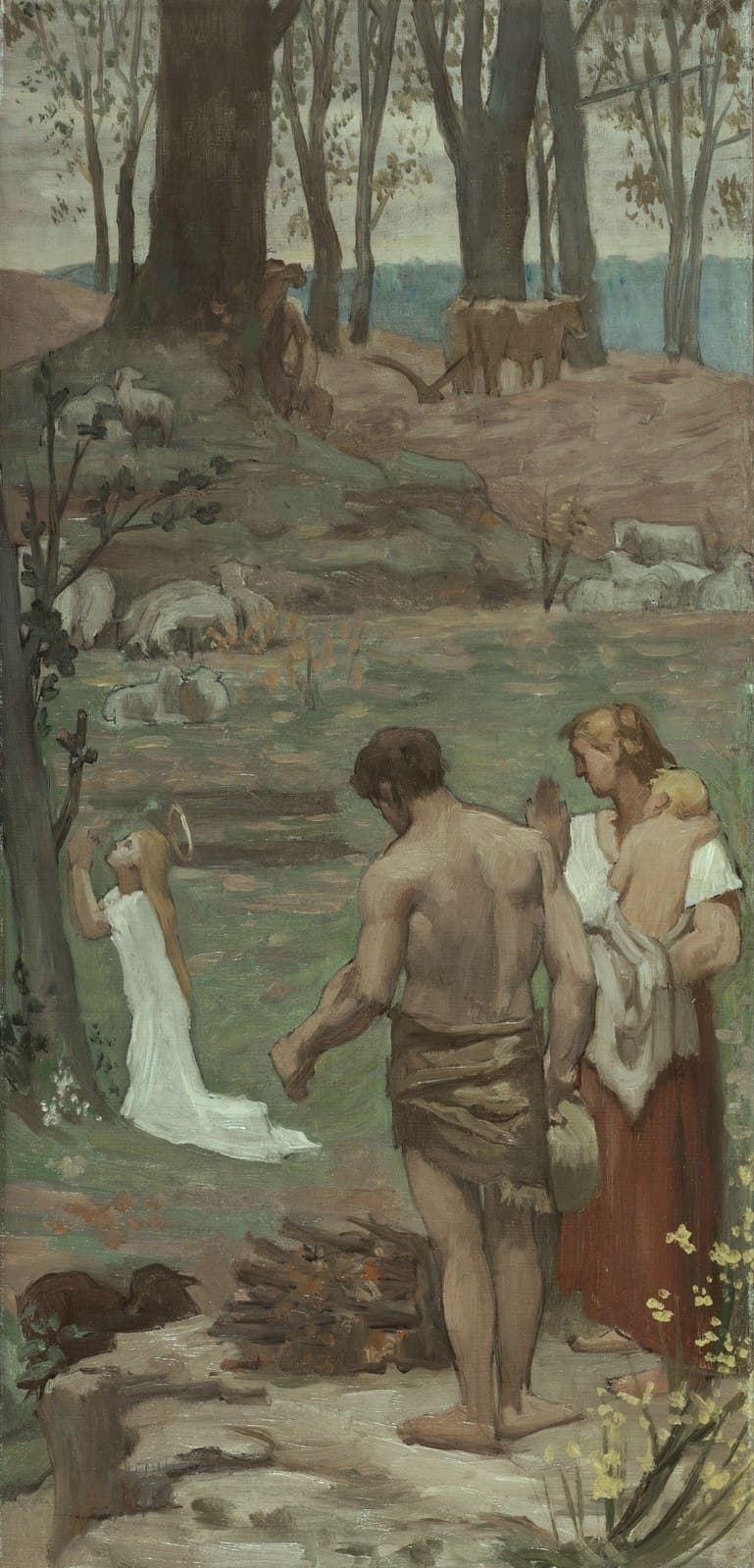
Sainte Geneviève enfant en prière, painting by Pierre Puvis de Chavannes, 1877, Petit Palais, Musée des Beaux-Arts de la Ville de Paris · Public Domain
Why She Matters
Genevieve shows what steady, practical leadership rooted in real trust in God can look like in a genuine civic crisis, holding a frightened city together through both prayer and concrete action, organizing food for the hungry as readily as calming panic.
Virtue for Today
Steadfast Trust
Try Today
Be the calm, steady presence for someone who is panicking today, and back it up with one concrete, practical action to help them, not just reassuring words.
Marked Out as a Child
Genevieve was born around 422 in Nanterre, a village near Paris, in the final decades of Roman rule in Gaul. According to her Vita, written within a few decades of her death and therefore a comparatively close, near-contemporary source rather than a legend composed centuries later, she was seven years old when the traveling bishop Germanus of Auxerre passed through Nanterre in 429, noticed her, and, struck by something in her bearing, prophesied that she would live a life dedicated to God; he gave her a small medal engraved with a cross as a token of that calling. After her parents died, Genevieve moved to Paris, where she took up a disciplined life of prayer, fasting, and charity toward the poor, still as a laywoman rather than as part of any formal religious order, since organized convent life as it later developed did not yet exist in fifth-century Gaul in the form it would take later.
Talking a City Out of Panic
Genevieve's best-known moment in Parisian memory came in 451, when Attila and the Huns swept into Gaul and Paris braced for what looked like certain destruction, with many residents preparing to flee. Her Vita records her urging the city to stay, do penance, and trust in God rather than run, reportedly telling the frightened citizens that the places they hoped to flee to were no safer and that Paris itself would be spared if they held their nerve and turned to prayer instead of terror. Attila's forces, for reasons of strategy that had nothing directly to do with Genevieve, bypassed Paris and moved instead toward Orléans. Her role in the outcome cannot be independently verified beyond her own community's memory of it, recorded in her Vita, but the episode became central to how Parisians remembered her for the rest of the city's history.
Suspicion, and Then Grain Boats Under Siege
Genevieve's reputation was not universally welcomed in her own lifetime. Her Vita and later accounts record that some neighbors, uneasy with her visions, prophecies, and evident spiritual authority as an unmarried laywoman, accused her of being a fraud or a hypocrite, and at one especially hostile moment reportedly conspired to drown her, a plan only defused through the intervention of her early mentor, Germanus of Auxerre. Genevieve's most concretely documented act of practical leadership came later, during a siege of Paris by the Frankish king Childeric: with the city cut off and facing starvation, she is credited with personally organizing and leading a convoy of boats upriver to bring grain back to the besieged population, a specific, physically demanding act of leadership under real danger, distinct from the more devotional legend-building around her prophecies.
Patroness Through the Centuries
Genevieve died around the year 500 in Paris, having lived to see the city pass from Roman to Frankish rule and having reportedly maintained some influence with Clovis, the first Catholic Frankish king. She was buried in a basilica later dedicated to her honor, on the hill in Paris that still bears her name today, the site now occupied by the Panthéon. She has been venerated as principal patroness of Paris ever since, invoked in later centuries during floods, plagues, and other civic crises, a continuous tradition of appealing to her specifically as protector of the city she once refused to abandon.
Helper
Reflection Questions:
- Genevieve urged an entire frightened city to stay and trust rather than flee. When have you needed to be the calm, steady voice for people around you who were panicking, and how did you find the composure to do it?
- She faced real suspicion and hostility from neighbors uneasy with her spiritual authority as an unmarried laywoman. Have you ever doubted or dismissed someone's genuine faithfulness simply because it didn't fit an expected role?
- Beyond her visions and prophecies, Genevieve is remembered for the very physical, practical act of organizing grain boats to feed a starving city. Where might your own faith need to become more practical and hands-on rather than only interior or spiritual?
- She maintained her convictions even when a hostile faction reportedly conspired against her life. What convictions of yours have you softened under social pressure that you might need to hold more firmly?
- Genevieve is remembered specifically as a protector of one city she loved and never abandoned, even when leaving might have been safer. Is there a community or place you feel called to stay committed to, even when it would be easier to walk away?
Short Prayer
“St. Genevieve, pray for us — that we may meet fear with trust, and trust with real, practical action. Amen.”
Prayer to St. Genevieve
Prayer to St. Genevieve of Paris St. Genevieve, when your whole city was ready to run in terror, you stood your ground and urged its people to trust in God instead, and when disaster came anyway in the form of siege and hunger, you did not stop at prayer alone but organized real, practical relief for people who were starving. Pray for us when fear tempts us to flee what we should instead face with faith, and give us the same instinct you had to follow prayer with concrete action for those in need. Watch over every city and community struggling under crisis today, as you once watched over Paris. St. Genevieve, pray for us. Amen.
Vita Sanctae Genovefae (near-contemporary biography, likely 6th century); Catholic Encyclopedia — "St. Genevieve"

Grow closer to God.
Agnioz is here to walk with you.
Register for FREE and unlock more Catholic content, prayers, and reflections to help you become a more enlightened Catholic — FREE FOREVER.


Let's grow together in faith, hope, and love. 🙏