
St. George: The Martyr Behind the Dragon
? – 303
“Megalomartyr — "the Great Martyr" (George's traditional title in the Eastern Church, in use long before the dragon legend was ever attached to his name; no first-person quotation from him survives)”
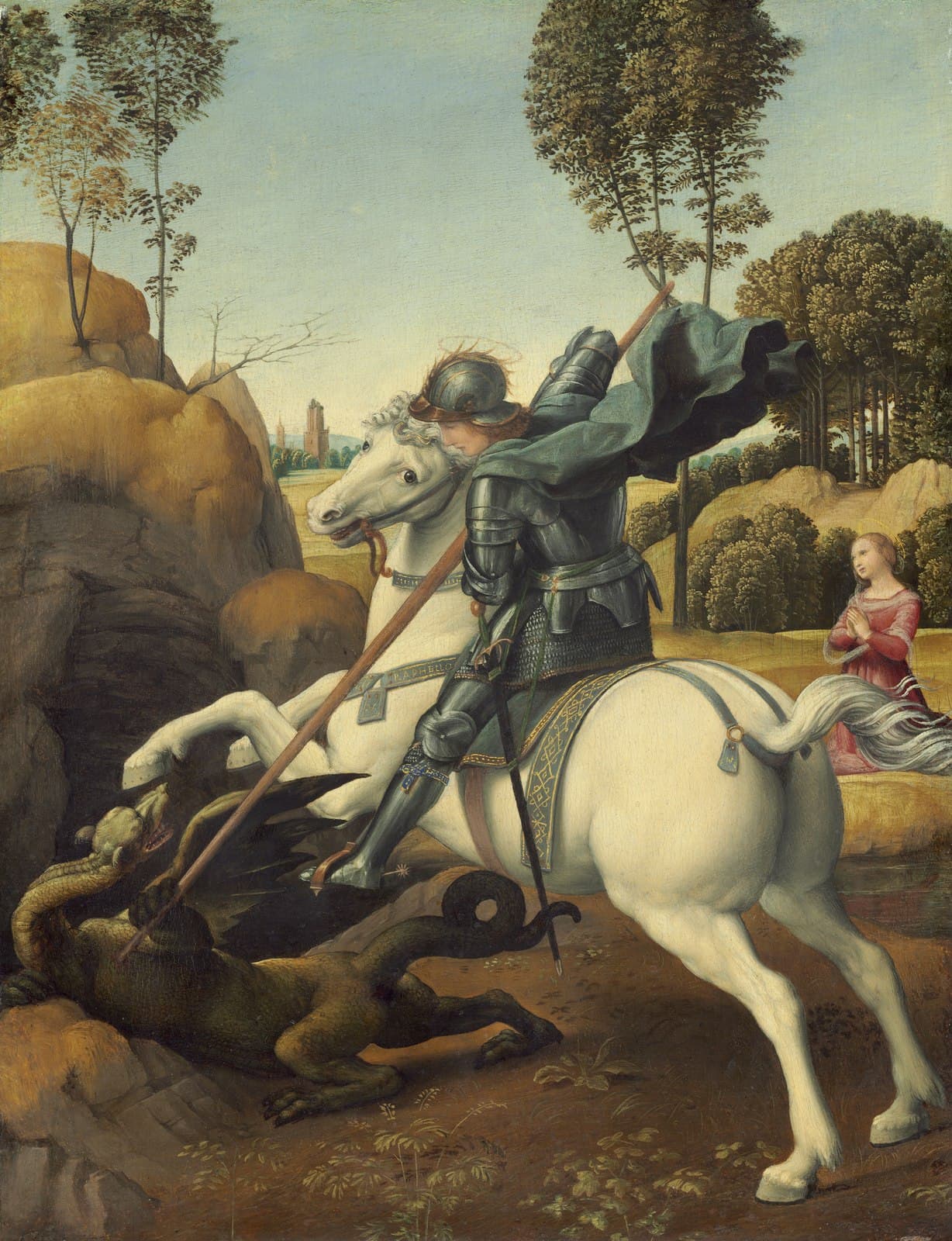
Saint George and the Dragon, painting by Raphael, c. 1506, National Gallery of Art, Washington · CC0 (National Gallery of Art Open Access)
Why He Matters
George shows that a real, early, courageous martyrdom can remain the true foundation of a saint's honor even after a much later legend becomes the more famous story, and that separating the two honestly does not diminish either the historical martyr or the symbolic power of the legend.
Virtue for Today
Courage Under Persecution
Try Today
Identify one thing you have been avoiding out of fear, whether a conversation, a decision, or an injustice, and take one concrete step toward facing it today.
A Real Martyr, Thinly Documented
Behind the dragon-slaying knight of legend stands a real early Christian martyr. Historical and archaeological evidence points to a soldier named Georgios executed at Nicomedia (in modern Turkey) during the persecution of Christians under Emperor Diocletian, traditionally dated to April 23, 303. Early inscriptions referring to his martyrdom survive from the fourth century, and the Emperor Constantine is recorded as having built a memorial church in George's honor at Lydda (modern Lod, Israel), George's traditional hometown, within a few decades of his death, evidence of a genuinely early and geographically specific cult. Beyond these basic facts, almost nothing about George's life is independently documented; the specifics of his military rank, his family, and the exact circumstances of his arrest and death all come from later, unreliable sources.
A Dragon That Belonged to Someone Else First
The single detail everyone associates with George, rescuing a princess by slaying a dragon, is not part of any ancient account of his life and was not, originally, even his story. Art historians have traced the dragon-slaying motif in early Byzantine art and literature to a different soldier-saint, Theodore Tiro; the story appears to have transferred to George only around the eleventh century, gradually displacing Theodore as its central figure. The narrative reached its best-known form in the thirteenth-century Golden Legend, the same immensely popular medieval collection responsible for the equally legendary St. Christopher narrative, compiled by Jacobus de Voragine around 1260, nearly a thousand years after George's actual death. Read plainly, as generations of Christians understood it, the story functions as an allegory of good triumphing over evil, the Church over persecution, faith over fear, rather than as a claimed historical event, and it is presented here honestly as legend rather than as verified biography.
From Local Martyr to Patron of Nations
Despite, or perhaps because of, the power of that later legend, devotion to George spread extraordinarily widely across both the Eastern and Western Church. Crusaders returning from the Holy Land in the twelfth century brought intensified devotion to him back to Western Europe, and England in particular came to embrace him as a national patron: King Edward III founded the Order of the Garter under George's patronage in 1348, and by the late Middle Ages he had effectively displaced earlier English patrons in popular devotion. He remains today patron not only of England but also of Georgia (the country takes its name from him in several traditions), Portugal, Catalonia, and numerous cities and military and scouting organizations worldwide, an unusually broad patronage for a martyr about whom so little verifiable biographical detail actually survives.
Honored Without Depending on the Legend
The Eastern Church has traditionally honored George with the title "Megalomartyr," meaning "Great Martyr," a designation reserved for a small number of especially venerated early martyrs and used well before the dragon story was ever attached to his name, evidence that his core reputation for extraordinary faithfulness under persecution long predates and does not depend on the medieval legend. His feast, April 23, continues to be celebrated widely in both East and West.
Helper
Reflection Questions:
- George's core identity, an early martyr honored as "Great Martyr" centuries before the dragon story existed, does not depend on the legend at all. Where might you be resting your own faith on a compelling story rather than on its actual, sturdier foundation?
- The dragon legend was not originally George's; it migrated to him from another saint over centuries. How do stories or reputations, true or exaggerated, tend to attach themselves to people in your own experience?
- Read as an allegory rather than history, the dragon story is about courage confronting evil directly rather than avoiding it. What "dragon," a fear, an injustice, a hard conversation, have you been avoiding rather than confronting?
- George became patron of an unusually wide range of nations and causes, well beyond anything about his own thin, specific biography. Why do you think certain saints become symbols people from very different backgrounds all claim as their own?
- The earliest honest witnesses to George's life said very little about him beyond the fact that he died for his faith. Would your own life, stripped of any story or reputation attached to it, still show real faithfulness underneath?
Short Prayer
“St. George, pray for us — that we may face what threatens us with the same courage tradition remembers in you. Amen.”
Prayer to St. George
Prayer to St. George St. George, the true record of your life is far thinner than the legend that made you famous, yet even the earliest honest witnesses agreed on the one fact that matters most: you were willing to die for your faith under real persecution. Pray for us when we face our own dragons, whether fear, injustice, or simple cowardice, that we might confront them directly rather than looking away. Help us build our own faith on what is actually true and sturdy, rather than only on the stories that happen to be most exciting. St. George, Great Martyr, pray for us. Amen.
Catholic Encyclopedia (New Advent) — "St. George"; Jacobus de Voragine, The Golden Legend, c. 1260

Grow closer to God.
Agnioz is here to walk with you.
Register for FREE and unlock more Catholic content, prayers, and reflections to help you become a more enlightened Catholic — FREE FOREVER.


Let's grow together in faith, hope, and love. 🙏