St. Hildegard
of Bingen: The Visionary Who Became a Doctor of the Church
1098 – 1179
“I am the fiery life of divine substance, I blaze above the beauty of the fields, I shine in the waters, I burn in the sun, the moon, and the stars.”
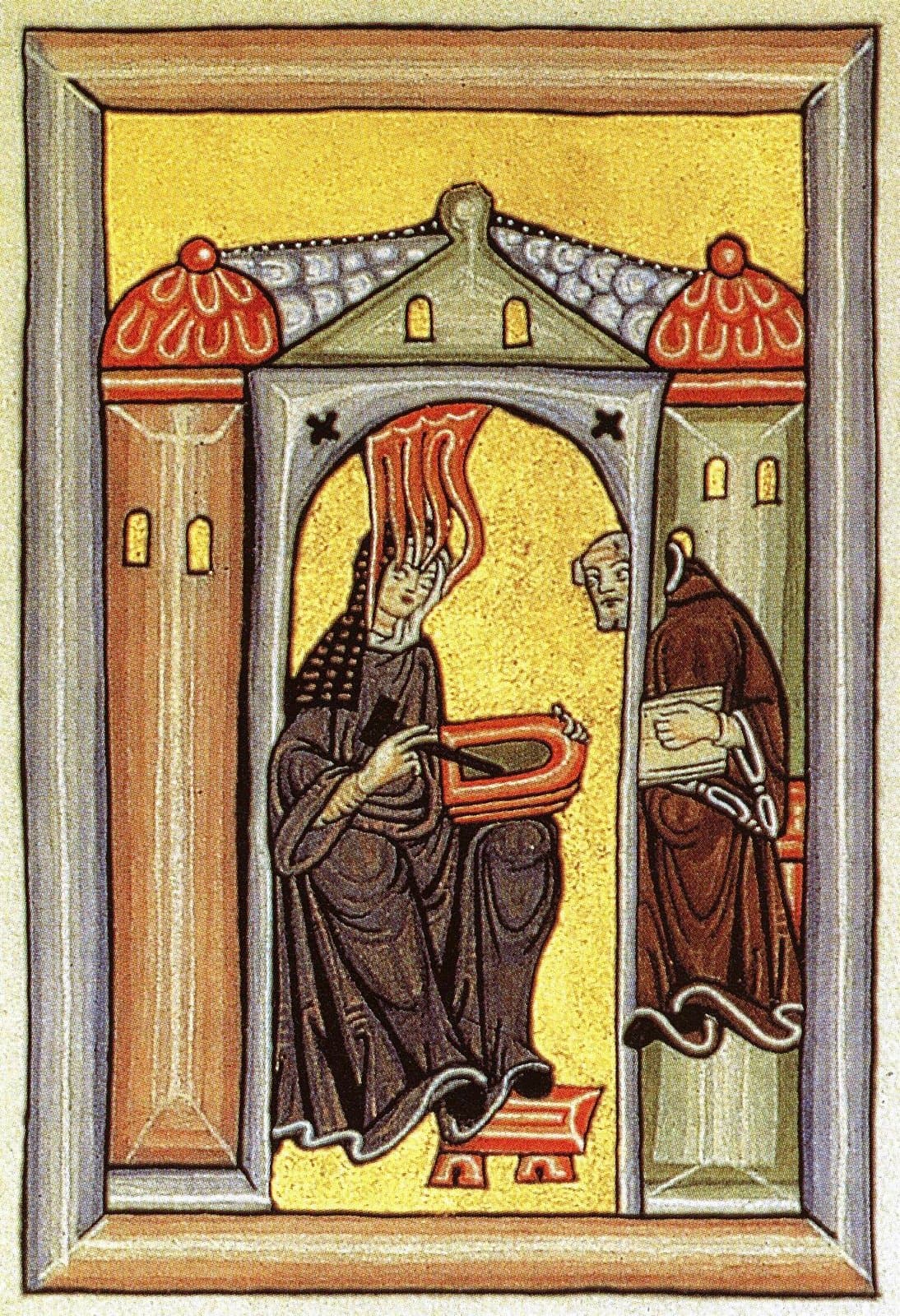
Hildegard von Bingen receives a divine vision, miniature from the Rupertsberg Codex of the Liber Scivias, 12th century (Rupertsberg) · Public Domain
Why She Matters
Hildegard shows that serious engagement with medicine, music, and the natural world is not in competition with a serious spiritual life but can be one integrated expression of it, and that a calling delayed by fear can still bear extraordinary fruit once finally accepted. She matters to anyone in healthcare, the arts, or ministry who has been taught to treat those callings as separate rather than connected.
Virtue for Today
Wisdom in Balance
Try Today
Spend a few minutes outside today paying deliberate attention to the vitality of the natural world as a sign of God's presence, rather than rushing past it.
Visions From Childhood
Hildegard was born in 1098 in the Rhineland region of what is now Germany, the youngest of ten children in a noble family. Around age eight, following a custom of the time, she was placed in the care of a religious recluse named Jutta, who lived walled into a small hermitage attached to a Benedictine monastery near Disibodenberg. Hildegard reported experiencing vivid visions from very early childhood, but, uncertain what to make of them and fearful of how they might be received, she confided them only to Jutta and later to a monk named Volmar, keeping them almost entirely private for decades. As other women joined Jutta's hermitage over the years, it grew into a small formal community, and upon Jutta's death in 1136, Hildegard, then in her late thirties, was elected its leader.
"Write What You See and Hear"
At age forty-two, Hildegard reported receiving an unusually forceful vision commanding her to write down everything she had seen and understood in her visions across her lifetime. Still hesitant and reportedly made physically ill by her own resistance to the task, she eventually began dictating what became Scivias ("Know the Ways"), a sprawling theological work describing and interpreting twenty-six visions covering creation, redemption, and the nature of the Church. She completed it around 1151 after roughly a decade of work, and it received the formal endorsement of Pope Eugenius III after a Church commission reviewed portions of it — an extraordinary level of official validation for a woman's theological writing in twelfth-century Europe.
Physician, Composer, Reformer
Hildegard's productivity over the following decades was remarkable by any standard. She wrote two substantial texts on natural science and medicine, Physica and Causae et Curae, describing the medicinal properties of plants, minerals, and animals alongside treatments for a wide range of ailments, grounded in the medieval humoral theory of her time but reflecting careful, systematic observation rather than pure speculation. She composed dozens of surviving musical works, including Ordo Virtutum, one of the earliest known liturgical morality plays, and corresponded directly and often bluntly with popes, emperors, and bishops, offering unsolicited spiritual and political counsel that few dared to ignore given her growing reputation. She also founded two new monastic communities of her own, relocating her community from Disibodenberg to Rupertsberg against considerable resistance from the monks who had previously overseen it.
A Doctor of the Church, Eight Centuries Later
Hildegard died on September 17, 1179, at Rupertsberg, in her early eighties — an unusually long life for the era. Formal sainthood proceedings begun shortly after her death stalled for centuries, and she was venerated locally as a saint long before any formal canonization was completed; Pope Benedict XVI extended her liturgical veneration to the universal Church in 2012 and, later that same year, declared her a Doctor of the Church — a title recognizing a saint's writings as carrying particular doctrinal significance for the whole Church, held at the time by only three other women in history. Her integrated approach to medicine, spirituality, music, and the natural world — captured in her concept of viriditas, the "greening power" she saw running through all living creation as a sign of divine vitality — has made her a particular touchstone for modern conversations about holistic health and the connection between physical and spiritual well-being.
Helper
Reflection Questions:
- Hildegard kept her visions almost entirely private for decades out of fear and uncertainty before finally obeying a command to write them down. Is there something you sense you are meant to say or create that you have been holding back out of fear?
- She wrote seriously about medicine and the natural world alongside her theology, seeing no real division between the physical and the spiritual. Do you tend to treat your physical health and your spiritual life as connected, or as separate concerns?
- Hildegard corresponded bluntly with popes and emperors, offering counsel few others dared to give. Is there something true you know you should say to someone in authority over you, but have avoided saying?
- She resisted her calling to write for years and reported becoming physically ill from that resistance, only recovering once she began. Has avoiding something you knew you needed to do ever taken a real toll on you?
- Her concept of viriditas describes a "greening" vitality she saw running through all of creation as a sign of God's presence. Where have you noticed something like that vitality recently — in nature, in another person, or in your own life?
Short Prayer
“St. Hildegard of Bingen, Doctor of the Church, pray for us — that we may see body, mind, and spirit as one integrated gift from God. Amen.”
Prayer to St. Hildegard of Bingen
Prayer to St. Hildegard of Bingen St. Hildegard, you kept your visions hidden for decades out of fear before finally obeying the call to write them down, and what followed was theology, music, and medicine that the Church is still studying nearly nine hundred years later. You saw no real division between caring for the body and caring for the soul, and you were unafraid to counsel popes and emperors when you believed the truth required it. Pray for us in whatever calling we are still delaying out of fear or self-doubt. Help us see our own health, our work, and our spiritual lives as connected rather than separate, and give us the courage to speak plainly when something true needs to be said. St. Hildegard, Doctor of the Church, pray for us. Amen.
National Catholic Register — "Why St. Hildegard of Bingen Is a Doctor of the Church"; Britannica — "St. Hildegard"
Grow closer to God.
Agnioz is here to walk with you.
Register for FREE and unlock more Catholic content, prayers, and reflections to help you become a more enlightened Catholic — FREE FOREVER.


Let's grow together in faith, hope, and love. 🙏