
St. Ignatius
of Antioch: God's Wheat, Ground for Christ
? – 108
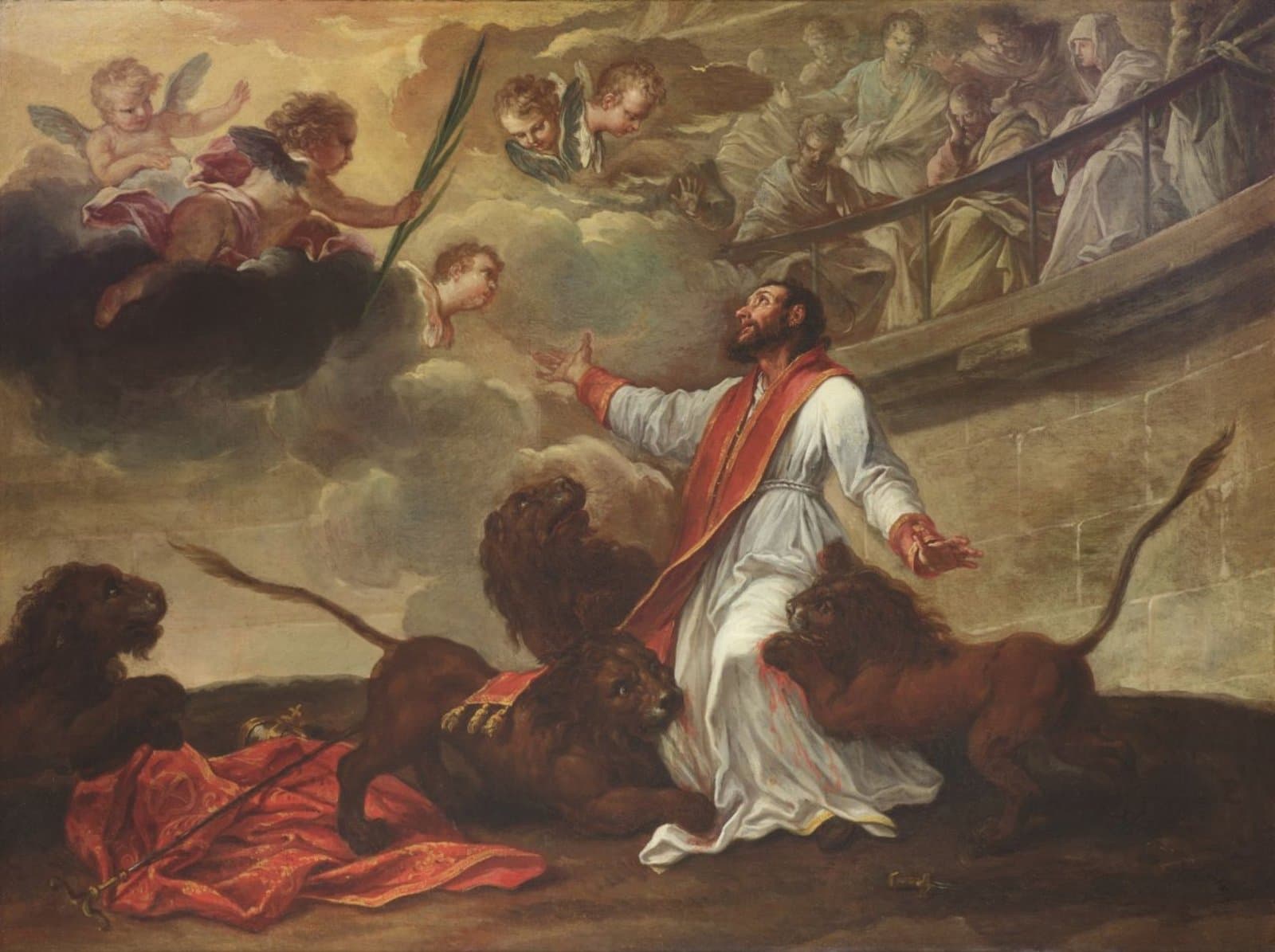
“I am God's wheat, and I am ground by the teeth of wild beasts, that I may become the pure bread of Christ.”
Martyrdom of St. Ignatius of Antioch, painting by Pier Leone Ghezzi, 18th century · Public Domain (PD-old-100-expired)
Why He Matters
Ignatius left seven letters written on his own forced march to execution — among the earliest surviving Christian writings outside the New Testament, and the first place the phrase "the Catholic Church" appears. He matters because his eagerness to imitate Christ's suffering, rather than escape it, shaped how the early Church understood martyrdom, unity, and the Eucharist within a generation of the apostles.
Virtue for Today
Joyful Martyrdom
Try Today
Do one small, uncomfortable act of faithfulness today that you have been avoiding, and offer it up deliberately as a small imitation of Christ.
Bishop of a Major Christian City
Ignatius served as bishop of Antioch, one of the most important cities in the early Christian world and, according to Acts 11:26, the very place where believers were first called "Christians." Little about his early life is documented with certainty; Church tradition holds that he was the second or third bishop of Antioch after St. Peter, and that he may have known the Apostle John personally, placing him among the last generation of Christian leaders with a direct link to the apostles themselves.
Arrested and Condemned
During the reign of the emperor Trajan, in the early second century, Ignatius was arrested for his faith and condemned to be transported to Rome, there to be thrown to wild beasts in the arena as public entertainment. He was marched the long overland route under armed guard — a journey he described in his own writing as being bound to "ten leopards," his grim name for the soldiers escorting him, whose treatment grew harsher, he wrote, the more kindly he treated them.
Seven Letters on the Road to Death
What makes Ignatius one of the most historically significant figures of the earliest post-apostolic Church is not just his martyrdom but what he did on the way to it: at stops along his forced march, he wrote seven letters — to the churches at Ephesus, Magnesia, Tralles, Rome, Philadelphia, and Smyrna, and a personal letter to Polycarp, the bishop of Smyrna. These letters are among the earliest surviving Christian writings outside the New Testament by a single, identifiable author, and they are foundational documents for understanding how the Church organized and understood itself within a few decades of the apostles' deaths. It is in his letter to the Smyrnaeans that the phrase "the Catholic Church" (he katholike ekklesia) appears for the first time in surviving Christian literature, used to describe the universal Church united around its bishops.
"God's Wheat"
In his letter to the Christians of Rome, Ignatius made an unusual and urgent request: he begged them not to intervene on his behalf or attempt to secure his release. He wanted, he wrote, to imitate the suffering of his God: "I am God's wheat, and I am ground by the teeth of wild beasts, that I may become the pure bread of Christ." Far from despairing, his letters convey something closer to eagerness — a conviction that martyrdom was the fullest possible imitation of Christ's own self-offering, and that dying for the faith would make him, in his words, "a true disciple of Jesus Christ" for the first time.
Martyrdom in Rome
Ignatius was killed in Rome, likely in the Colosseum or a similar arena, torn apart by wild beasts as he had expected, somewhere around AD 107–110. His request to the Roman church was granted — no recorded attempt was made to save him — and his own writings became treasured reading among Christian communities almost immediately, preserved and copied for centuries as some of the clearest windows available into how the Church understood the Eucharist, the role of bishops, and unity in the years just after the apostles.
Helper
Reflection Questions:
- Ignatius asked his fellow Christians not to try to save him, believing his death would be a fuller imitation of Christ. Is there a hardship in your own life you have been trying to escape rather than let form you?
- He described his guards' cruelty increasing the kinder he was to them, and kept being kind anyway. Where does returning kindness for hostility feel hardest for you right now?
- His letters, written under armed guard on the way to execution, still guide the Church two thousand years later. What are you doing today that might quietly outlast you?
- He used the phrase "the Catholic Church" to describe unity around one shared faith and leadership. Where in your own community could you actively work toward unity instead of division?
- Ignatius wanted to become "God's wheat" — ground down so something new could be made of him. What in your life needs to be surrendered before God can make something new of it?
Short Prayer
“St. Ignatius of Antioch, pray for us — that we may follow Christ as eagerly as you did, whatever it costs. Amen.”
Prayer to St. Ignatius of Antioch
Prayer to St. Ignatius of Antioch St. Ignatius, on your final journey to execution, you wrote to the churches you loved not out of despair but with an eagerness to imitate the Christ you had given your life to. You asked your friends not to save you, wanting nothing more than to become, in your own words, the pure bread of Christ. Pray for us when we are tempted to escape every hardship rather than let any of them shape us. Give us a measure of your courage and your unity of purpose, so that whatever we are asked to endure, we endure it bound closely to Christ, as you did. St. Ignatius, pray for us. Amen.
Ignatius of Antioch, Letter to the Romans (early 2nd century); Catholic Encyclopedia (New Advent), "St. Ignatius of Antioch"; EWTN
Grow closer to God.
Agnioz is here to walk with you.
Register for FREE and unlock more Catholic content, prayers, and reflections to help you become a more enlightened Catholic — FREE FOREVER.


Let's grow together in faith, hope, and love. 🙏