St. Ignatius
of Loyola: The Soldier Who Founded an Army for Christ
1491 – 1556
“Take, Lord, and receive all my liberty, my memory, my understanding, and my entire will... Give me only your love and your grace, for that is enough for me.”
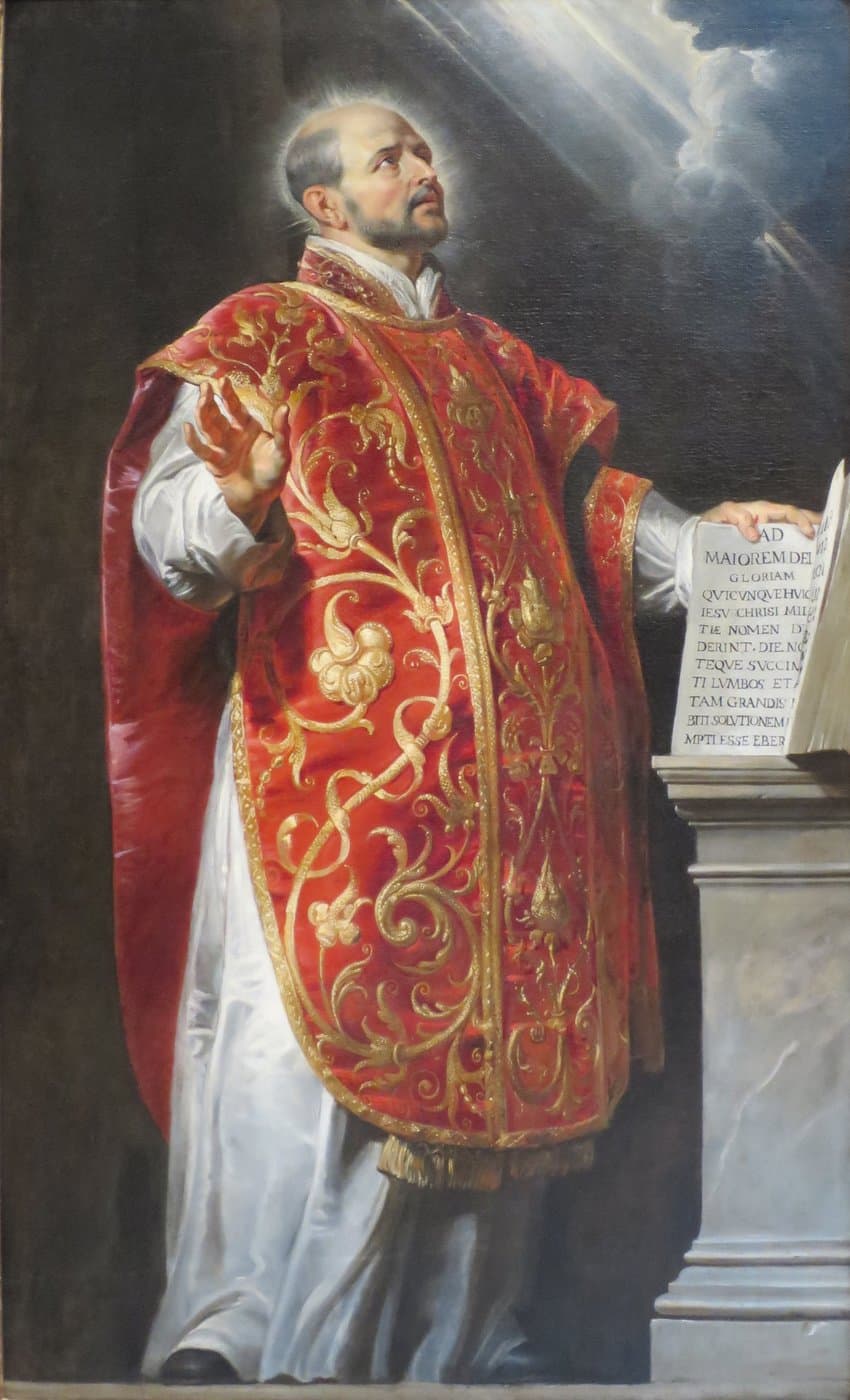
Portrait of Ignatius of Loyola, painting by Peter Paul Rubens, c. 1620-1622 · Public Domain
Why He Matters
Ignatius turned a shattered leg and a ruined military career into a method for discerning God's will that the Church still teaches today. He matters because he shows that a painful, unwanted interruption can become the doorway to a completely different and more fruitful life.
Virtue for Today
Discernment
Try Today
At the end of today, spend a few minutes reviewing where you felt drawn toward God and where you felt pulled away — a simple version of the Ignatian "examen."
A Soldier's Wound
Íñigo López de Loyola was born in 1491 in the Basque region of Spain, the youngest son of a noble family, and grew up pursuing the ambitions typical of minor nobility: a career at court and in arms. He served as a soldier, and on May 20, 1521, while defending the citadel of Pamplona against a French assault, a cannonball shattered one of his legs and injured the other. He was carried home to Loyola to recover, facing multiple painful operations — including having a protruding bone rebroken and reset because he wanted his leg to look right in fashionable hose — and a long, immobile convalescence that changed the direction of his entire life.
The Long Convalescence
Bored during recovery and hoping for tales of romance and chivalry, Ignatius instead was given the only books available in the house: a life of Christ and a collection of saints' lives. Reading them repeatedly, he noticed something he later analyzed carefully: daydreams of worldly glory left him excited in the moment but empty afterward, while thoughts of imitating the saints left him with lasting peace. This observation — that different kinds of thoughts leave different, traceable spiritual "aftertastes" — became the seed of what he would later develop into a whole method of discernment.
Manresa and the Spiritual Exercises
After his recovery, Ignatius abandoned his military ambitions and spent nearly a year in prayer, penance, and reflection near the town of Manresa, undergoing intense interior struggles and periods of consolation that he later distilled into the Spiritual Exercises — a structured, four-week program of prayer and self-examination designed to help a person discern God's will in their life. The Exercises remain in active use today, centuries later, as a foundational tool of Catholic spiritual direction and retreat practice.
Founding the Society of Jesus
Ignatius pursued formal theological study as an adult, eventually studying at the University of Paris, where he gathered a small circle of companions — including Francis Xavier and Peter Faber — who together took vows of poverty and chastity in 1534. On August 15, 1534, at Montmartre, this small group committed themselves to a shared mission; in 1540, Pope Paul III formally approved them as the Society of Jesus, with Ignatius elected its first Superior General in 1541. The Jesuits combined rigorous intellectual formation with a vow of special obedience to the pope, sending members out as teachers, missionaries, and confessors across the world within Ignatius's own lifetime.
Governing from Rome
Ignatius spent his final fifteen years in Rome, directing the Society's rapid growth through an enormous volume of correspondence — thousands of letters survive — to Jesuits establishing schools and missions from Portugal to Japan. He wrote the Jesuit Constitutions, a detailed governing document balancing central authority with flexibility to adapt to local circumstances, a structure still recognizable in the order today. He died in Rome on July 31, 1556.
For the Greater Glory of God
Ignatius was canonized in 1622. The motto he gave the Society he founded, Ad maiorem Dei gloriam ("for the greater glory of God"), summarized his conviction that any legitimate work — teaching, scholarship, diplomacy, manual labor — could be turned into an offering to God if done with the right intention. His method of discernment, distinguishing consolation from desolation in a person's inner life, remains one of the most widely used tools in Catholic spiritual direction more than four centuries later.
Helper
Reflection Questions:
- Ignatius noticed that daydreams of glory felt exciting but left him empty, while thoughts of following Christ left him at peace. Have you noticed a similar pattern in your own thoughts and daydreams?
- His convalescence forced a pause he never would have chosen, and that pause redirected his entire life. Has an unwanted interruption ever turned out to redirect you toward something better?
- He built the Spiritual Exercises around real, sustained self-examination rather than quick spiritual fixes. Do you give your own prayer life that kind of unhurried attention?
- He wrote thousands of letters guiding people he mostly never saw in person. Who in your life could use a real, thoughtful letter or message from you right now?
- His motto was "for the greater glory of God" — turning ordinary work into an offering. Is there a task in front of you today that you could reframe that way?
Short Prayer
“St. Ignatius of Loyola, pray for us — that we may discern God's will patiently and offer whatever we do for his greater glory. Amen.”
Prayer to St. Ignatius of Loyola
Prayer to St. Ignatius of Loyola St. Ignatius, a shattered leg ended the future you had planned for yourself, and in the long, frustrating recovery that followed, God gave you a different and far more fruitful path. You learned to notice which thoughts brought lasting peace and which only left you restless, and you built a whole method of prayer around that discernment for the whole Church to use. Pray for us in our own interrupted plans and unwanted delays, that we might look for what God could be doing in them rather than only mourning what we lost. Help us offer our ordinary work, whatever it is, for God's greater glory, as you taught your companions to do. St. Ignatius, pray for us. Amen.
Encyclopaedia Britannica, "St. Ignatius of Loyola"; Ignatius of Loyola, Autobiography and Spiritual Exercises
Grow closer to God.
Agnioz is here to walk with you.
Register for FREE and unlock more Catholic content, prayers, and reflections to help you become a more enlightened Catholic — FREE FOREVER.


Let's grow together in faith, hope, and love. 🙏