
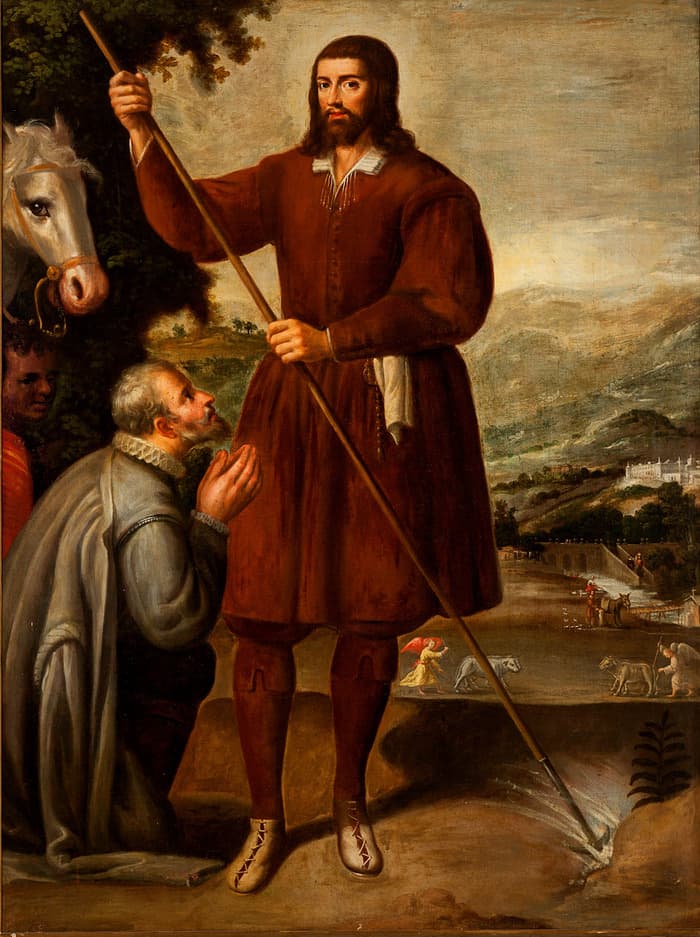
St. Isidore the Farmer: Holiness Behind the Plough
1070 – 1130
“El Santo Labrador — "The Holy Ploughman" (his traditional Spanish title; no first-person quotation from Isidore survives)”
San Isidro Labrador, painting by Jusepe Leonardo, c. 1625–1630, Museo Ibercaja Camón Aznar, Zaragoza · Public Domain
Why He Matters
Isidore shows that sanctity does not require education, wealth, or public achievement — a lifetime of ordinary manual labor, folded around real prayer and real generosity to the poor, can be recognized by the whole Church as heroic holiness.
Virtue for Today
Prayerful Labor
Try Today
Offer a brief, deliberate prayer before starting your work today, the way Isidore's legend describes him doing before he began ploughing each morning.
A Life Spent in Someone Else's Fields
Isidore was born around 1070 in Madrid, then a modest town in the Kingdom of Castile, to a poor family who named him after the great scholar-bishop Isidore of Seville. He never owned land of his own; from a young age he worked as a farmhand on the estate of a wealthy landowner, Juan de Vergas, just outside the city, and stayed in that same service for the rest of his life. He married a woman of similarly humble, devout character, Maria Torribia, known in Spain as Maria de la Cabeza; the couple had one son, who died as a young child, a loss the tradition says the couple accepted as an invitation to give the rest of their lives more completely to God and to the poor.
A Reputation for Prayer Before Work Began
What distinguished Isidore in the eyes of his neighbors and eventually his employer was not any dramatic achievement but a steady, visible pattern of devotion folded into ordinary labor: rising early to attend Mass before the workday, praying while he ploughed, and giving away food and money to anyone poorer than himself, even when that meant less for his own household. Later medieval biographers embellished this pattern into specific miracle stories, most famously that angels were seen ploughing alongside him or in his place on days he lingered too long at prayer, allowing him to complete a full day's work despite the time spent in church. These stories are pious legend rather than documented fact, but they reflect what contemporaries apparently did observe and remember about him: a laborer who somehow made room for both unusually serious prayer and a full, faithful day's work, without one displacing the other in his employer's eyes.
Death, Growing Devotion, and a Royal Cure
Isidore died in Madrid on May 15, 1130, and was buried in the churchyard of St. Andrew. Local devotion to him grew steadily over the following centuries among Madrid's working poor, who saw in him one of their own. The clearest documented turning point in his cause came in 1615, when King Philip III of Spain, gravely ill with a fever his physicians could not treat, ordered Isidore's shrine carried in procession from Madrid to his sickroom; contemporary accounts record that the king recovered soon after the relics arrived, and this episode became a central piece of evidence in the formal Church investigation that followed.
Canonized Alongside Giants of the Counter-Reformation
Isidore was beatified in 1619 and canonized on March 12, 1622, by Pope Gregory XV, in the same ceremony as Ignatius Loyola, founder of the Jesuits, Francis Xavier, the missionary to Asia, and Teresa of Ávila, the great reforming mystic — all figures already in this Faith Library. It is a striking pairing: three towering, highly educated founders and reformers of the Counter-Reformation Church, canonized alongside an illiterate farm laborer whose only recorded ministry was faithful, humble work and prayer on someone else's land. He was declared patron of Madrid and, later, of farmers and rural life more broadly; his feast, May 15, is still celebrated in Madrid with the Fiestas de San Isidro, one of the city's largest annual festivals.
Helper
Reflection Questions:
- Isidore never rose above the position of a hired farmhand, yet his ordinary faithfulness became internationally renowned. Where might you be undervaluing quiet, unglamorous faithfulness in your own life or work?
- Legend says Isidore made time for daily Mass even when it meant less time working the fields, trusting the work would still get done. What daily practice do you keep putting off because you feel too busy, and what would it cost you to prioritize it anyway?
- Isidore and his wife, Maria, responded to the death of their only child by giving themselves more fully to prayer and care for the poor rather than turning inward. How have you, or could you, respond to loss by turning outward toward others rather than only inward?
- He was canonized alongside three of the era's most brilliant, educated saints, without ever having had access to formal education himself. Where do you assume holiness requires credentials, talent, or status it may not actually require?
- Isidore's devotion was rooted entirely in the same small piece of land and the same daily labor for his whole life. Is there a place, job, or responsibility in your own life that you're tempted to see as "too small" to be a real setting for holiness?
Short Prayer
“St. Isidore the Farmer, pray for us — that our daily work may be joined to daily prayer, and never crowd it out. Amen.”
Prayer to St. Isidore the Farmer
Prayer to St. Isidore the Farmer St. Isidore, you spent your whole life laboring in another man's fields, yet you never let that labor push prayer to the margins of your day, rising early for Mass and giving generously to the poor from what little you had. Pray for us in our own work, whatever form it takes, that we might hold prayer and labor together as you did rather than letting one crowd out the other. Help us trust, as you and your wife Maria did after losing your only son, that faithfulness in small, hidden things is never wasted in God's eyes, however unnoticed it seems to everyone else. St. Isidore, holy ploughman, pray for us. Amen.
Catholic Encyclopedia (New Advent) — "St. Isidore the Husbandman"; EWTN — St. Isidore of Madrid

Grow closer to God.
Agnioz is here to walk with you.
Register for FREE and unlock more Catholic content, prayers, and reflections to help you become a more enlightened Catholic — FREE FOREVER.


Let's grow together in faith, hope, and love. 🙏