
St. Jerome: The Scholar Who Gave the Church Its Bible
347 – 420
“Ignorance of Scripture is ignorance of Christ.”
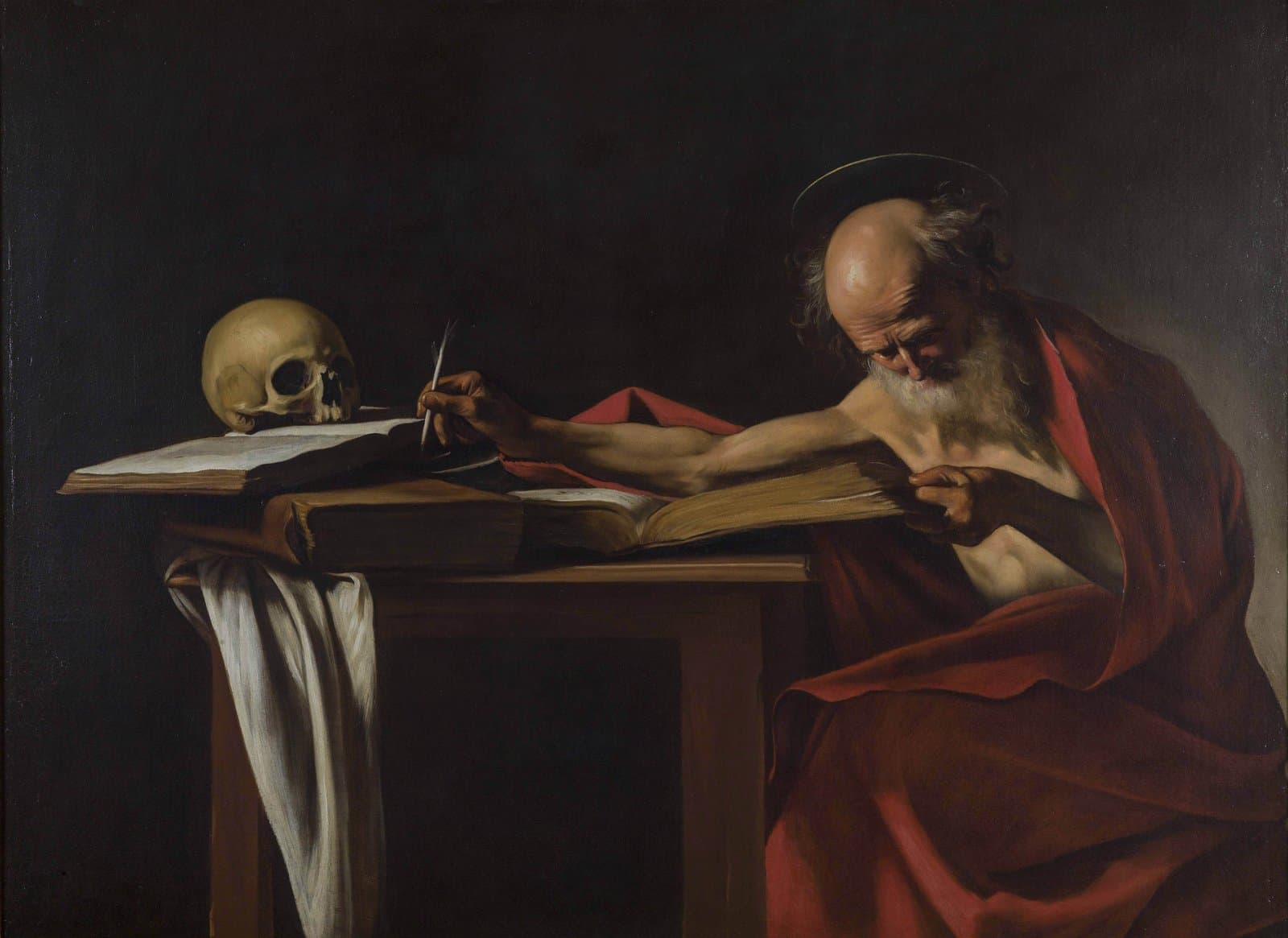
Saint Jerome Writing, painting by Caravaggio, 1606, Galleria Borghese · Public Domain
Why He Matters
Jerome single-handedly gave the Western Church a reliable, accessible Bible in its own common language, a work of scholarship so foundational it shaped Catholic teaching and worship for over a millennium. He matters because he shows that rigorous, patient scholarship is itself a form of holiness and service to the whole Church.
Virtue for Today
Love of Scripture
Try Today
Read one chapter of Scripture slowly today, the way Jerome insisted every Christian should.
A Roman Education, A Restless Conscience
Jerome was born around 347 in Stridon, on the border of Dalmatia and Pannonia, to a Christian family wealthy enough to send him to Rome for a first-rate education in rhetoric, literature, and law. He excelled at Latin and Greek and built a personal library he treasured — a library he later described, with characteristic drama, as filled with pagan authors he loved more than he should have. He was baptized in Rome as a young man, but the pull between classical learning and Christian devotion would define the rest of his life.
The Desert and a Famous Dream
In his late twenties, Jerome traveled east and spent several years living as a hermit in the Syrian desert near Chalcis, practicing extreme asceticism and teaching himself Hebrew from a Jewish convert — a rare and difficult undertaking for a Latin-speaking scholar of his era. He later recounted a vivid dream in which he was hauled before a divine tribunal and accused of being "a Ciceronian, not a Christian," so attached was he to pagan literary style. Whether taken literally or as a moral turning point, the story marks the moment Jerome redirected his formidable learning entirely toward the service of Scripture.
Secretary to a Pope, Enemy to Many
Jerome returned to Rome and served for several years as secretary to Pope Damasus I, who in 382 commissioned him to revise the existing Latin translations of the Gospels against the Greek originals — the seed of what would become his life's great work. Jerome was also, by his own admission and everyone else's, a difficult man: sharp-tongued, quick to feud, and unsparing toward scholars he thought sloppy or heretical. His combative correspondence with St. Augustine of Hippo over points of biblical interpretation is itself a small classic of vigorous, if not always gentle, theological debate between two future Doctors of the Church.
Forty Years in Bethlehem
After Damasus died in 384, Jerome left Rome for the Holy Land and settled in Bethlehem, where he lived out the rest of his life attached to a monastery near the traditional site of Christ's birth, supported by a community of wealthy Roman women, including Paula and her daughter Eustochium, who had followed him east to study Scripture. There, working from Hebrew and Greek manuscripts rather than earlier Latin translations, he spent over two decades producing what became known as the Vulgate — the "common" Latin Bible that would remain the Catholic Church's standard biblical text for more than a thousand years, formally confirmed at the Council of Trent in the sixteenth century.
Defender and Scholar to the End
Jerome also wrote extensive biblical commentaries, translated and continued a major work of Church history, and produced biographies of earlier Christian writers — but he considered the Vulgate his central contribution, insisting that access to Scripture in a language people could actually read was not a luxury for specialists but a necessity for every believer. He died in Bethlehem in 420, and was later named a Doctor of the Church for the sheer scale of his biblical scholarship. He is honored today as the patron saint of translators, librarians, and biblical scholars.
Helper
Reflection Questions:
- Jerome gave up the polished literary career his education had prepared him for in order to serve Scripture directly. Is there a talent or ambition of yours that could be redirected more fully toward God?
- He spent years learning Hebrew as an adult specifically so he could translate the Old Testament accurately rather than rely on secondhand versions. What would it look like to go to the actual source of something important, rather than settling for an easier shortcut?
- Jerome was famously difficult and combative, even with people he respected, like Augustine. Where do you need to pursue truth without losing charity toward the people you disagree with?
- He believed ignorance of Scripture was ignorance of Christ himself. How well do you actually know the text of the Bible, beyond what you've absorbed secondhand?
- He worked for decades on a single monumental project whose fruit he would only partly see in his own lifetime. What long, unglamorous work are you being asked to be faithful to right now?
Short Prayer
“St. Jerome, patron of Scripture scholars, pray for us — that we may love God's word enough to study it patiently and live it faithfully. Amen.”
Prayer to St. Jerome
Prayer to St. Jerome St. Jerome, you gave up worldly literary fame and years of your life in the desert and in Bethlehem so that the Church would have the Scriptures in a language her people could read and understand. You believed, and taught fiercely, that ignorance of Scripture is ignorance of Christ himself. Pray for us in our own neglect of God's word — for the days we skip it, rush it, or let it grow unfamiliar. Obtain for us some measure of your discipline and your hunger for the truth found in the sacred text, and help us approach it not as a chore but as a real encounter with the Lord you spent your life translating for others. St. Jerome, pray for us. Amen.
EWTN — St. Jerome
Grow closer to God.
Agnioz is here to walk with you.
Register for FREE and unlock more Catholic content, prayers, and reflections to help you become a more enlightened Catholic — FREE FOREVER.


Let's grow together in faith, hope, and love. 🙏