Why He Matters
St. John Eudes shows that real devotion — even to something as tender as the Sacred Heart — is proven in unglamorous action: he founded a refuge for women his century had given up on, and preached to the poor when comfort was available elsewhere.
Virtue for Today
Zeal — a persistent, practical love that goes toward whoever is hardest to love and stays there.
Try Today
Do one concrete act of mercy today for someone others have written off, and offer it silently as a prayer to the Sacred Heart.
A Preacher Who Walked Toward the Plague
John Eudes was born in 1601 in Normandy, France, into a farming family that expected him to take over the land. Instead, at fourteen, he made a private vow of celibacy and set his sights on the priesthood, entering the Oratory of Cardinal Pierre de Bérulle — a community reshaping French clergy formation around serious theology and interior prayer — and was ordained in 1625.
His first great test came almost immediately. Plague swept through Normandy in the late 1620s, and Eudes volunteered to minister to the dying when other priests understandably kept their distance. He lived in a wine cask in an open field for weeks at a time so as not to carry infection back to his community, going out each day to hear confessions and anoint the sick. It was dangerous, unglamorous work, and it set the pattern for the rest of his life: John Eudes went toward whoever the rest of society was most inclined to avoid.
The Refuge for Women Normandy Had Given Up On
That instinct found its clearest expression in 1641, when Eudes founded a refuge in Caen for women trying to leave prostitution — a ministry the polite society of the day regarded as, at best, hopeless and, at worst, faintly scandalous for a priest to bother with. He was undeterred. Out of that refuge grew the Congregation of Our Lady of Charity, a religious order of women dedicated specifically to caring for women whom the Church's own language of the era bluntly called "fallen." Eudes insisted these women were not beyond restoration; he insisted on it publicly, repeatedly, in a century not known for extending that kind of confidence to anyone on the margins.
The refuge was not a side project fitted around his other work. It was, in many ways, the practical proof of the theology he was about to spend the rest of his life articulating: that the human heart, however wounded or however far it has wandered, remains an object of tender and specific love, not a lost cause to be written off.
The Birth of a Devotion: Two Hearts, One Love
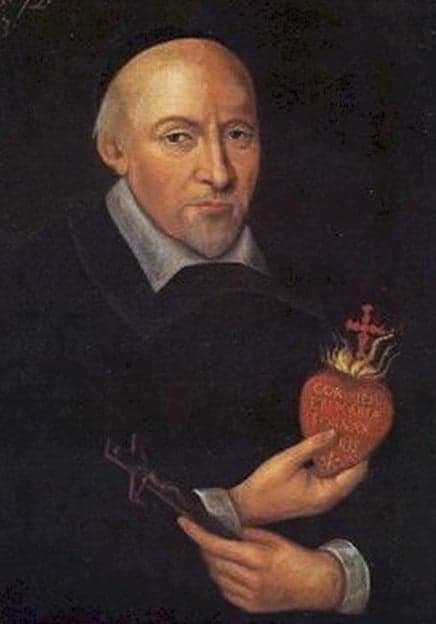
Eudes is remembered above all as the priest who gave the Church its first sustained theology and liturgy of devotion to the Sacred Heart of Jesus and the Immaculate Heart of Mary — decades before the more famous visions given to St. Margaret Mary Alacoque made the Sacred Heart devotion a household practice across Catholic Europe. Eudes composed a Mass and Office in honor of the Sacred Heart as early as 1668, and preached constantly on the image of Christ's heart, wounded on the cross and yet endlessly, deliberately open — not a private symbol for mystics, but a plain, physical image any ordinary parishioner could hold onto: God loves you specifically, and that love cost him something real.
He paired it, inseparably, with devotion to the Immaculate Heart of Mary, insisting the two belonged together — Christ's heart and his mother's heart, formed by the same love, offered for the same purpose. The Eudist motto, still used by the religious congregations he founded, captures the whole of his spirituality in three words: Vive Jésus — "Live, Jesus." Not admire Jesus from a safe distance. Live him, in the heart, daily.
This is why the Church now honors him with the title "Father of the liturgical devotion to the Sacred and Immaculate Hearts of Jesus and Mary" — a devotion so widely absorbed into ordinary Catholic life today, from home altars to parish feast days, that it is easy to forget it had to be argued for, composed, and defended by one persistent priest before it became common inheritance.
Founding the Eudists
In 1643, Eudes founded the Congregation of Jesus and Mary — popularly called the Eudists — a society of priests dedicated to two unglamorous, essential tasks: training seminarians properly, at a time when clerical formation in France was often shockingly thin, and preaching parish missions to ordinary Catholics who rarely heard a sermon that expected anything real of them. He personally preached over a hundred parish missions across Normandy and Brittany, often weeks long, walking from town to town, hearing confessions late into the night, and refusing every opportunity to settle into a comfortable benefice instead.
The seminaries he founded became models other French dioceses copied. His insistence that priests be formed not just in doctrine but in a real interior life of prayer — the same Bérullian emphasis he had absorbed as a young Oratorian — shaped generations of French clergy long after his own death.
Opposition, and the Ordinary Cost of Persistence
None of this came without a fight. Eudes's decision to found the Eudists as an independent congregation put him at odds with his own Oratorian superiors, who saw it as a defection; the split was bitter enough that some of his former Oratorian brethren worked actively against him for years afterward. His devotion to the Sacred Heart, novel in its liturgical formality, met resistance from churchmen who considered it theologically premature or excessive. He was, by multiple contemporary accounts, an anxious and interiorly struggling man for much of his life — hardly the serene plaster-saint image later hagiography sometimes prefers.
He kept working anyway. That combination — real inner difficulty, held together with real outer perseverance — is part of what makes his life useful rather than merely admirable. Sanctity, in John Eudes's case, was not the absence of struggle; it was fidelity in the middle of it.
Recognized, Centuries Later
John Eudes died on August 19, 1680, in Caen, the city where his refuge for discarded women still stood. Recognition from Rome came slowly — he was beatified in 1909 and canonized only in 1925, by Pope Pius XI, nearly two and a half centuries after his death. By then, the devotion he had fought to establish needed no more defending; it had become one of the most recognizable expressions of Catholic piety in the world, practiced by millions who had never heard his name.
That gap between the work and its recognition is, in its own way, a fitting epitaph for a man who spent his life on people and causes the rest of his century was in no hurry to notice.
Helper
Reflection Questions:
- Who in your own life or community is treated the way Normandy treated the women John Eudes refused to give up on — and what would it look like to extend them the same confidence he did?
- Eudes paired devotion to the Sacred Heart with real, unglamorous action (plague care, parish missions, a refuge for the marginalized). Where in your life has devotion stayed private when it was meant to become action?
- He struggled interiorly for much of his life while still doing demanding, sustained work. Does your own idea of holiness leave room for that combination, or does it quietly assume the saints never doubted?
- The Eudist motto is Vive Jésus — "Live, Jesus." What would change today if you treated that as an instruction rather than a slogan?
Short Prayer
“Heart of Jesus, live in me; let me love as tenderly and as practically as you love. Amen.”
Prayer to St. John Eudes
St. John Eudes, priest and apostle of the Sacred and Immaculate Hearts, you gave your life to the people your century preferred to overlook, and to a devotion the Church had not yet learned to name. Obtain for me your same persistent charity — willing to work without recognition, to love without condition, and to keep going when opposition and self-doubt both press in. Teach me to make "Vive Jésus" not a motto but a daily practice, until Christ's own heart truly lives in mine. Amen.
Grow closer to God.
Agnioz is here to walk with you.
Register for FREE and unlock more Catholic content, prayers, and reflections to help you become a more enlightened Catholic — FREE FOREVER.


Let's grow together in faith, hope, and love. 🙏