
St. John
of God: The Wandering Soldier Who Built a Hospital From Nothing
1495 – 1550
“Do good to yourselves! For the love of God, Brothers, do good!”
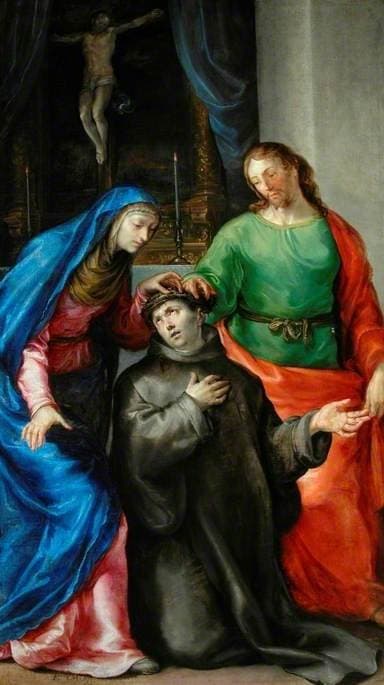
Our Lady and St. John the Evangelist Crowning St. John of God with Thorns, painting by Francisco Camilo, 1653, The Bowes Museum · Public Domain
Why He Matters
John of God shows that a life spent drifting without direction is not disqualified from radical, sudden transformation, and that a single afternoon of profound repentance can be the seed of institutions that still exist five centuries later. He matters to anyone who feels it is too late to change course, and to every hospital worker whose ministry is physical, exhausting, and largely unglamorous.
Virtue for Today
Mercy in Action
Try Today
Give something concrete today — money, time, food, or supplies — directly to someone in need, without overplanning it.
A Life of Wandering
John of God was born João Cidade around 1495 in Montemor-o-Novo, Portugal. According to tradition, he left home around age eight after hearing a visiting priest describe adventures in the newly discovered lands across the Atlantic, and he spent much of the rest of his youth working as a shepherd in Spain. In his late twenties, to avoid an arranged marriage he did not want, he enlisted as a soldier, serving first against the French and later against the Ottoman Turks in Hungary. Military life in that era was often as morally corrosive as it was physically dangerous, and by his own later account, John drifted for years without much direction or discipline, cycling through soldiering, an attempt to ransom Christian captives in North Africa, and finally a modest trade running a religious bookshop in Granada, Spain, once he had settled down in his forties.
A Breakdown and a Sermon
Everything changed in 1537, when John went to hear a sermon by the noted preacher (and future saint) John of Ávila. The sermon on repentance struck him with such overwhelming force that he suffered what witnesses described as a complete breakdown: he tore his clothes, gave away his books and money in the street, and behaved in ways so extreme that he was committed to Granada's Royal Hospital, where mentally disturbed patients of the time were treated with beatings and confinement rather than care. John spent roughly forty days there. Rather than breaking him further, the experience gave him an unforgettable firsthand view of exactly how badly the sick and disturbed were treated by the institutions meant to help them — and, according to tradition, John of Ávila visited him during this time and encouraged him toward a life of active service rather than further self-punishment.
From the Asylum to the Streets
On his release, John began collecting abandoned, sick, and homeless people directly off the streets of Granada, first sheltering them in a rented house and then in progressively larger quarters as the need kept growing. He supported the work by begging publicly, walking the streets at night calling out an appeal that has survived in multiple historical accounts: "Do good to yourselves! For the love of God, Brothers, do good!" He personally carried the sick on his own back when they could not walk, nursed contagious patients others refused to touch, and reportedly ran into a burning hospital to carry patients out one by one when professional help hesitated.
The Brothers Hospitallers
John never became a priest and founded no formal religious rule during his own lifetime; the community that gathered around his example organized itself into the Brothers Hospitallers of St. John of God only after his death, receiving formal papal approval in 1586. He died in Granada on March 8, 1550, reportedly kneeling in prayer, after collapsing from exhaustion following an attempt to rescue a man from a flooding river. He was canonized in 1690. Today the order he inspired but did not formally found operates well over one hundred hospitals across more than fifty countries, and John is honored as patron of hospitals, nurses, the sick, heart patients, alcoholics, the homeless, booksellers, and firefighters.
Helper
Reflection Questions:
- John drifted for decades — as a shepherd, soldier, and bookseller — before one sermon reordered his entire life at nearly middle age. Is it ever too late, in your own view, for a life to change direction completely?
- His breakdown led him into an asylum where he witnessed exactly how badly the sick and disturbed were treated. Has a painful or humiliating experience of your own ever become the source of a deeper compassion for others in the same situation?
- John begged publicly and without embarrassment for the sake of people who could not beg for themselves. What keeps you from asking directly for help, on behalf of someone else, when you know it is needed?
- He carried the sick on his own back rather than only arranging for others to help them. Where in your life do you delegate care that you could, at some real cost, provide yourself?
- John founded no formal religious order himself; his community organized only after his death, built entirely on the example he left behind. What example are you leaving for others to organize around, whether or not you are there to see it?
Short Prayer
“St. John of God, patron of hospitals and the sick, pray for us — that we may do good for others as directly and urgently as you did. Amen.”
Prayer to St. John of God
Prayer to St. John of God St. John of God, you drifted for decades as a shepherd, a soldier, and a bookseller before one sermon broke you open and turned your whole life toward the sick and the abandoned. You begged in the streets without shame, carried the dying on your own back, and ran into danger when professional help hesitated, asking only that people "do good, for the love of God." Pray for every hospital worker exhausted by the sheer physical weight of caring for others, and for anyone who feels their past disqualifies them from a meaningful future. Help us act on mercy immediately, the way you did, rather than waiting until we feel ready or resourced enough to help. St. John of God, pray for us. Amen.
Britannica — "Saint John of God"; Catholic Online — Saints & Angels
Grow closer to God.
Agnioz is here to walk with you.
Register for FREE and unlock more Catholic content, prayers, and reflections to help you become a more enlightened Catholic — FREE FOREVER.


Let's grow together in faith, hope, and love. 🙏