
St. John
of the Cross: The Mystic Who Wrote Poetry in a Prison Cell
1542 – 1591
“In the evening of life, we will be judged on love alone.”
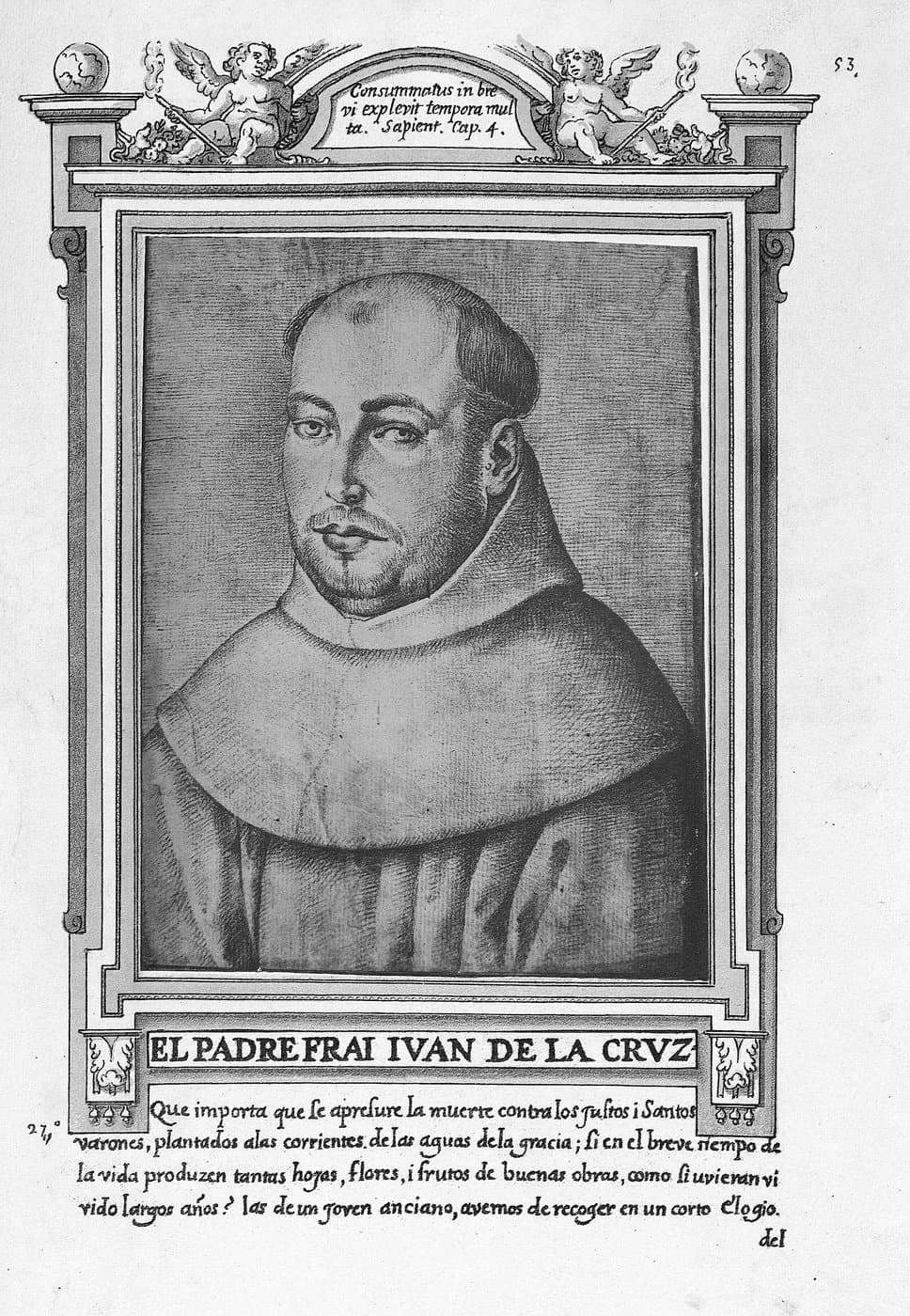
Fray Juan de la Cruz, O.F.M., portrait attributed to Francisco Pacheco, c. 1599 · Public Domain
Why He Matters
John of the Cross turned severe suffering — imprisonment and mistreatment by his own religious brothers — into some of the deepest mystical writing in the Christian tradition. He matters because he shows that periods of spiritual darkness and apparent divine absence can be part of real growth toward God, not evidence that God has abandoned you.
Virtue for Today
Perseverance in Darkness
Try Today
If you are in a difficult or spiritually dry season right now, keep one small faithful practice going today anyway — even without feeling anything from it.
Poverty and Early Hardship
Juan de Yepes y Álvarez was born in 1542 in Fontiveros, in Old Castile, Spain, into a family that had already fallen into poverty; his father, from a family of some means, had been disowned for marrying a woman of lower social standing, and died while John was still a small child, leaving the family in real hardship. John worked as a nursing assistant in a hospital for the poor as a young man while pursuing his education, eventually studying philosophy and theology at the prestigious Carmelite college in Salamanca. He entered the Carmelite order in 1563 and was ordained a priest in 1567.
Partnership with Teresa of Ávila
In 1567, shortly after his ordination, John met Teresa of Ávila (also in this library), already deep into her own effort to reform the Carmelite order back toward its original, stricter observance of poverty and contemplative prayer. Teresa persuaded the young priest to join her reform movement, and together they became co-founders of what became known as the Discalced ("shoeless," referring to their simpler sandals rather than shoes) Carmelites. In 1568, John helped found the first monastery of the reformed friars at Duruelo, adopting a life of unusual austerity even by monastic standards of the time.
Imprisonment by His Own Order
The Carmelite reform was not welcomed by many friars of the older, unreformed observance, who saw it as an implicit and unwelcome criticism of how they were living. In 1577, a group of these friars had John forcibly seized and imprisoned in a monastery in Toledo, holding him in a small, cramped, poorly ventilated cell with little light, subjecting him to public punishment before the community and pressuring him to abandon the reform. He was held for approximately nine months in conditions severe enough to threaten his health.
Poetry From Darkness
It was during this imprisonment, remarkably, that John composed some of his most celebrated poetry, reportedly working out verses in his mind in the dark and writing fragments down when brief opportunities allowed. He eventually escaped in August 1578 by working a lock loose and lowering himself from a window using knotted blankets. The poems and theological commentaries he wrote both during and after this imprisonment — most famously the Dark Night of the Soul and the Spiritual Canticle — describe the soul's difficult, often painful passage through periods of spiritual dryness and apparent divine absence on the way toward deeper union with God, a theme that drew directly on his own lived experience of suffering and abandonment.
Teaching Union With God
After his escape, John continued serving the Discalced reform in various leadership roles, writing extensive theological commentaries on his own poetry that carefully mapped the stages of contemplative prayer and mystical union with God. His writing is marked by an unusual combination of precise theological analysis and genuinely moving poetic imagery, describing the soul's relationship with God in terms of light and darkness, thirst and satisfaction, and the "dark night" that strips away attachment to anything less than God himself.
Doctor of Mystical Theology
John of the Cross died on December 14, 1591, in Úbeda, worn down by illness and, by some accounts, renewed mistreatment from within his own order even near the end of his life. He was canonized in 1726 and declared a Doctor of the Church in 1926, specifically honored for the depth of his teaching on contemplative prayer and mystical union. He remains the patron of contemplatives, mystics, and Spanish-language poets, and the phrase "dark night of the soul" — drawn directly from his writing — has entered common language far beyond Catholic or even religious contexts, as a way of describing any period of profound spiritual darkness endured on the way toward something deeper.
Helper
Reflection Questions:
- John wrote some of his greatest work while imprisoned and mistreated by his own religious brothers, the very community he had given his life to serve. Has betrayal or mistreatment from your own community ever tested your faith, and how did you respond?
- He described the soul's growth as passing through a "dark night" — periods of spiritual dryness that are actually part of drawing closer to God, not a sign of failure. Have you ever mistaken a difficult spiritual season for God's absence, when it may have been part of the process?
- He partnered with Teresa of Ávila on a reform that made him deeply unpopular with powerful people in his own order. What is a difficult but right cause you have avoided because of how unpopular it would make you?
- He continued teaching and writing about union with God even after severe suffering at the hands of fellow believers. What helps you keep your faith intact when people who should have supported you instead hurt you?
- His poetry turned real personal suffering into something that has helped countless others understand their own spiritual struggles centuries later. How might your own hardest experiences become a source of help for someone else facing something similar?
Short Prayer
“St. John of the Cross, pray for us — that we may trust God even in spiritual darkness, and grow deeper through it rather than giving up. Amen.”
Prayer to St. John of the Cross
Prayer to St. John of the Cross St. John of the Cross, you were imprisoned and mistreated by your own religious brothers for trying to reform your order toward greater fidelity, and in that darkness you wrote some of the most beautiful testimony to God's love the Church has ever received. You taught that periods of spiritual dryness and apparent absence are not necessarily signs of failure, but can be part of the soul's real growth toward God. Pray for us in our own dark seasons, when God feels distant and faith feels difficult to sustain. Help us keep going faithfully even without comfort or feeling, trusting, as you did, that we will ultimately be judged on love alone. St. John of the Cross, pray for us. Amen.
Encyclopaedia Britannica, "Saint John of the Cross"; John of the Cross, Dichos de luz y amor (Sayings of Light and Love)
Grow closer to God.
Agnioz is here to walk with you.
Register for FREE and unlock more Catholic content, prayers, and reflections to help you become a more enlightened Catholic — FREE FOREVER.


Let's grow together in faith, hope, and love. 🙏