
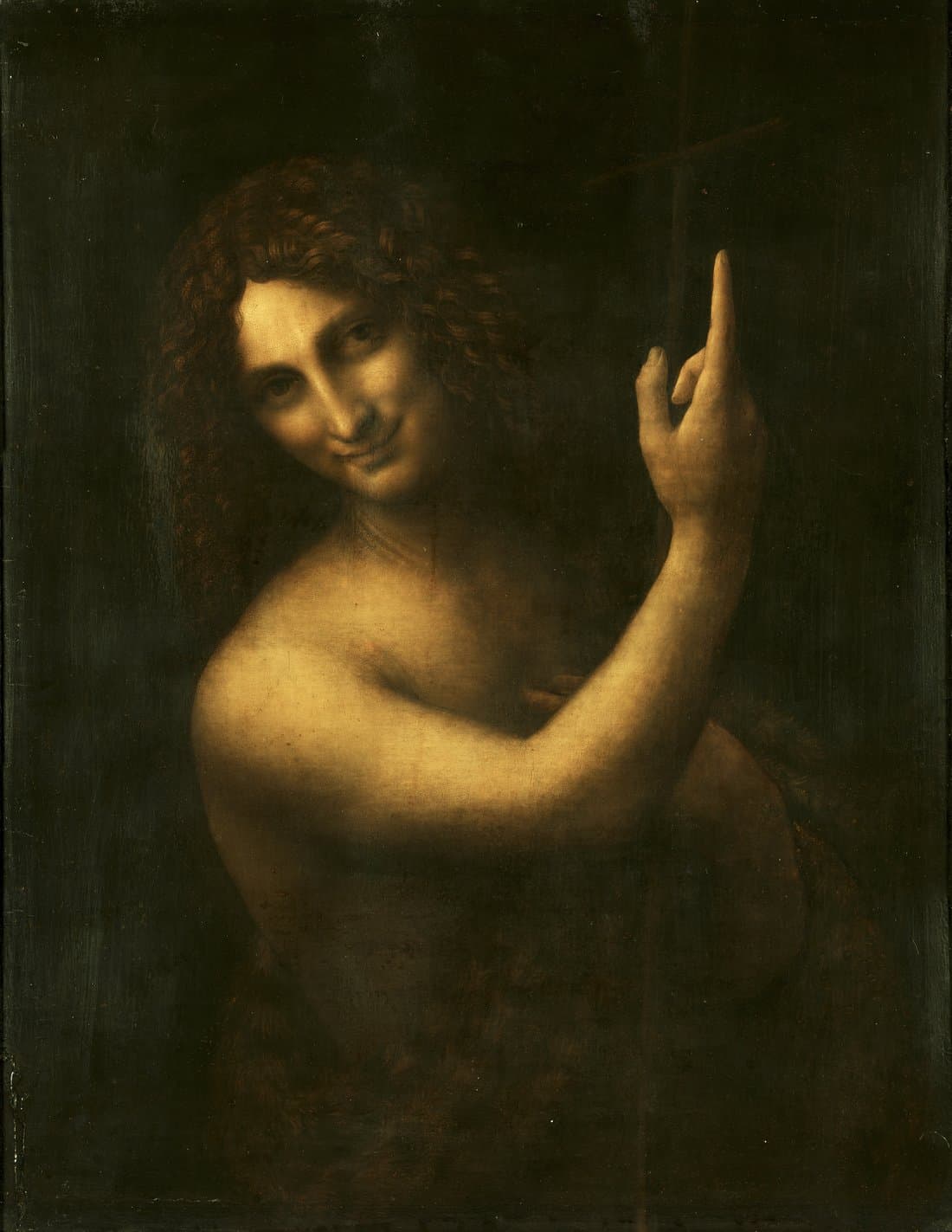
St. John the Baptist: The Voice That Had to Decrease
“He must increase, but I must decrease. — John 3:30”
Saint John the Baptist, Leonardo da Vinci, c. 1513–1516, Musée du Louvre · Public Domain
Why He Matters
John the Baptist shows that prophetic courage and radical humility are not opposites — he confronted a king's sin publicly and still insisted his own role was only to point toward someone greater than himself.
Virtue for Today
Humility joined to courage — decreasing so that Christ could increase, even at the cost of his own life.
Try Today
Point credit or attention toward someone else's good work today instead of your own, and if a hard truth needs saying in your circle, say it gently but plainly.
A Voice Crying in the Wilderness
Before there was a public ministry of Jesus, there was John — his cousin, six months older, born to elderly parents, Zechariah and Elizabeth, in a birth so unexpected that Zechariah lost his own speech for doubting the angel who announced it (Luke 1:5-25). John grew up and, when the time came, went not to a synagogue or the Temple but out into the desert along the Jordan River, preaching a stark, unadorned message: "Repent, for the kingdom of heaven is at hand" (Matthew 3:2).
He described his own role in the plainest possible terms, quoting the prophet Isaiah about himself without hesitation: "I am the voice of one crying in the wilderness, make straight the way of the Lord" (John 1:23). He was not the message. He was insistent, almost aggressively so, about being merely the announcement of it — dressed in camel's hair, eating locusts and wild honey, drawing crowds from Jerusalem and all Judea who came out to be baptized and confess their sins (Matthew 3:4-6).
The Baptism That Named the Lamb of God
The turning point of John's ministry is also one of the most theologically loaded moments in all four Gospels: the day Jesus himself came to the Jordan to be baptized. John recognized who was standing in front of him and initially refused — "I need to be baptized by you, and do you come to me?" (Matthew 3:14) — before relenting at Jesus's own insistence that it was fitting "to fulfill all righteousness." At that baptism, John became the one who first publicly identified Jesus's true nature: "Behold, the Lamb of God, who takes away the sin of the world!" (John 1:29), a title that has echoed through every Catholic Mass ever offered since.
He Must Increase, I Must Decrease
As Jesus's own ministry grew and his disciples began outnumbering John's, some of John's own followers came to him, visibly uneasy, reporting that "all are going to him" (John 3:26) — as though Jesus's rising popularity were a problem to be managed or resented. John's answer is one of the clearest statements of humility in Scripture, and arguably the single sentence that defines his entire life's meaning: "He must increase, but I must decrease" (John 3:30). He had spent his whole ministry pointing away from himself. Watching the crowds finally look where he had been pointing was not, for John, a loss. It was the entire point.
A King's Guilty Conscience
John's directness did not stop at doctrine. He confronted Herod Antipas, the regional ruler of Galilee, publicly and repeatedly for unlawfully taking Herodias, his own brother Philip's wife, as his own (Mark 6:17-18). This was not a private pastoral rebuke offered quietly; it was public prophetic confrontation of a ruler's sin, delivered by a man with no political position or protection of his own. Herod had John arrested and imprisoned — though Mark's Gospel adds a striking detail: Herod himself "feared John, knowing that he was a righteous and holy man... and he heard him gladly" (Mark 6:20). Herodias, unlike her husband, held no such ambivalence. She wanted John dead, and simply lacked the opportunity — until a birthday party gave her one.
A Dance, an Oath, and a Head on a Platter
At a banquet celebrating his own birthday, Herod watched Herodias's daughter dance, and, delighted, made a reckless public oath in front of his assembled guests: he would give her whatever she asked, up to half his kingdom. Prompted by her mother, the girl asked for the head of John the Baptist, delivered immediately, on a platter (Mark 6:21-25). Mark tells us plainly that the request "made the king exceedingly sorry," but that Herod granted it anyway — not out of any change of heart about John's guilt or innocence, but "because of his oaths and his guests," unwilling to look weak or foolish in front of the people he was trying to impress (Mark 6:26). John was beheaded in prison, and his head brought to the girl on the spot.
His own disciples came afterward, took his body, and buried it — and then went and told Jesus (Matthew 14:12), who withdrew alone by boat upon hearing the news, a rare moment of Jesus's own grief recorded plainly in the Gospels.
The Church's Second Birthday for a Saint
The Church keeps two separate feasts for John the Baptist, an honor given to almost no one else in the calendar besides Jesus and Mary: his Nativity on June 24, and this memorial of his Passion, his martyrdom, on August 29. That double observance is itself a kind of tribute to what Jesus said of him during his lifetime: "among those born of women there has arisen no one greater than John the Baptist" (Matthew 11:11) — a prophet whose whole life, from a mute father's unexpected joy to a tyrant's reluctant oath, pointed at every turn toward someone other than himself.
Helper
Reflection Questions:
- John said, "He must increase, but I must decrease," without apparent bitterness. Where in your own life is God asking you to step back so someone or something else can rightly take the spotlight?
- John confronted Herod's sin publicly, at real personal cost, rather than staying safely silent. Is there a truth in your own circle of influence that you've avoided naming because it would be costly to say?
- Herod feared John, respected him, even "heard him gladly" — and still let him be killed rather than look weak in front of his guests. Where has the fear of looking foolish or losing face led you to compromise something you knew was right?
- Jesus withdrew to grieve when he heard of John's death. Do you allow yourself real grief over loss, or do you rush past it toward the next task?
Short Prayer
“St. John the Baptist, voice in the wilderness, help me decrease so that Christ may increase in my life, whatever that costs me today. Amen.”
Prayer to St. John the Baptist
St. John the Baptist, greatest of those born of women, you spent your whole life pointing toward Christ and never toward yourself, confronting sin in a king's own palace though it cost you your head. Obtain for me your same courage to speak truth when it is costly, and your same humility to step back gladly when the attention rightly belongs to another. Teach me that a decreased self, offered fully to God, is never a diminished one. Amen.
Grow closer to God.
Agnioz is here to walk with you.
Register for FREE and unlock more Catholic content, prayers, and reflections to help you become a more enlightened Catholic — FREE FOREVER.


Let's grow together in faith, hope, and love. 🙏