
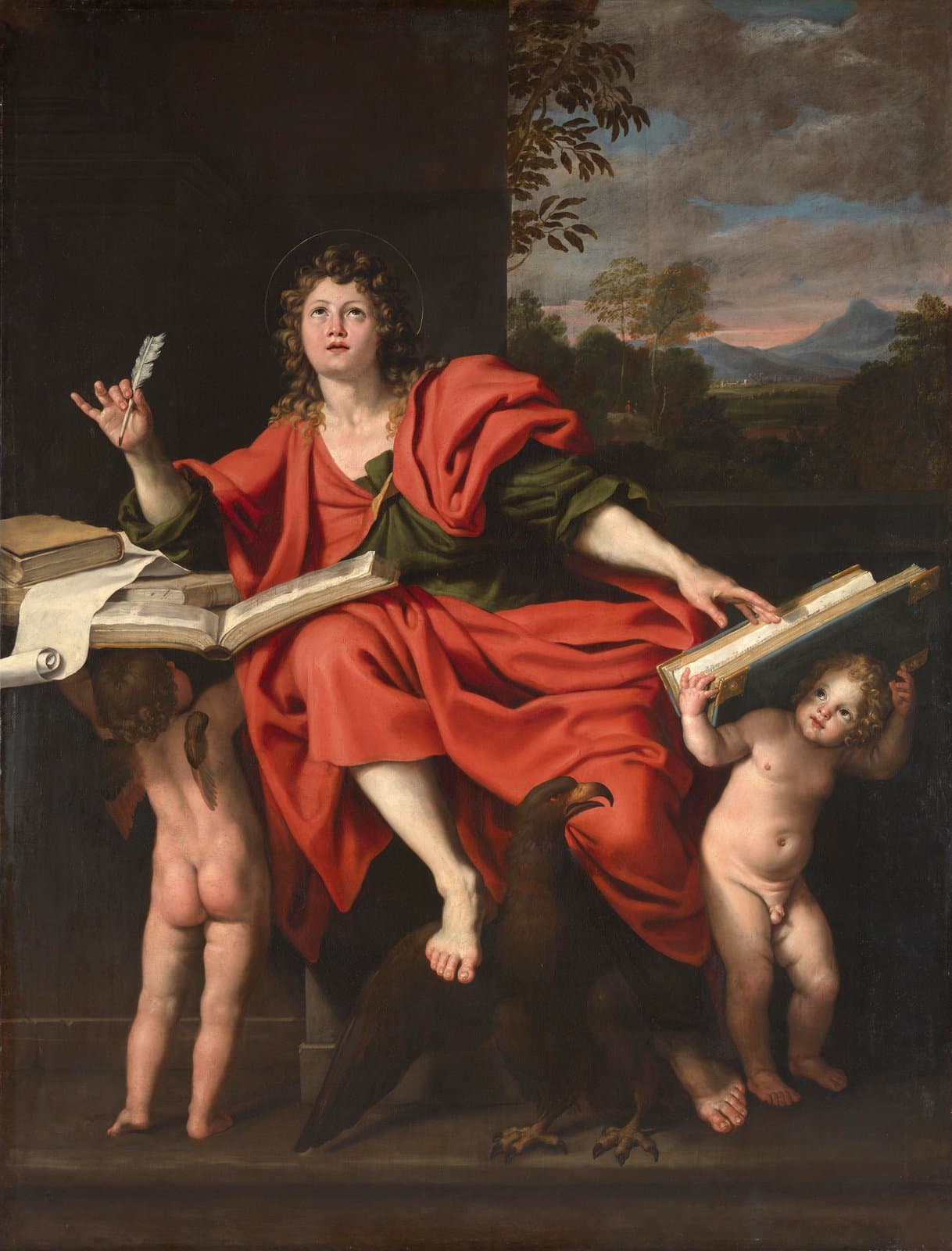
Saint John the Evangelist, painting by Domenichino, c. 1624–1629 · Public Domain (PD-old-100-expired)
Why He Matters
John shows that closeness to Christ — staying present through suffering rather than fleeing it — reshapes an entire life and its teaching. His insistence that "God is love" remains one of the most quoted and foundational lines in Christian Scripture, and his Gospel offers the most theologically distinct account of who Jesus is among the four.
Virtue for Today
Contemplative Love
Try Today
Reread 1 John 4:7-8 slowly today, and let it shape one decision you make.
A Son of Zebedee
John was a fisherman on the Sea of Galilee, called by Jesus alongside his brother James and their father Zebedee. Jesus nicknamed the brothers Boanerges, "Sons of Thunder" (Mark 3:17), a hint of the intensity that also once led John to ask Jesus whether he should call down fire on a village that had refused them hospitality (Luke 9:54). Along with Peter and James, John belonged to the inner circle of three disciples present at the Transfiguration, at the raising of Jairus's daughter, and in Gethsemane during Jesus's agony before his arrest — witnessing more of Jesus's life up close than almost anyone else who followed him.
The Disciple Whom Jesus Loved
In his own Gospel, John never names himself directly, referring to himself instead as "the disciple whom Jesus loved" — reclining next to Jesus at the Last Supper, close enough to lean back and ask him who would betray him (John 13:23-25). Of the Twelve, only John is recorded as present at the crucifixion itself; the others had scattered in fear. From the cross, Jesus looked down at John and at his own mother, Mary, and said, "Woman, behold your son," then to John, "Behold your mother" — entrusting his mother's care to him from that hour (John 19:26-27). When Mary Magdalene reported the empty tomb, it was John who outran Peter to reach it first, looked in, and "believed" (John 20:8).
Writings That Shaped Christian Theology
Tradition and long-standing Church attribution credit John with writing the Gospel that bears his name — theologically the most distinct of the four Gospels, opening not with a genealogy or a birth narrative but with "In the beginning was the Word" (John 1:1) — as well as three New Testament epistles. His first epistle contains one of Scripture's most quoted definitions of God: "God is love" (1 John 4:8), a theme that runs through nearly everything attributed to him. Church tradition also credits him with the Book of Revelation, written during a period of exile on the small island of Patmos under the persecution of the emperor Domitian, recording a series of visions concerning the end of the age and the ultimate triumph of Christ.
The Only Apostle to Die of Old Age
Ancient tradition, recorded by writers including Tertullian, holds that John survived an attempt on his life in Rome — thrown into a vat of boiling oil and emerging unharmed — before being exiled to Patmos. After his eventual release, he is believed to have settled in Ephesus, leading the Christian community there into extreme old age. Unlike every other apostle, whom tradition records as martyred, John is the only one believed to have died a natural death, reportedly around AD 100.
The Apostle of Love
John's writing is remembered above all for its insistence that love is not simply one Christian virtue among others but the very definition of who God is and what following Christ requires. Having stood at the cross when almost everyone else ran, and having been given the singular trust of caring for Jesus's own mother, he spent his long life writing and teaching from that same place of nearness.
Helper
Reflection Questions:
- John stayed at the foot of the cross when most of the other disciples had fled. What makes it hard for you to stay present with someone who is suffering, rather than retreating from discomfort?
- Jesus entrusted John with the care of his own mother in his final moments. Is there a responsibility someone has trusted you with that deserves more attention than you're currently giving it?
- John's writing keeps returning to one central claim: that God is love. Does your own understanding of God feel more defined by love, or by fear and obligation?
- He ran to the empty tomb and "believed" before fully understanding what the resurrection meant. Where might belief need to come before full understanding in your own life?
- Tradition holds he spent his final years in Ephesus, still teaching in extreme old age. What would it look like to keep serving faithfully into whatever "old age" — literal or figurative — you're currently in?
Short Prayer
“St. John, beloved disciple, pray for us — that we may stay near Christ in both joy and suffering, as you did. Amen.”
Prayer to St. John the Evangelist
Prayer to St. John the Evangelist St. John, you alone among the apostles stood at the foot of the cross, refusing to flee even when it was dangerous to be seen there, and you were entrusted in that moment with the care of Christ's own mother. Your writing returns again and again to a single truth: that God is love, and that anyone who does not love does not know God. Pray for us when fear tempts us to distance ourselves from someone who is suffering. Help us stay present the way you stayed present, and let that same conviction — that God is love — shape not just what we believe but how we treat the people in front of us. St. John, pray for us. Amen.
New Testament (Gospel of John; 1–3 John; Revelation); Catholic Encyclopedia (New Advent), "St. John the Evangelist"
Grow closer to God.
Agnioz is here to walk with you.
Register for FREE and unlock more Catholic content, prayers, and reflections to help you become a more enlightened Catholic — FREE FOREVER.


Let's grow together in faith, hope, and love. 🙏