St. Josephine Bakhita: From Enslavement to Freedom in Christ
1869 – 1947
“If I were to meet those slave traders who kidnapped me and even those who tortured me, I would kneel and kiss their hands, for if that did not happen, I would not be a Christian and religious today.”
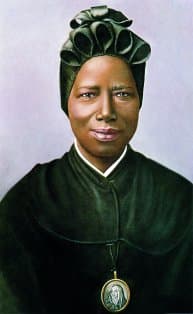
St. Josephine Bakhita, portrait photograph via the Institute of the Canossian Daughters of Charity (Vatican.va), photographer unknown, early 20th century · Public Domain
Why She Matters
Bakhita survived twelve years of slavery and chose forgiveness over bitterness, finding in the Catholic faith a freedom deeper than her legal emancipation. She is a living rebuke to despair and a patroness for the millions still trapped in human trafficking today.
Virtue for Today
Forgiveness
Try Today
Look up a reputable local or national organization fighting human trafficking and learn one concrete way to support their work.
Josephine Bakhita was born around 1869 in the village of Olgossa in the Darfur region of Sudan, into the Daju people; her uncle was a local tribal chief. She was around seven or eight years old when Arab slave traders kidnapped her — the trauma was so severe that she forgot her own birth name, and "Bakhita," meaning "fortunate" in Arabic, was a name given to her by her captors, one of grim irony rather than truth.
Twelve Years of Slavery
Over the following twelve years, Bakhita was bought, sold, and given away at least a dozen times, forced to walk hundreds of miles between markets and owners across Sudan. She suffered severe abuse, including a practice in which one of her owners had her body ritually scarred — cut more than a hundred times and packed with salt to make the wounds scar permanently, a mutilation she carried on her body for the rest of her life. In her own later account, she said she had by then almost forgotten how to feel, treating pain and abuse as an ordinary condition of existence rather than an injustice against her.
An Italian Family, and the Canossian Sisters
In 1883, an Italian vice consul, Callisto Legnani, purchased Bakhita, and treated her with a degree of ordinary human kindness she had not experienced in years. When Legnani returned to Italy, Bakhita went with the family and was eventually given to another Italian family, the Michielis, as a nanny for their daughter. When the Michielis needed to travel and left Bakhita and their daughter for a time with the Canossian Sisters of Charity in Venice, Bakhita first encountered the Catholic faith and, through the sisters, came to understand God for the first time as someone who had known and loved her through every part of her suffering.
Freedom, Twice Over
When the Michielis returned to reclaim Bakhita, she refused to leave the convent. The dispute went to an Italian court, which ruled in 1889 that slavery had never been legally recognized in Italy or in Sudan under the treaties in force at the time of Bakhita's birth, meaning she had never lawfully been anyone's property — she was declared unconditionally free. She chose to remain with the Canossian Sisters, was baptized in 1890, taking the name Josephine, and entered the religious congregation in 1893, making her final vows in 1896.
A Quiet Later Life
Josephine Bakhita spent most of the rest of her life as a Canossian sister in Schio, Italy, working primarily as the convent's cook, doorkeeper, and a gentle, well-loved presence known locally as "Sor Moretta" ("our black sister"). She spoke publicly at times about her enslavement to support the congregation's missionary work, and consistently expressed forgiveness toward those who had enslaved and abused her, saying that if she met them again she would kneel and kiss their hands, because without that suffering she would never have come to know Christ. She died on February 8, 1947, and was canonized by Pope John Paul II on October 1, 2000 — the first canonized saint from modern Sudan, and a particular patroness invoked for victims of human trafficking.
Helper
Reflection Questions:
- Bakhita said she had nearly forgotten how to feel her own suffering as an injustice, having lived with it so long. Is there a pain in your life you have simply gotten used to, rather than named honestly?
- She chose, through an Italian court, actual legal freedom — and then chose it again spiritually, entering religious life. What is the difference in your own life between being technically free and actually living free?
- Bakhita explicitly forgave the people who tortured and enslaved her, saying it was through that suffering she came to know Christ. Is there someone you are withholding forgiveness from, even while claiming to have moved on?
- She spent decades doing quiet, ordinary convent work — cooking, answering the door — after a life of extraordinary trauma. What does faithfulness in small, unremarkable tasks look like for you right now?
- She is now a patroness for victims of human trafficking, a crime that still exists today. What is one way you could support anti-trafficking work in your own community?
Short Prayer
“St. Josephine Bakhita, pray for us — that we may forgive as completely as you did, and work for the freedom of all who are enslaved today. Amen.”
Prayer to St. Josephine Bakhita
Prayer to St. Josephine Bakhita St. Josephine Bakhita, you endured twelve years of slavery and cruelty that scarred your body for life, and yet you came to say that you would kiss the hands of those who hurt you, because it was through that suffering that you found Christ. Pray for us when we cling to bitterness over far smaller wounds. Pray especially for everyone today who is trafficked, enslaved, or exploited, that they would find both earthly freedom and the deeper freedom you discovered in God. Teach us to see every person's dignity as inviolable, no matter how the world has treated them. St. Josephine Bakhita, pray for us. Amen.
Vatican.va — Homily of Pope John Paul II at the Canonization of Josephine Bakhita, October 1, 2000; Franciscan Media — "St. Josephine Bakhita"
Grow closer to God.
Agnioz is here to walk with you.
Register for FREE and unlock more Catholic content, prayers, and reflections to help you become a more enlightened Catholic — FREE FOREVER.


Let's grow together in faith, hope, and love. 🙏