
St. Junípero Serra: The Apostle
of California, and a Contested Legacy
1713 – 1784
“Siempre adelante, nunca para atrás. (Always forward, never turn back.)”
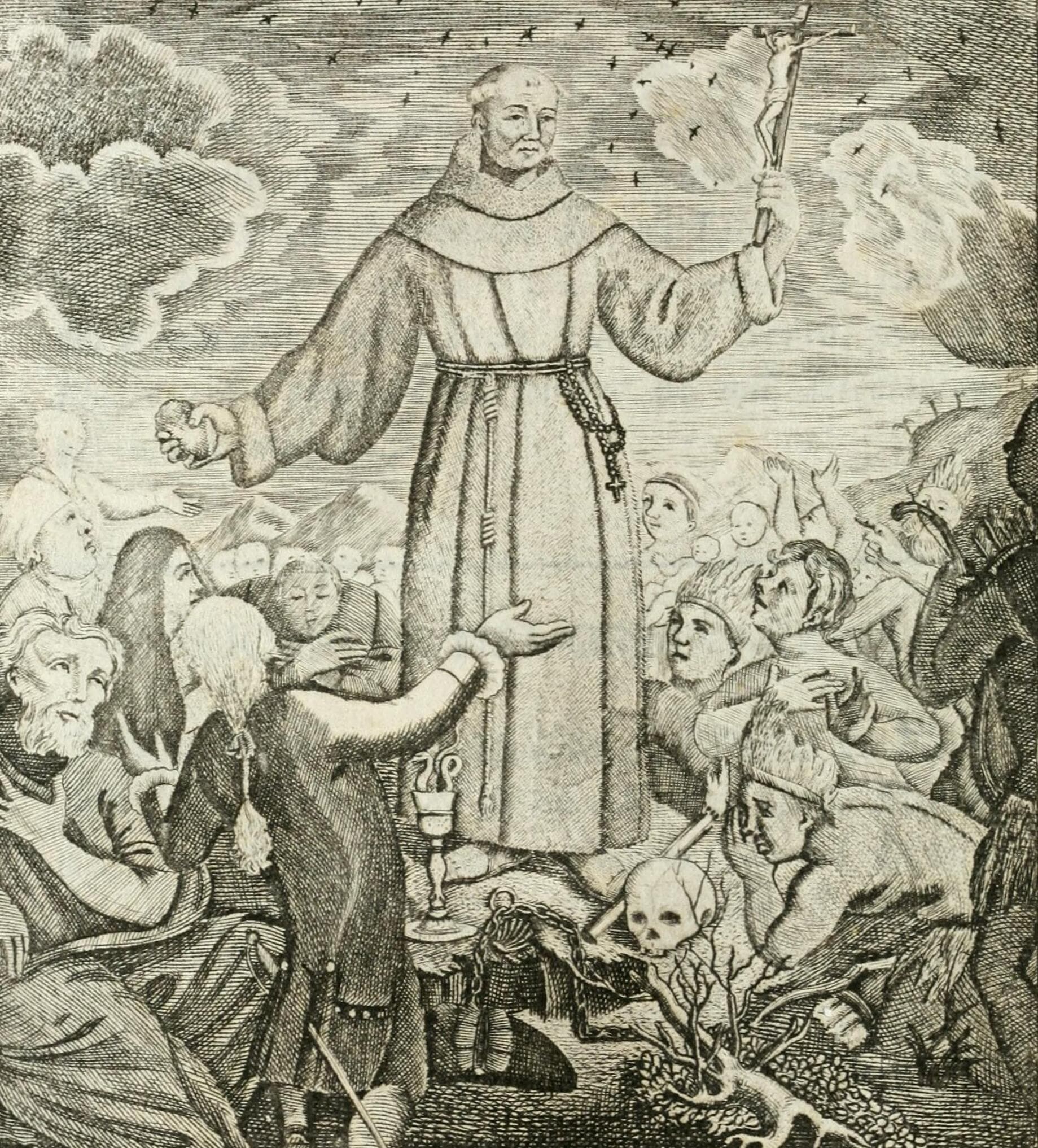
St. Junípero Serra, engraving from Francisco Palóu's "Relación Histórica," unknown engraver, 1787 · Public Domain
Why He Matters
Serra's life combines genuine missionary sacrifice with real, documented harm to the Native peoples he set out to evangelize — a legacy the Church honors for its holiness of intent while historians and Native communities today continue, rightly, to hold it to honest account.
Virtue for Today
Perseverance
Try Today
Read a source on the California missions written from a Native Californian perspective today, and sit honestly with what you learn.
Miquel Josep Serra i Ferrer was born on November 24, 1713, in Petra, on the Spanish island of Mallorca, to a farming family. He entered the Franciscan order at sixteen, taking the name Junípero, and went on to earn a doctorate in philosophy and to teach at the Lullian University in Palma, where by his mid-thirties he held a respected academic chair. In 1749, at age thirty-five, he gave up that settled academic position to volunteer as a missionary in Spain's American territories, writing to his parents a line that became his personal motto: "Siempre adelante, nunca para atrás" — "Always forward, never turn back."
Missionary in New Spain
Serra spent nearly two decades working as a missionary in the Sierra Gorda region of central Mexico before being assigned, in 1767, to lead the Franciscan missionary effort into Alta California following the Spanish Crown's expulsion of the Jesuits from its territories. Beginning in 1769, Serra founded the first of what would become twenty-one Spanish missions along the California coast, personally establishing nine of them — including Mission San Diego de Alcalá, Mission San Carlos Borromeo de Carmelo (which became his headquarters and burial place), and Mission San Francisco de Asís — before his death.
Method and Motive
Serra's own stated purpose was the conversion and salvation of California's Native peoples, and by the accounts of his contemporaries and his own writings, he pursued that goal with genuine personal austerity and physical hardship, walking enormous distances on a permanently injured leg and eating little. He is also documented, by his own and others' contemporary accounts, to have supported corporal punishment — including flogging — for baptized Native residents who left the missions or violated mission rules, practices defended at the time as standard paternal discipline but now widely recognized as coercive and abusive.
A Genuinely Contested Legacy
Serra's legacy is a matter of real, ongoing disagreement among serious historians, not simply a dispute between defenders and detractors talking past each other. His supporters point to his personal sacrifice, his documented interventions on behalf of Native people against abusive Spanish soldiers, and the era's near-universal colonial practices, which Serra did not invent and in some instances actively pushed back against. His critics — including many Native Californian communities today — point to the missions' role in disrupting and often destroying existing Indigenous cultures and autonomy, the coercive and sometimes violent discipline within mission life, and catastrophic Native population decline from introduced diseases that spread rapidly in the crowded mission settlements, regardless of intent. Both sets of facts are documented, and thoughtful historians, including many Catholic ones, generally caution against a purely heroic or purely villainous reading of his life. His 2015 canonization by Pope Francis, at a Mass in Washington, D.C., was itself accompanied by public protest from Native American groups and renewed historical debate that continues today.
Death and Canonization
Serra died on August 28, 1784, at Mission San Carlos Borromeo de Carmelo, and was buried there. He was beatified in 1988 and canonized by Pope Francis on September 23, 2015 — the first canonization to take place on United States soil. The Church's stated basis for his sainthood is his personal holiness and missionary zeal in bringing the Gospel to California, a judgment that does not require, and has not received, universal agreement about the full consequences of the missions he founded.
Helper
Reflection Questions:
- Serra gave up a comfortable academic career for a much harder missionary life. What comfortable, settled path might God be asking you to leave for something harder but more meaningful?
- His legacy includes both real personal sacrifice and real participation in coercive, harmful practices. How do you hold space for both the good and the harm a single person can cause, without collapsing the story into only one or the other?
- Serra's canonization was met with genuine, informed protest from people directly connected to the communities his missions affected. How do you respond when people you respect disagree sharply about whether someone deserves honor?
- His personal motto was "always forward, never back." Where in your life does that kind of relentless forward motion serve you well — and where might it have kept him, or you, from stopping to reconsider a harmful method?
- Serra intervened at times on behalf of Native people against abusive soldiers, even while supporting corporal punishment within the missions himself. What does it look like to hold yourself to a genuinely consistent standard, rather than a convenient one?
Short Prayer
“St. Junípero Serra, pray for us — that our zeal for good would always be paired with real humility toward the people we serve. Amen.”
Prayer to St. Junípero Serra
Prayer to St. Junípero Serra St. Junípero Serra, you left a comfortable, settled life to carry the Gospel across an ocean and a continent, walking on an injured leg to found missions up and down the California coast. Your story also includes real harm to the Native peoples you meant to serve, harm the Church does not ask us to excuse or forget. Pray for us that our own zeal, however well-intentioned, would never become an excuse for treating other people as means to our purposes rather than as full image-bearers of God. Pray for the Native peoples of California, past and present, and for honest healing between the Church and the communities its missionaries did not always serve well. St. Junípero Serra, pray for us. Amen.
NPR — "Native Americans Protest Canonization of Junípero Serra"; National Catholic Reporter — "Junípero Serra: saint or not?"; Vatican.va — Canonization Mass homily of Pope Francis, September 23, 2015

Grow closer to God.
Agnioz is here to walk with you.
Register for FREE and unlock more Catholic content, prayers, and reflections to help you become a more enlightened Catholic — FREE FOREVER.


Let's grow together in faith, hope, and love. 🙏