St. Kateri Tekakwitha: The Lily
of the Mohawks
1656 – 1680
“Who will teach me what is most agreeable to God, that I may do it?”
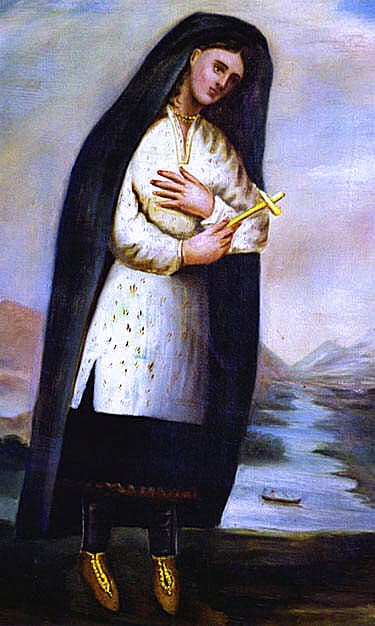
St. Kateri Tekakwitha, painting by Fr. Claude Chauchetière, S.J., c. 1696 · Public Domain
Why She Matters
Kateri Tekakwitha shows that following Christ does not require abandoning one's own people or heritage, even when that path is misunderstood by those closest to you. As the first Native American saint, she stands as a bridge between Indigenous identity and Catholic faith.
Virtue for Today
Steadfastness
Try Today
Learn about the Native or Indigenous history of the land you live on today.
Kateri Tekakwitha was born around 1656 in the Mohawk village of Ossernenon, near present-day Auriesville, New York, to a Mohawk father and a Christian Algonquin mother who had been captured and adopted into the tribe. When Kateri was about four years old, a smallpox epidemic swept through the village, killing her parents and younger brother and leaving her badly scarred and with permanently damaged eyesight. She was raised afterward by an aunt and an uncle who had become a Mohawk chief.
Hidden Faith
Kateri's mother had raised her, quietly, with some knowledge of Christian prayer before her death, and Jesuit missionaries — the "Black Robes" — periodically visited or passed through Mohawk territory. Kateri was drawn to the faith from a young age but faced real resistance from her own family and community, who saw growing Christian influence as a threat to Mohawk tradition and were also wary of the diseases and disruption that had followed European contact. She was baptized on Easter Sunday, 1676, at about twenty years old, taking the name Catherine — rendered "Kateri" in Mohawk — after St. Catherine of Siena.
Persecution and Flight
Her conversion brought real consequences. She faced ridicule, threats, and reportedly physical harassment from people in her own village who viewed her new faith as a betrayal. In 1677, with the help of a Christian relative and a sympathetic missionary, Kateri fled roughly two hundred miles on foot and by canoe to the Jesuit mission of Sault Saint-Louis (Kahnawake) near present-day Montreal, a community of Christian Mohawk and other Native converts. There she was finally free to practice her faith openly.
A Short, Intense Religious Life
At Kahnawake, Kateri embraced a life of prayer and self-denial that impressed even the missionaries who knew her, including significant fasting and penance in keeping with the ascetic spiritual practices common to the era. She took a vow of perpetual virginity in 1679, an unusual and difficult choice within her community's expectations for women, and devoted herself to caring for the sick and elderly. Her health, always fragile from childhood smallpox, declined further, and she died on April 17, 1680, at about twenty-four years old. Witnesses reported that the scars on her face seemed to visibly clear in the minutes after her death — an account central to her early veneration, though not itself a claim the Church requires anyone to accept as fact.
Canonization
Devotion to Kateri as "Lily of the Mohawks" grew steadily over the following centuries among both Native and non-Native Catholics in North America. She was declared venerable in 1943, beatified in 1980, and canonized by Pope Benedict XVI on October 21, 2012, becoming the first Native American recognized as a saint. Her canonization miracle involved the healing of a young boy in Washington State from a severe flesh-eating bacterial infection. She is now honored as a patroness of Native peoples, ecology, and those living with chronic illness.
Helper
Reflection Questions:
- Kateri's family and community actively opposed her conversion, seeing it as a threat to their way of life. Have you ever held a conviction that put you at odds with people you loved? How did you handle it?
- She walked roughly two hundred miles to find a place where she could practice her faith freely. What would you be willing to give up — comfort, relationships, familiarity — to live your convictions honestly?
- Her physical suffering, from childhood smallpox onward, was lifelong and severe, yet it did not become the center of her story; her faith did. How do you let suffering shape you without letting it define you entirely?
- Kateri devoted much of her short adult life to caring for the sick and elderly in her new community. Who in your life right now needs that kind of practical, ordinary care?
- She is honored today by both Native and non-Native Catholics as a bridge between cultures. Where might you be called to be a bridge, rather than forcing someone to choose between two parts of who they are?
Short Prayer
“St. Kateri Tekakwitha, Lily of the Mohawks, pray for us — that we may follow Christ with courage, whatever it costs us. Amen.”
Prayer to St. Kateri Tekakwitha
Prayer to St. Kateri Tekakwitha St. Kateri, you were orphaned and disfigured as a small child, and still you found your way to a faith that your own community did not understand, walking two hundred miles to practice it freely. You cared for the sick and the old with a tenderness that came from your own long experience of suffering. Pray for us when living our convictions honestly puts us at odds with people we love. Help us hold on to our roots and our faith together, rather than being forced to choose, and give us your steadfastness in seeking, always, what is most agreeable to God. St. Kateri, pray for us. Amen.
Britannica — "Saint Kateri Tekakwitha"; Vatican.va — Canonization homily of Pope Benedict XVI, October 21, 2012
Grow closer to God.
Agnioz is here to walk with you.
Register for FREE and unlock more Catholic content, prayers, and reflections to help you become a more enlightened Catholic — FREE FOREVER.


Let's grow together in faith, hope, and love. 🙏