
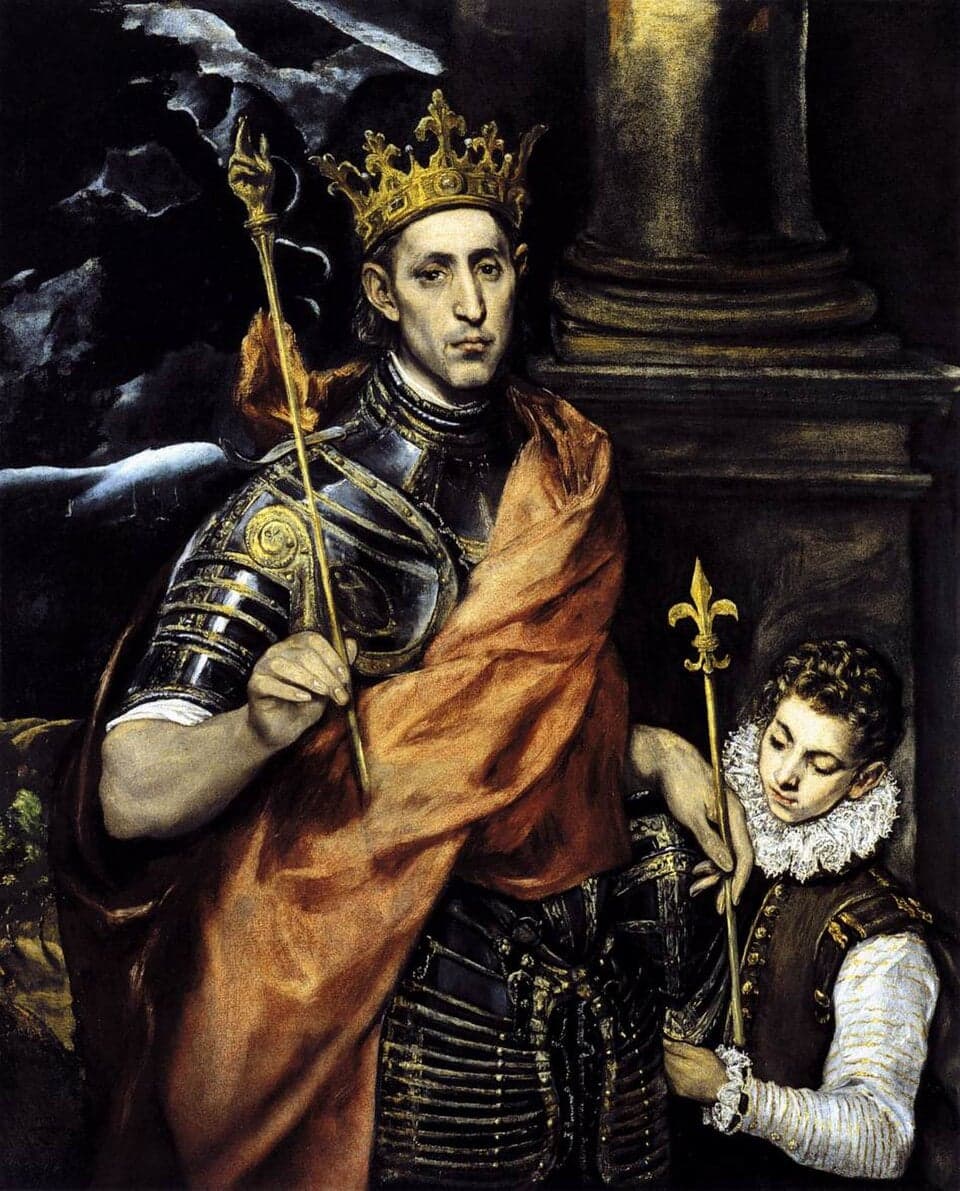
St. Louis IX: The King Who Judged Under an Oak Tree
1214 – 1270
“Dear son, the first thing I would teach you is to set your heart to love God.”
Why He Matters
St. Louis IX shows that real power, even absolute medieval kingship, can be spent in the service of justice and the poor rather than self-interest — a rare and demanding model for anyone who holds authority over others.
Virtue for Today
Justice tempered by mercy — using whatever power or influence you hold on behalf of people who have no way to repay you.
Try Today
Do one concrete act of justice or mercy today for someone who cannot repay you or advance your own interests in any way.
A King Crowned at Twelve
Louis IX became King of France in 1226 at only twelve years old, after his father Louis VIII died suddenly on campaign. For nearly a decade the real governing power belonged to his mother, Blanche of Castile, a formidable regent who is often credited with shaping the conscience of the boy who would become one of the most admired rulers in medieval Christendom. Blanche is said to have told her son bluntly that she would rather see him dead than see him commit a single mortal sin — a hard line for a mother to take, but one Louis apparently absorbed and carried with him for the rest of his life.
He took full control of the kingdom around 1234 and married Margaret of Provence that same year, eventually raising eleven children with her while ruling one of the most powerful kingdoms in Europe for over four decades.
Justice Under an Oak Tree
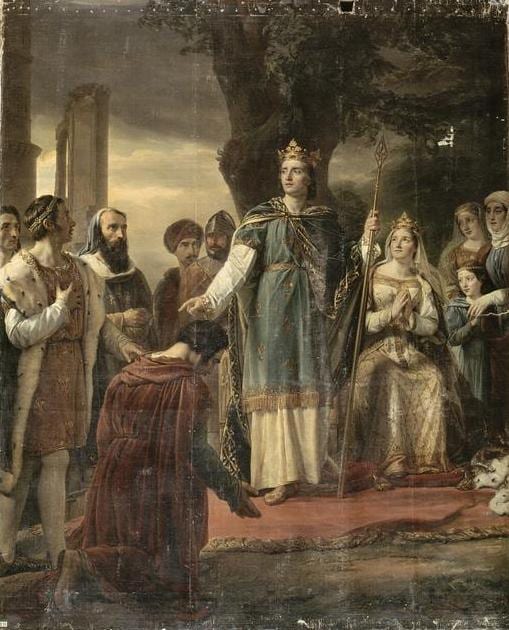
The image most closely associated with Louis IX is not a throne room but a tree. He was known to sit personally beneath an oak tree in the forest of Vincennes, near Paris, where any subject — noble or peasant — could bring him a grievance directly and receive a judgment on the spot, without the delay, expense, or intimidation of formal court proceedings. This was not a symbolic gesture performed occasionally for effect; contemporary accounts describe it as a regular practice, central to how Louis understood his own office.
He backed the practice with real legal reform: he worked to curb trial by combat — the medieval custom of settling disputes through duels — in favor of evidence and testimony, expanded the right of royal subjects to appeal unjust local rulings directly to the crown, and pursued anti-corruption investigations into his own regional officials, sending royal inspectors to root out abuse of power by the very administrators working in his name. For a medieval monarch, whose word was ordinarily close to unquestionable law, this was a genuinely unusual use of absolute power: spending it to make himself more accountable, not less.
A Crown of Thorns and a Chapel of Light
Louis's devotion had a dramatic material expression as well. In 1239, he acquired what was venerated as Christ's own Crown of Thorns from the financially desperate Latin Emperor of Constantinople, paying a sum so enormous — by some estimates nearly half his kingdom's annual royal revenue — that it stunned his own court. He is said to have walked the final stretch into Paris barefoot, in a simple tunic, personally carrying the relic into the city, a king making himself, quite visibly, the lowest person in his own procession.
To house it properly, he built the Sainte-Chapelle in Paris, still standing today — a chapel whose soaring stained-glass walls remain one of the most breathtaking achievements of Gothic architecture, built not as a monument to Louis's own power but explicitly as a reliquary, a jewel box constructed around an object of devotion rather than around the king who commissioned it.
Friend to the Poor and the Leper
Louis's court chronicler and close friend, Jean de Joinville, left detailed firsthand accounts of a king who fed the poor at his own table, sometimes serving them himself, and who deliberately sought out and ate with people afflicted with leprosy — a disease so feared in the medieval world that its sufferers were routinely isolated from ordinary society altogether. This was not performative charity staged for an audience; Joinville's accounts describe a private, consistent habit, carried out because Louis genuinely believed Christ was to be found and served in exactly the people his own century found easiest to avoid.
He also founded hospitals, hospices for the blind, and refuges for reformed prostitutes in Paris, funding them from the royal treasury as a matter of course rather than occasional royal generosity.
Two Crusades and a Death Far from Home
Louis's reign was also shaped, and ultimately ended, by his conviction that the Crusades were a Christian obligation. He led the Seventh Crusade to Egypt in 1248, was captured after a military disaster at the Battle of Al Mansurah, and was ransomed at enormous cost — an experience that did nothing to dampen his conviction and, if anything, deepened his personal piety through the years of captivity and difficulty that followed.
In 1270, already ill and past his physical prime, he set out on the Eighth Crusade toward Tunis. He never reached the fighting. Dysentery swept through the crusader camp, and Louis died outside the walls of Tunis on August 25, 1270, reportedly with the word "Jerusalem" on his lips at the end — the city his whole crusading effort had ultimately, and unsuccessfully, been aimed at reaching.
A Father's Last Teaching
Before setting out on that final campaign, Louis wrote down instructions for his son and heir, the future Philip III — a document that survives and remains one of the clearest windows into his own priorities. It begins not with statecraft but with love of God: "Dear son, the first thing I would teach you is to set your heart to love God, for without this no one can be saved." Everything else in the letter — justice, mercy to the poor, humility in power — flows from that opening line, the same order of priorities that had shaped his own reign from the oak tree at Vincennes onward.
Louis was canonized in 1297, less than thirty years after his death, by Pope Boniface VIII — a remarkably swift recognition for a king, and a rare case of a European monarch whose actual exercise of power, not merely his personal piety in retirement or defeat, was held up by the Church as a model of Christian holiness.
Helper
Reflection Questions:
- Louis used his absolute power to make himself more accountable — hearing grievances in person, curbing his own officials' corruption. Where in your own life do you have influence you could use to hold yourself, not just others, to a higher standard?
- He sought out lepers deliberately, when avoiding them would have been easy and expected. Who is the "leper" in your own circle — someone easy to avoid — that you are being invited to draw closer to instead?
- His last teaching to his son began with loving God before any practical advice about ruling well. What's the "first thing" you would want to pass on to someone you're responsible for guiding?
- He spent a fortune on a relic and gave lavishly to the poor, yet walked barefoot into his own city. How do wealth and humility coexist, or fail to coexist, in your own life?
Short Prayer
“St. Louis, king who judged the poor with his own ears and served lepers with his own hands, teach me to spend whatever power I have in the service of others. Amen.”
Prayer to St. Louis IX
St. Louis IX, king who set justice above privilege and mercy above convenience, you heard the grievances of the poor under an open sky and ate at table with those your century cast aside. Obtain for me the grace to use whatever authority, comfort, or influence I hold not for my own advancement, but in humble service of those who cannot repay me. Teach me, as you taught your own son, to set my heart first on loving God, and to let every other priority in my life follow honestly from that one. Amen.
Grow closer to God.
Agnioz is here to walk with you.
Register for FREE and unlock more Catholic content, prayers, and reflections to help you become a more enlightened Catholic — FREE FOREVER.


Let's grow together in faith, hope, and love. 🙏