
St. Lucy: Bringing Light Out
of the Dark
? – 304
“Lucia — from the Latin lux, "light" (the meaning of her own name, the earliest and most reliable basis for her association with light and eyesight; no first-person quotation from her survives)”
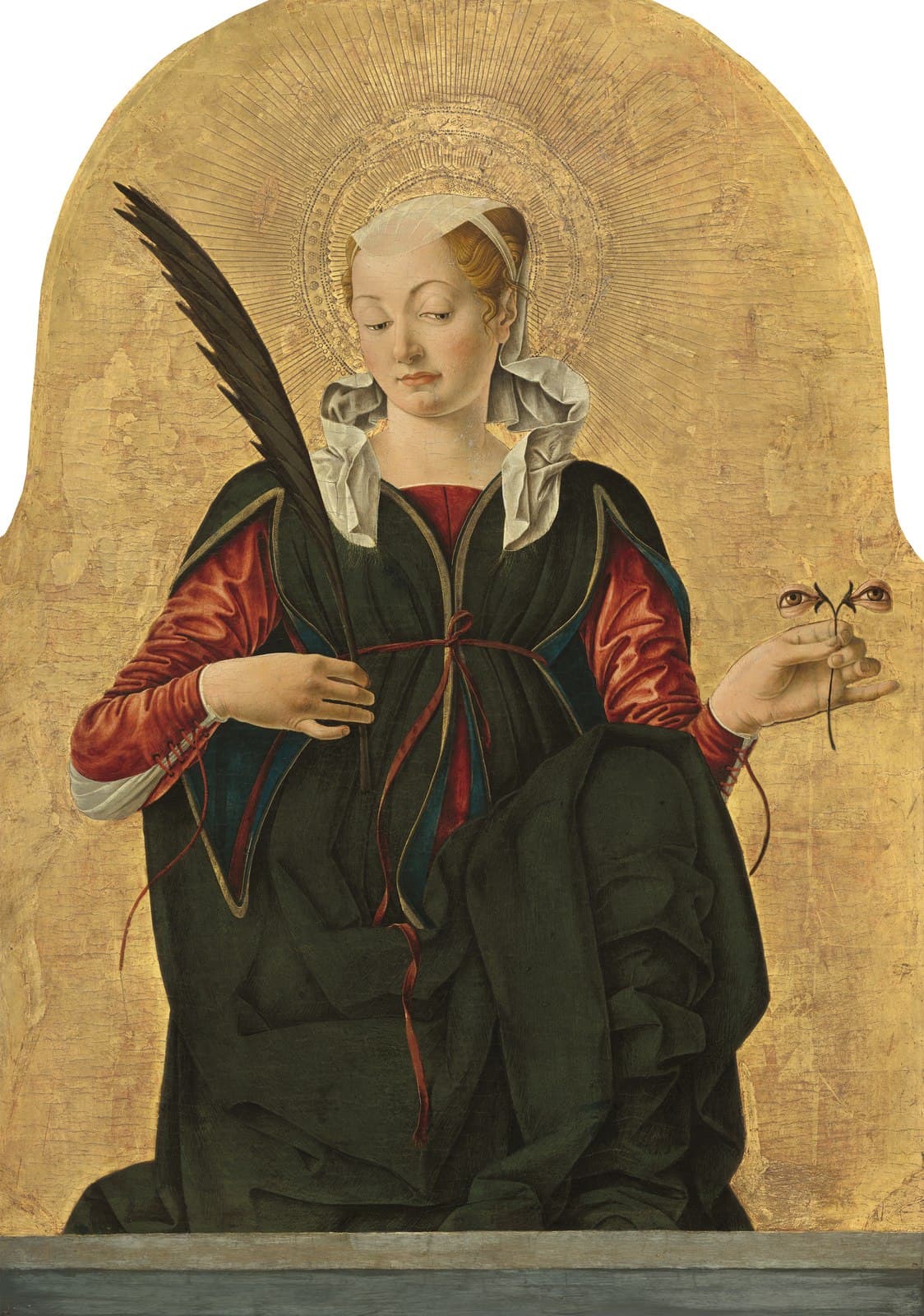
Saint Lucy, painting by Francesco del Cossa, c. 1473–1474, National Gallery of Art, Washington · CC0 (National Gallery of Art Open Access)
Why She Matters
Lucy shows how an early, genuinely attested martyrdom can carry forward for centuries through devotion built on symbol and name as much as on verified narrative detail, and still speak honestly to real darkness, loss, and the hope of light returning.
Virtue for Today
Hope in Darkness
Try Today
Light a candle today and pray specifically for someone going through a genuinely dark season, or reach out to someone living with vision loss or blindness.
What Can Be Confirmed About Her Death
Lucy was martyred in Syracuse, Sicily, during the persecution of Christians under Emperor Diocletian, traditionally dated to the year 304. Of all the details later attached to her story, the Catholic Encyclopedia notes that the place and approximate time of her death "can hardly be questioned," making this the firmest anchor available for her biography. Her veneration spread quickly and early: she is named in the ancient Roman Canon of the Mass, the Communicantes, among a small handful of women honored by name in that most solemn and ancient part of the liturgy, evidence of a genuinely early and serious cult, likely within a couple of centuries of her death.
A Legend Written Two Centuries Later
The fuller, more dramatic story most people know, a wealthy young woman who gives away her dowry to the poor after being healed at the tomb of St. Agatha, is denounced to the Roman governor by the suitor she spurns, survives an attempt to burn her alive, and is finally killed by the sword, comes from Acts that scholars date to roughly the fifth century, around two hundred years after her actual death. The Catholic Encyclopedia is candid that these details "may be only a repetition of similar accounts of a virgin martyr's life and death," a recognizable pattern common to several early martyr narratives rather than a uniquely documented record of Lucy specifically. This does not mean nothing happened; it means the specific narrative details cannot be independently verified as historical fact, distinct from the confirmed core of an early martyrdom in Syracuse.
Why "Light," and the Later Legend of Her Eyes
Lucy's name comes from the Latin lux, meaning "light," and this etymology alone was enough, in a culture that took names and their meanings seriously, to associate her from an early date with light, vision, and protection of the eyes. The vivid image most familiar from later religious art, Lucy holding a plate bearing her own eyes, either torn out by her persecutors as an added torment or removed by her own hand to discourage an admirer drawn to their beauty, does not appear in her earliest accounts at all. It is a late medieval addition, layered onto the older, simpler fact of her name's meaning, and it is presented honestly here as legend rather than as a documented part of her martyrdom. Whatever its origin, the image cemented Lucy's patronage of eyesight and blindness so thoroughly that it remains, alongside music for Cecilia, one of the most instantly recognized saintly attributes in Christian art.
A Feast That Marked the Old Winter Solstice
Because the Julian calendar in use through the Middle Ages placed December 13, Lucy's feast day, close to the winter solstice, the shortest and darkest day of the year, her feast became strongly associated across Northern Europe, especially in Scandinavia, with light returning after darkness. Traditions of candlelit processions on her feast, particularly the Swedish observance of Sankta Lucia, persist strongly today, a devotional and folk practice resting as much on the calendar's old placement of her feast and the meaning of her name as on any verified detail of her actual death in third- or fourth-century Sicily.
Helper
Reflection Questions:
- Lucy's patronage of eyesight grew largely from the meaning of her name rather than a verified historical event. Where else might a name, symbol, or coincidence have shaped a tradition you assumed was based purely on fact?
- The one thing "hardly questioned" about Lucy is the simple, brutal fact of an early martyrdom in a real place, at a real time. What is the one solid, unembellished fact at the core of your own faith that you could return to when everything else feels uncertain?
- Her feast became associated with light returning after the year's darkest day. What "dark" season of your own life are you currently waiting for light to return to?
- The legend of her eyes, whether torn out or given up voluntarily, casts physical loss as something offered rather than merely suffered. Is there a loss or limitation in your own life you could try to reframe as offered rather than only endured?
- Lucy is remembered as generous with her wealth even before her arrest, giving away her dowry to the poor. What would it look like for you to give away something valuable now, before circumstances force the question later?
Short Prayer
“St. Lucy, bearer of light, pray for us — that light may return to whatever darkness we are carrying. Amen.”
Prayer to St. Lucy
Prayer to St. Lucy of Syracuse St. Lucy, your name itself means light, and the Church has honored you since ancient times as one of its earliest and most beloved virgin martyrs, named even in the oldest prayers of the Mass. Pray for us in whatever darkness we are currently facing, physical, emotional, or spiritual, that light might return to us as your feast has long promised light returning after winter's longest night. Watch over all who live with blindness or vision loss, and help the rest of us see more clearly what truly matters. St. Lucy, pray for us. Amen.
Catholic Encyclopedia (New Advent) — "St. Lucy"; Roman Canon of the Mass (Communicantes)
Grow closer to God.
Agnioz is here to walk with you.
Register for FREE and unlock more Catholic content, prayers, and reflections to help you become a more enlightened Catholic — FREE FOREVER.


Let's grow together in faith, hope, and love. 🙏