St. Maximilian Kolbe: The Priest Who Died So Another Could Live
1894 – 1941
“Let us remember that love lives through sacrifice and is nourished by giving. Without sacrifice, there is no love.”
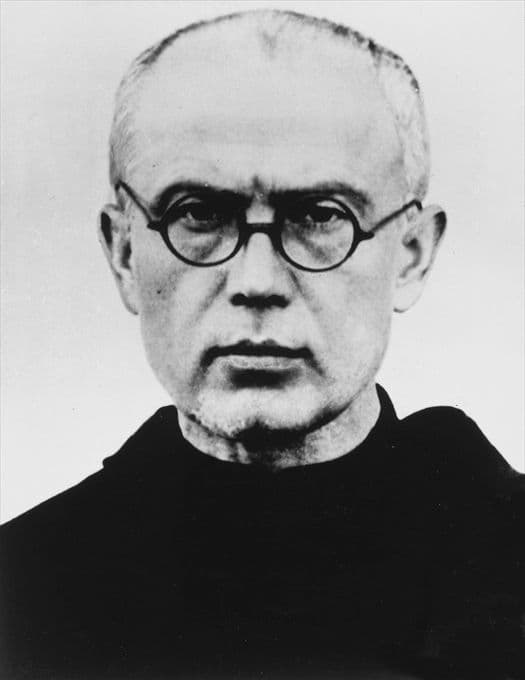
Fr. Maximilian Kolbe, photograph, 1939 · Public Domain (PD-Poland; published without copyright notice before the 1994 law change)
Why He Matters
Kolbe volunteered to die by starvation in another prisoner's place at Auschwitz, then spent his final two weeks leading the condemned men in prayer rather than despair. He matters because he shows that costly, sacrificial love for a stranger is not just an ideal preached from a pulpit but something one Franciscan friar actually lived out to its final, literal end.
Virtue for Today
Sacrificial Love
Try Today
Do one concrete, costly act of kindness today for someone you owe nothing to.
A Life Devoted to Mary
Raymund Kolbe was born in 1894 in Zduńska Wola, Poland, then part of the Russian Empire. As a boy, he reported a vision of the Virgin Mary offering him two crowns — one white for purity, one red for martyrdom — and asked which he would accept. He said he would take both. He entered the Conventual Franciscans, taking the name Maximilian, and was ordained a priest in Rome in 1918.
Kolbe founded the Militia Immaculatae (Army of the Immaculate One) in 1917 to promote consecration to Mary, and later built Niepokalanów ("City of the Immaculate") near Warsaw, which grew into one of the largest Franciscan communities in the world and ran a printing operation producing a monthly magazine with a circulation in the hundreds of thousands. He also spent years as a missionary in Japan, founding a friary in Nagasaki that — situated on the far side of a hill from the 1945 atomic bomb's blast — survived when much of the city did not.
Arrest and Auschwitz
After the Nazi invasion of Poland in 1939, Kolbe's friary sheltered refugees, including an estimated 2,000 Jews, and his community continued printing anti-Nazi material. He was arrested by the Gestapo in February 1941 and sent to Auschwitz that May, where he was assigned to a work detail known for brutal treatment of priests.
In late July 1941, a prisoner escaped from Kolbe's block. Camp policy required ten men be selected at random for death by starvation as reprisal. When one of the chosen men, Franciszek Gajowniczek, cried out that he had a wife and children, Kolbe stepped forward and volunteered to take his place. Camp commander Karl Fritzsch, reportedly startled by the request, allowed the substitution.
Two Weeks in the Starvation Bunker
Kolbe and the other nine men were placed in an underground starvation cell. Survivors and camp workers later testified that Kolbe led the men in prayer and hymns rather than despair, and that he was the last to remain alive after two weeks without food or water. On August 14, 1941, guards administered a lethal injection to end his life. His body was cremated the next day, the feast of the Assumption.
Franciszek Gajowniczek, the man whose place Kolbe took, survived the war and lived until 1995 — attending Kolbe's canonization by Pope John Paul II in 1982, at which the pope declared him a martyr of charity. Kolbe is the patron saint of prisoners, families, and the pro-life movement.
Helper
Reflection Questions:
- Kolbe made an irreversible decision in a single moment. Have you ever faced a choice that demanded immediate sacrifice for someone else?
- Survivors said Kolbe kept the starvation bunker calm through prayer. What sustains your hope in the hardest circumstances you have faced?
- His devotion to Mary shaped decades of ordinary work — publishing, teaching, building community — long before Auschwitz. How do small daily devotions prepare us for larger tests we cannot foresee?
- Gajowniczek carried the weight of being saved by another man's death for the rest of his life. Have you ever had to live with a gift you didn't feel you deserved?
- Kolbe's sacrifice was for a stranger, not a friend or family member. What would it take for you to make a costly sacrifice for someone you don't know?
Short Prayer
“St. Maximilian Kolbe, martyr of charity, pray for us — that we may love sacrificially, even when it costs us everything. Amen.”
Prayer to St. Maximilian Kolbe
Prayer to St. Maximilian Kolbe St. Maximilian Kolbe, in a place built to strip people of their humanity, you gave your life so a husband and father could go home to his family, and you spent your final days leading condemned men in prayer instead of despair. Pray for us when love asks something costly of us — a sacrifice of time, comfort, or safety for someone we may barely know. Help us believe, as you did from childhood, that both purity and sacrifice are crowns worth accepting rather than fates to avoid. Obtain for us the courage to step forward for someone else the way you stepped forward at Auschwitz. St. Maximilian Kolbe, martyr of charity, pray for us. Amen.
Vatican.va — Canonization homily, October 10, 1982
Grow closer to God.
Agnioz is here to walk with you.
Register for FREE and unlock more Catholic content, prayers, and reflections to help you become a more enlightened Catholic — FREE FOREVER.


Let's grow together in faith, hope, and love. 🙏