
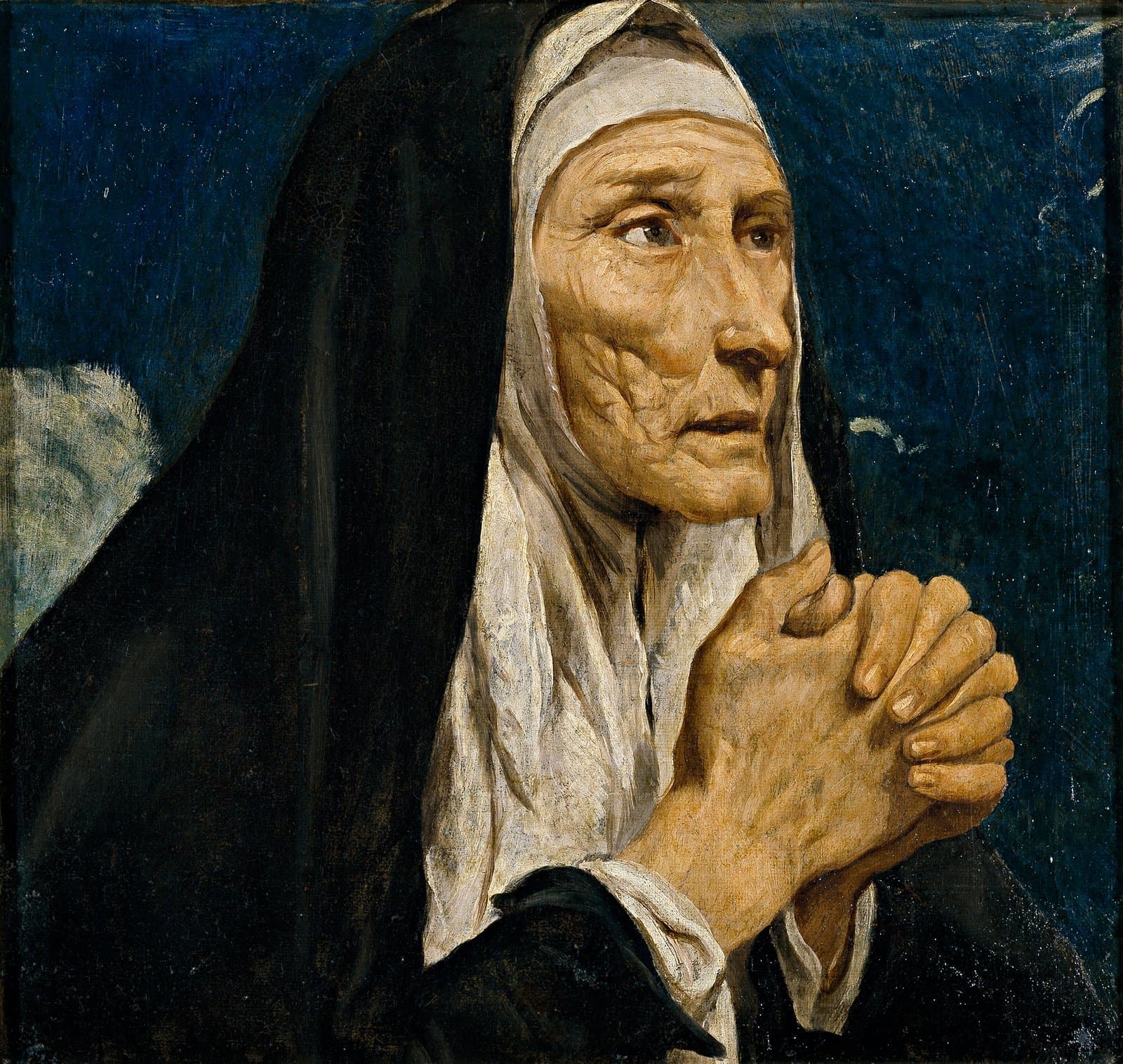
Saint Monica, painting by Luis Tristán, 1616, Museo del Prado · Public Domain
Why She Matters
Monica shows what decades of persistent, hopeful prayer for someone else's conversion can look like, and that even when change seems impossibly slow, it can still come completely.
Virtue for Today
Persevering Prayer
Try Today
Pray by name today for someone whose return to faith you have been hoping and waiting for.
A Difficult Marriage
Monica was born around 331 or 332 in Thagaste, in Roman North Africa (in present-day Algeria), to a Christian family. While still young she was given in marriage to Patricius, a local Roman official who was not a Christian, known for a volatile temper and, by Augustine's own later account in his Confessions, for infidelity. Monica bore his outbursts with a patience her son later described admiringly: she avoided provoking him during his anger and waited for calmer moments to address problems, a strategy that, combined with her steady character, is credited with gradually winning over both her husband and her difficult mother-in-law, who lived in the household. Patricius was baptized shortly before his death around 371, after years of Monica's quiet influence and example.
A Son Who Ran From the Faith
Monica and Patricius had at least three children; her eldest, Augustine, born in 354, was catechized as a child but drifted from the faith as a brilliant, ambitious young student, eventually adopting Manichaeism, a rival religious philosophy, and living for years with a woman outside of marriage, with whom he had a son. Augustine's own Confessions, written decades later after his conversion, describe his mother's grief over this period in vivid, painful detail — including a famous scene in which Monica, warned in a dream that her son would eventually "be with her" in the faith, took hope from an image she did not yet understand, and a meeting with a bishop who, weary of her repeated pleading that he argue Augustine out of his errors, told her simply: "Go thy way, and God bless thee, for it is not possible that the son of these tears should perish."
Following Him to Italy
When Augustine, still unconverted, left North Africa for Rome without telling her — he later confessed he deliberately deceived her to slip away unnoticed — Monica followed him across the sea. By the time she reached Rome he had already moved on to Milan for a prestigious teaching post, so she followed again, arriving in Milan where Augustine had come under the influence of the city's bishop, St. Ambrose, whose preaching began, slowly, to dismantle Augustine's intellectual objections to Christianity. Monica remained at his side through this period, and in 386, in a garden in Milan, Augustine experienced the sudden, decisive conversion he describes in Confessions Book VIII; he was baptized by Ambrose at Easter in 387, seventeen years after Monica had begun her sustained campaign of prayer for his return.
Death at Ostia
Shortly afterward, mother and son, together with friends and family, set out to return to Africa, stopping at the port town of Ostia to await passage. There Monica and Augustine shared what Augustine records as a profound mystical conversation and vision of eternal life, described in one of the most celebrated passages of the Confessions. Days later, Monica fell ill and died at Ostia in 387, at around fifty-six. When her sons asked whether she feared being buried far from her homeland, she answered simply, "Nothing is far from God," adding that she did not fear that God would fail to know, at the end of time, the place from which to raise her up — asking only to be remembered at the altar wherever her sons might be.
A Model of Persevering Prayer
Monica has been venerated since the early Church as the model of the praying parent who does not give up on a wayward child, and Augustine's own account of her, written by the son she prayed for, who became a bishop, theologian, and Doctor of the Church himself, remains one of the most detailed and moving portraits any child has left of a parent's faith.
Helper
Reflection Questions:
- Monica prayed for Augustine's conversion for roughly seventeen years without seeing results for most of that time. What are you still praying for without visible progress, and how do you sustain hope in the meantime?
- She was told bluntly that a son of so many tears could not perish, and she believed it before she had any proof. Whose faith in you, or your prayer for someone else, has kept hope alive when evidence was thin?
- Monica adapted her approach to her husband's temper — choosing timing and patience over confrontation — without ever abandoning her convictions. Where might patience serve your convictions better than an argument would?
- She physically followed her son across the sea, twice, refusing to let distance end her involvement in his life. Is there a relationship you have quietly given up on that deserves one more act of pursuit?
- Her dying words showed total trust that nothing, not even burial far from home, is far from God. What "far away" fear or worry in your life could you hand over with that same trust today?
Short Prayer
“St. Monica, pray for us — that we may never stop praying for those we love, however long it takes. Amen.”
Prayer to St. Monica
Prayer to St. Monica St. Monica, you prayed for your son's conversion for seventeen years without giving up, following him across the sea more than once, trusting that God could reach even the person who seemed to have wandered the farthest. Pray for us for those we love who have drifted from the faith or from us, that we would keep interceding for them patiently, without bitterness, for as long as it takes. Help us trust, as you did, that nothing and no one is ever truly far from God. St. Monica, pray for us. Amen.
St. Augustine, Confessions, Books III, VIII–IX (New Advent Church Fathers)
Grow closer to God.
Agnioz is here to walk with you.
Register for FREE and unlock more Catholic content, prayers, and reflections to help you become a more enlightened Catholic — FREE FOREVER.


Let's grow together in faith, hope, and love. 🙏