
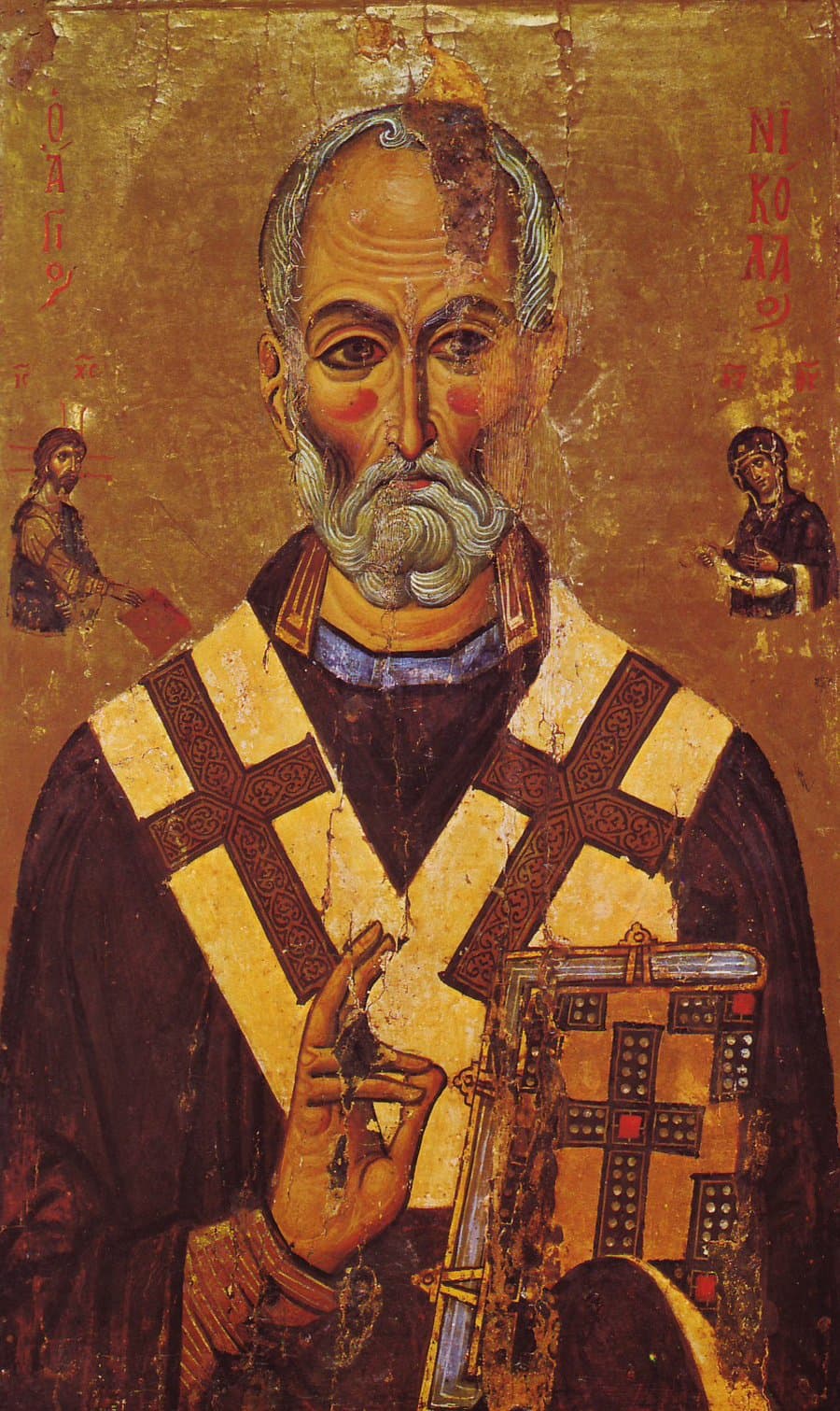
St. Nicholas
of Myra: The Bishop Who Secretly Paid Off a Family's Ruin
270 – 343
“Nicholas the Wonderworker”
Icon of St. Nicholas, Saint Catherine's Monastery, Sinai, 13th century · Public Domain
Why He Matters
Nicholas secretly gave away his inheritance to save a poor family's daughters from being sold into slavery, going to great lengths to keep his own generosity hidden. He matters because, centuries before he became the folklore basis for Santa Claus, his story modeled a very specific kind of giving: targeted, sacrificial, and anonymous, aimed at protecting the dignity of people in real danger.
Virtue for Today
Generosity
Try Today
Give an anonymous gift today to someone in genuine need, without letting them find out it was you.
A Bishop Known for Quiet Generosity
Nicholas was born around 270 AD in the Greek city of Patara, in the Roman province of Lycia (modern-day Turkey), to wealthy Christian parents who died while he was young, leaving him a substantial inheritance. He became Bishop of Myra, a nearby port city, and — according to tradition attested by multiple early hagiographers — was known throughout his diocese not for public displays of piety but for using his wealth to quietly relieve the suffering of the poor, often without being recognized as the source.
Three Nights, Three Daughters
The most famous story associated with him concerns a poor man in Myra with three unmarried daughters and no money for their dowries — in the economic and social conditions of the time, this meant the very real risk that the daughters would be sold into prostitution or slavery simply to survive. Nicholas, learning of the family's desperation, is said to have gone secretly by night to their house and thrown a bag of gold through an open window (in some versions, down the chimney, where it landed in stockings or shoes left by the fire to dry — a detail credited with originating the Christmas stocking tradition). This provided a dowry for the eldest daughter. He returned a second night to do the same for the second daughter. On the third night, the father — determined to discover his benefactor — stayed awake and caught Nicholas in the act; Nicholas begged him to tell no one while he lived.
From Local Bishop to Global Legend
Nicholas is also traditionally said to have been present at the First Council of Nicaea in 325, one of the most consequential councils in Church history, though his participation is not confirmed in the council's surviving official records. He died around 343 and was venerated widely and quickly, becoming one of the most popular saints in both the Eastern and Western Church — patron of children, sailors, merchants, and, because of the dowry story, of the poor and of pawnbrokers (whose traditional three-ball shop symbol is often traced to his three bags of gold). Centuries of legend and Dutch immigrant tradition (Sinterklaas) eventually transformed his image into the modern figure of Santa Claus, though the original story is one of quiet, targeted relief for a family facing real economic ruin — not general gift-giving.
Helper
Reflection Questions:
- Nicholas gave in secret and asked the father to tell no one. What would it look like for you to give generously without needing anyone to know it was you?
- He acted because he specifically learned of one family's desperate circumstances — he didn't wait for a general appeal. Is there a specific person's need in front of you right now that you've been slow to respond to?
- The gift was aimed precisely at preventing exploitation born of poverty, not simply charity for its own sake. How do you think about giving that protects someone's dignity, not just their immediate need?
- His legend has been so reshaped by culture that the original story — about real economic desperation — is often lost. What deeper truth in your own faith story has been flattened or commercialized by others?
- He returned a second and third time rather than considering one act of generosity "enough." Where might God be asking you to keep showing up rather than stopping after a single gesture?
Short Prayer
“St. Nicholas, pray for us — that we may give generously and quietly, expecting nothing in return. Amen.”
Prayer to St. Nicholas of Myra
Prayer to St. Nicholas of Myra St. Nicholas, you used your inheritance not for yourself but to quietly rescue a desperate family from ruin, returning night after night and asking only that your gift stay secret. Pray for us in our giving, that we might learn to give specifically and sacrificially rather than only in the abstract, and without needing anyone to know it was us. Watch over children, sailors, and anyone whose safety depends on the kindness of strangers, as you watched over that family so long ago. Help us see the real, particular needs in front of us rather than waiting for a general appeal to move us to act. St. Nicholas, pray for us. Amen.
Roman Martyrology; Michael the Archimandrite, Life of St. Nicholas (9th c.)

Grow closer to God.
Agnioz is here to walk with you.
Register for FREE and unlock more Catholic content, prayers, and reflections to help you become a more enlightened Catholic — FREE FOREVER.


Let's grow together in faith, hope, and love. 🙏