
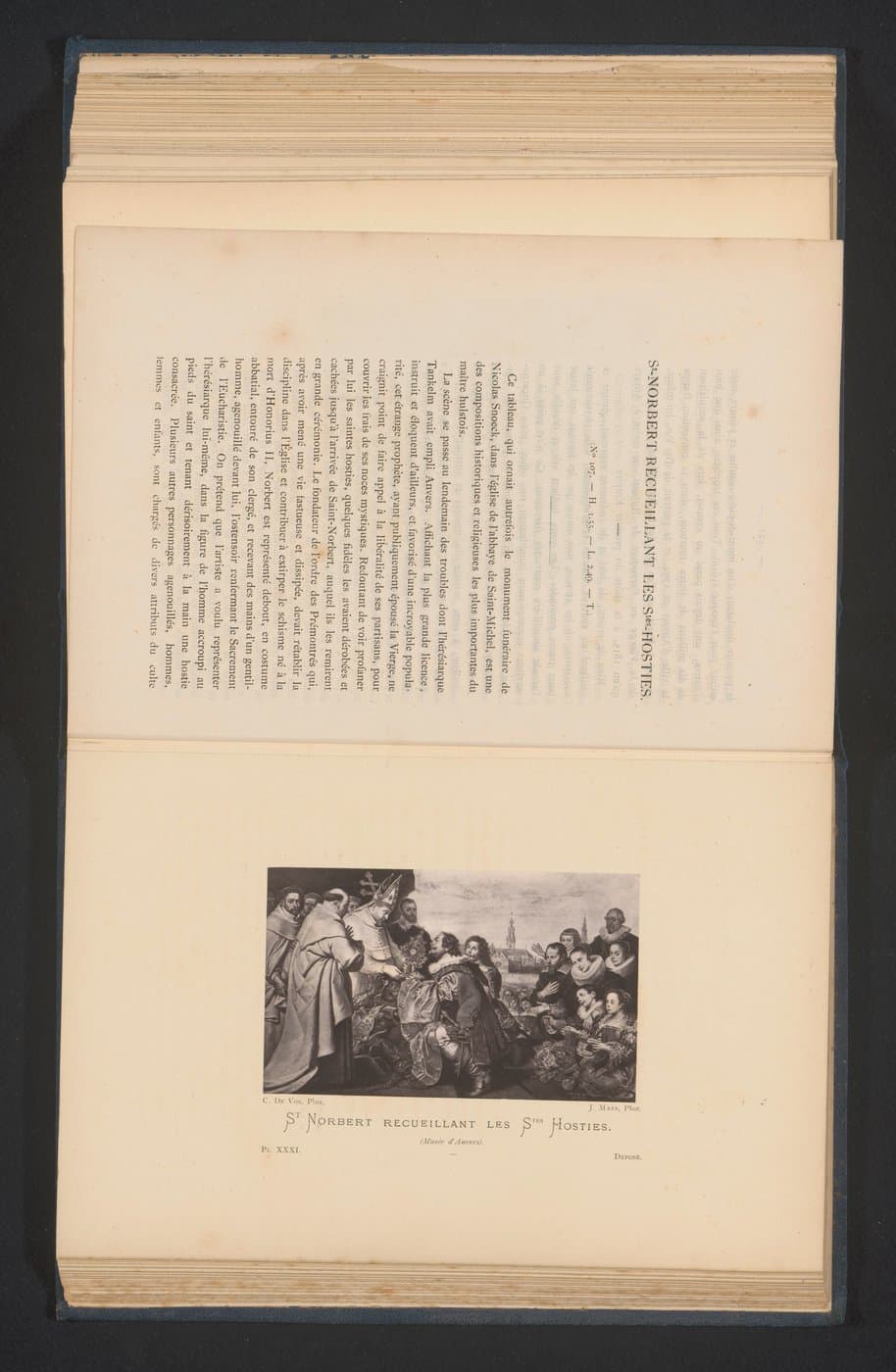
Reproduction of Cornelis de Vos's painting of the citizens of Antwerp returning the monstrance to St. Norbert, Rijksmuseum, c. 1872-1877 photographic reproduction of a 17th-century original · CC0
Why He Matters
Norbert abandoned a comfortable, status-driven clerical career after a dramatic conversion and spent the rest of his life defending belief in the Eucharist and reforming corrupt clergy. He matters because he shows that a genuinely wasted or misdirected start in life does not have to define how it ends.
Virtue for Today
Eucharistic Devotion
Try Today
Approach Mass or the Eucharist today with deliberately renewed attention and reverence, rather than routine.
A Comfortable, Worldly Start
Norbert was born around 1080 in Xanten, a town on the Rhine in what is now western Germany, into a family with connections to the imperial court. He was given a canonry — a paid clerical position — at Xanten as a young man largely through family influence, and rose to further prominence at the courts of the Archbishop-Elector of Cologne and later Emperor Henry V himself, eventually serving as the emperor's almoner. Contemporary accounts describe his early adulthood candidly as comfortable and pleasure-seeking, a career churchman more interested in status and court life than any serious vocation — exactly the kind of clerical careerism that was drawing sharp criticism from Church reformers of the period.
Struck From His Horse
In 1115, while riding near Xanten, Norbert was caught in a violent thunderstorm; a bolt of lightning struck near him, throwing him from his horse and leaving him unconscious for close to an hour. He later described the experience as a direct and unmistakable call to conversion — an unavoidable, physical interruption to a life he had never seriously examined. He withdrew afterward to a religious cell at Fürstenberg, near Xanten, where he spent roughly three years in penance, prayer, and theological study, radically reorienting a life that had previously been built around advancement and comfort.
Founding the Premonstratensians
Norbert emerged from this period of retreat as an itinerant preacher, walking barefoot through French and German territory preaching penance and reform to crowds that included both clergy and laypeople. At the invitation of the Bishop of Laon and with the encouragement of Pope Callixtus II, Norbert settled in a valley called Prémontré in northern France, where on Christmas Day, 1121, he formally founded a new community of canons regular — priests living a shared, disciplined common life under a rule, combining active pastoral ministry with the structure and prayer rhythm more typical of monastic life. This new order, the Premonstratensians (also called Norbertines, after their founder), adopted the Rule of St. Augustine along with some stricter Cistercian-influenced customs, and received formal papal confirmation in 1126, expanding rapidly across France, Germany, and the Low Countries within Norbert's own lifetime.
Defender of the Eucharist
Norbert's reputation for zeal reached a dramatic peak in Antwerp, where a heretical preacher named Tanchelm had convinced significant parts of the population to reject the sacraments, including the Real Presence of Christ in the Eucharist. Norbert's preaching campaign in the city is credited with restoring the population's Catholic faith and devotion to the Eucharist specifically, and later Catholic tradition remembers him particularly for a widely told account of his devotion to the Precious Blood: that a poisonous spider once fell into the chalice he was about to consume from, and rather than risk spilling any of the consecrated wine, he drank it anyway, trusting God to protect him — and suffered no harm. Whether taken as literal historical fact or pious legend attached to a genuinely fervent Eucharistic reformer, the story reflects why the Church came to honor him specifically as the Apostle of the Eucharist.
Archbishop of Magdeburg
In 1126, Norbert was chosen, somewhat against his own preference for the simpler preaching life, to become Archbishop of Magdeburg in Germany, an archdiocese in serious financial and moral disarray. He worked energetically to reform the clergy there, faced significant local resistance and even threats to his life from clergy resistant to reform, and continued serving as a trusted adviser to the emperor even while governing the troubled see.
Apostle of the Eucharist
Norbert died in Magdeburg on June 6, 1134. He was canonized in 1582 by Pope Gregory XIII. The Premonstratensian order he founded continues today, combining community life, disciplined prayer, and active pastoral and educational ministry, a structure that has proven durable for nearly nine centuries. Norbert is remembered above all as the Apostle of the Eucharist, a churchman whose worldly, comfortable early career was interrupted by one violent moment he could not ignore, and who spent the rest of his life making sure others did not ignore the sacrament he came to revere above all else.
Helper
Reflection Questions:
- Norbert spent his early adulthood pursuing comfort and status through Church connections, without any real examination of his vocation. Have you ever drifted into a comfortable path without seriously asking whether it was the right one?
- It took a literally shattering interruption — being thrown from his horse by lightning — to make him reconsider his life. Has it ever taken a real crisis, rather than gentle reflection, to get your attention about something that needed to change?
- He walked barefoot as an itinerant preacher after growing up wealthy and comfortable, a total reversal of his earlier priorities. What would "walking barefoot" — some deliberate, visible sacrifice — look like in your own life right now?
- He is remembered specifically for his fierce devotion to the Eucharist, at a time when a popular local heresy was denying it. How seriously do you take the sacraments you have easy, regular access to?
- He reluctantly accepted a difficult leadership post (Archbishop of Magdeburg) he had not sought and would have preferred to avoid. Is there a difficult responsibility you have been avoiding, that you may actually be equipped to carry?
Short Prayer
“St. Norbert of Xanten, Apostle of the Eucharist, pray for us — that we may revere the sacraments with the same zeal you did. Amen.”
Prayer to St. Norbert of Xanten
Prayer to St. Norbert of Xanten St. Norbert, you spent your early years chasing comfort and status through Church connections, until one violent, unavoidable moment knocked you from your horse and from the life you had been living. You gave up that comfort entirely, walked barefoot as a preacher of reform, and became known above all for your fierce defense of Christ's presence in the Eucharist. Pray for us when we have drifted into comfortable routines without examining whether they are the right ones. Help us approach the sacraments with the same reverence and zeal you fought to restore in the people around you. St. Norbert, pray for us. Amen.
New Advent Catholic Encyclopedia, "St. Norbert"; Dominicana Journal, "St. Norbert, Apostle of the Eucharist"
Grow closer to God.
Agnioz is here to walk with you.
Register for FREE and unlock more Catholic content, prayers, and reflections to help you become a more enlightened Catholic — FREE FOREVER.


Let's grow together in faith, hope, and love. 🙏