St. Patrick: The Slave Who Returned to Convert His Captors
385 – 461
“I am Patrick, a sinner, the most rustic and the least of all the faithful, and the most contemptible in the estimation of very many.”
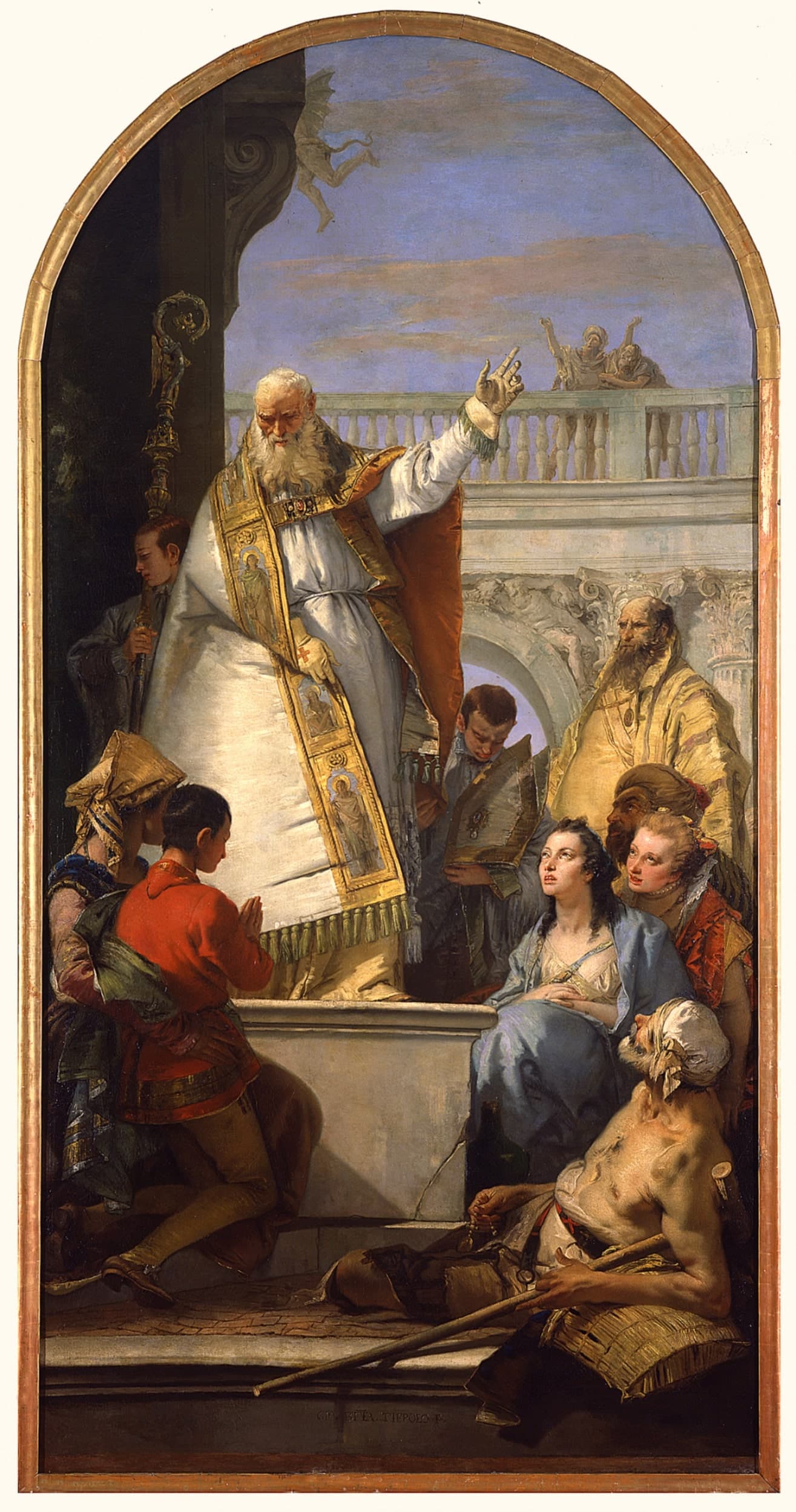
Saint Patrick, Bishop of Ireland, painting by Giambattista Tiepolo, 1746, Musei Civici di Padova · Public Domain
Why He Matters
Patrick shows that a period of real suffering — even something as devastating as slavery — can become the foundation of an entire life of faith, and that authentic conversion sometimes leads back toward the very place a person most wants to leave behind.
Virtue for Today
Missionary Courage
Try Today
Pray by name for someone from a country, community, or situation you associate with hardship, asking God to bless them the way Patrick chose to bless Ireland.
Kidnapped at Sixteen
Patrick was born around the year 385, most likely in Roman Britain, into a Christian family — his father was a deacon and local official. As a teenager he was, in his own words, careless about his faith. At sixteen he was captured by Irish raiders during a slave-trading expedition, taken to Ireland, and set to work as a shepherd, isolated and alone, likely in the west of the country, for six years. It was in that captivity, not before it, that his faith became real. In his own account, the Confessio, he wrote that during those lonely years he prayed constantly, "in the woods and on the mountain," even before dawn, in snow and frost.
Escape and Formation
After six years, Patrick believed he heard a voice telling him a ship was ready to take him home. He walked roughly two hundred miles to the coast, persuaded a reluctant ship's crew to take him aboard, and eventually made his way back to his family in Britain. He then spent years in formation for the priesthood — probably including time in Gaul — and was eventually ordained and consecrated a bishop.
The Return Nobody Expected
What sets Patrick apart is not the escape but what came after it. Rather than staying safely home, he asked to return to Ireland — the country of his enslavement — as a missionary bishop, arriving around 432. He spent the rest of his life traveling through a pagan, tribal, often dangerous Ireland, preaching, baptizing converts by the thousands, ordaining priests, and establishing the structures of a Church where none had existed. He faced real hostility: in the Confessio he describes threats on his life, and in a separate surviving letter, the Epistola, he excommunicates a British warlord's soldiers for killing and enslaving Irish converts — a document that shows him defending the very people who had once enslaved him.
Building a Church From Nothing
By the time of his death, traditionally dated to March 17, 461 (though, like his birth year, the exact date is uncertain), Patrick had established churches and a native clergy across a country that had had no organized Christian presence before him. He is credited with laying the groundwork for the flowering of Irish monasticism that would, within a couple of centuries, make Ireland one of the centers of learning and missionary activity in early medieval Europe. The now-famous legends about him — banishing snakes from Ireland, using the shamrock to teach the Trinity — appear centuries after his death and are not part of his own writings, but the two documents that do survive in his own hand, the Confessio and the Epistola, are considered authentic and are among the earliest surviving texts written in Ireland.
Patron of a Nation
Patrick is remembered today as the patron saint of Ireland, not chiefly for miracles but for a documented, lifelong decision: a man who had every reason to want nothing more to do with the place that enslaved him instead spent decades of freedom giving it everything he had.
Helper
Reflection Questions:
- Patrick's faith did not become real to him until he was isolated and suffering as a slave. Has hardship ever deepened your own faith in a way comfort never did?
- He chose to return to the very people who had enslaved him, in order to serve them. Is there a person or situation you've been avoiding that God may be calling you to face with forgiveness instead of distance?
- Patrick describes years of persistent, repeated prayer during his captivity — prayer that did not feel dramatic at the time. What does your own "unglamorous" daily prayer look like?
- In the Epistola, Patrick defended Irish converts against violence from people who shared his own background and language. Where might loyalty to what's right cost you standing with your own community?
- Patrick built a Church that outlived him by more than a thousand years, mostly through ordinary, unrecorded acts of teaching and travel. What are you building today whose full effect you may never personally see?
Short Prayer
“St. Patrick, apostle of Ireland, pray for us — that we may have the courage to return good for harm, as you did. Amen.”
Prayer to St. Patrick
St. Patrick's Breastplate (traditional text, the "Christ with me" portion of the Lorica long attributed to Patrick in Irish tradition) Christ with me, Christ before me, Christ behind me, Christ in me, Christ beneath me, Christ above me, Christ on my right, Christ on my left, Christ when I lie down, Christ when I sit down, Christ when I arise, Christ in the heart of everyone who thinks of me, Christ in the mouth of everyone who speaks of me, Christ in every eye that sees me, Christ in every ear that hears me. Amen.
St. Patrick, Confessio (patrickconfessio.ie, translated by Pádraig McCarthy); EWTN — "Saint Patrick, Apostle of Ireland"; Britannica — "St. Patrick"
Grow closer to God.
Agnioz is here to walk with you.
Register for FREE and unlock more Catholic content, prayers, and reflections to help you become a more enlightened Catholic — FREE FOREVER.


Let's grow together in faith, hope, and love. 🙏