St. Paul Miki: The Preacher Who Kept Preaching From the Cross
1562 – 1597
“I am a Japanese by birth, and a member of the Society of Jesus... I have committed no crime, and the only reason why I am put to death is that I have been teaching the doctrine of Christ. I thank God it is for this reason that I die.”
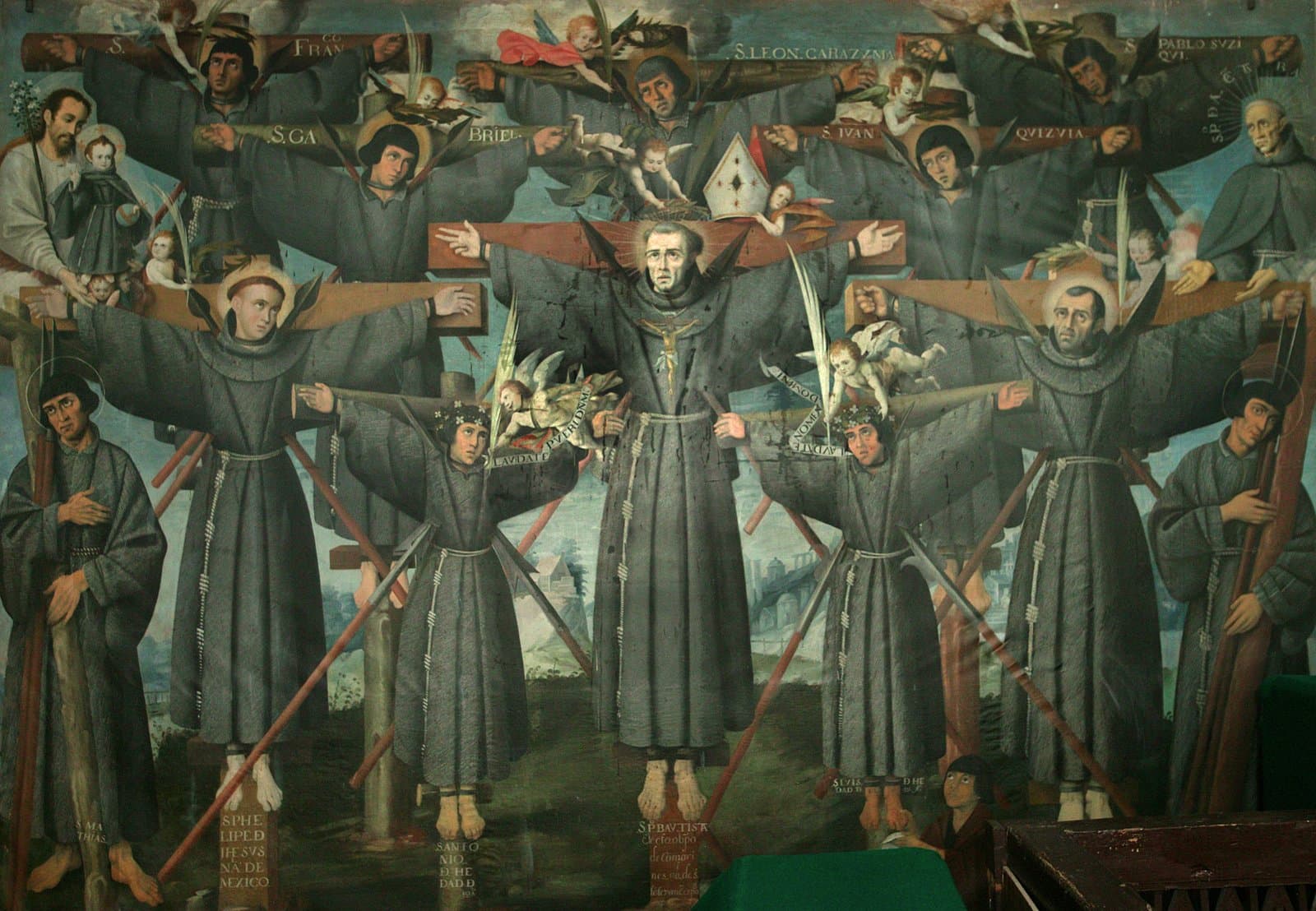
Painting of the Nagasaki Martyrs, Cuzco School, 18th–19th century · Public Domain
Why He Matters
Paul Miki shows that identity and faith do not have to be in conflict — he died insisting he was faithfully both Japanese and Christian — and that forgiveness can be offered even in the final moments of unjust execution.
Virtue for Today
Forgiveness
Try Today
Say or write one sincere sentence of forgiveness to someone who has wronged you, even if only privately in prayer.
Son of a Samurai Family
Paul Miki was born around 1562 in Japan, into the family of a prominent samurai military commander. He was educated at a Jesuit college and entered the Society of Jesus as a novice in 1580, at a time when Christianity — introduced to Japan by St. Francis Xavier decades earlier — had grown rapidly, reaching an estimated two hundred thousand converts by the 1580s. Miki proved to be an unusually gifted and popular preacher, well known across the Japanese Jesuit mission for his eloquence.
A Faith Turned Illegal
The political tolerance that had allowed Christianity to spread in Japan collapsed under the ruler Toyotomi Hideyoshi, who came to see the growing Christian community, and its ties to European powers, as a political threat. In 1587 Hideyoshi ordered Catholic missionaries banished, forcing the Jesuits into hiding and continued, more cautious ministry. Outright violent persecution did not begin until late 1596, when Hideyoshi ordered a group of Christians in Kyoto and Osaka rounded up as a deliberate public example.
The March to Nagasaki
Twenty-six people were arrested: six European Franciscan missionaries, three Japanese Jesuits (Paul Miki among them), and seventeen Japanese laypeople associated with the Franciscan mission, including at least three teenage boys. As part of their punishment, their left ears were partially cut off, and they were paraded through several towns as a warning before being forced to march roughly six hundred miles, through winter conditions, from Kyoto to Nagasaki — a journey of about a month.
Crucified on Nishizaka Hill
On February 5, 1597, the twenty-six were bound to individual crosses arranged in a row on Nishizaka Hill outside Nagasaki and killed by spear thrusts, the traditional Japanese method of execution by crucifixion. Witnesses recorded that Paul Miki, from his own cross, used his final moments to preach one last time, forgiving his executioners and affirming his identity as both a loyal Japanese subject and a Christian: "I am a Japanese by birth, and a member of the Society of Jesus... I have committed no crime, and the only reason why I am put to death is that I have been teaching the doctrine of Christ. I thank God it is for this reason that I die." Several of his companions reportedly sang psalms and hymns as they died alongside him.
Canonized Together
The martyrdom of the Twenty-Six Martyrs of Japan, as they came to be known, became one of the most widely documented and internationally reported events of the early Japanese mission era, thanks to eyewitness letters that quickly reached Europe. Pope Pius IX canonized all twenty-six together in 1862. Paul Miki, as the best known of the three Japanese Jesuits among them, is typically named as the group's lead figure, but the feast honors the entire company: priests, brothers, and laymen, foreign missionaries and native Japanese converts, adults and teenage boys, together.
Helper
Reflection Questions:
- Paul Miki used his final public moments not for despair or complaint but to preach one more time and forgive the men killing him. What would it look like for you to respond to a serious wrong done to you with active forgiveness rather than passive tolerance?
- He and his companions were paraded publicly and mutilated as a deliberate warning to others, yet several of them sang hymns during their final march. Where do you find the ability to keep your composure, or even your joy, during a genuinely hard season?
- The group included both foreign missionaries and Japanese laypeople, adults and teenagers, united by a shared faith despite very different backgrounds. Who in your own life is genuinely different from you but united with you in something that matters more than the difference?
- Miki insisted he was both faithfully Japanese and faithfully Christian, rejecting the idea that he had to choose one identity over the other. Do you ever feel pressured to treat faith and another part of your identity as being in conflict, when they may not need to be?
- Eyewitness letters about the martyrdom reached Europe quickly and shaped how the wider Church understood the Japanese mission. Whose witness, close to you, deserves to be told and passed on more widely than it currently is?
Short Prayer
“St. Paul Miki and Companions, pray for us — that we may forgive freely and preach the truth without fear, as you did to the very end. Amen.”
Prayer to St. Paul Miki
Prayer to St. Paul Miki and Companions St. Paul Miki, from your own cross you used your final breath not for despair but for one more sermon, forgiving the very people who were executing you and affirming both your Japanese identity and your Christian faith as one, undivided loyalty. Pray for us, together with your twenty-five companions — priests, brothers, and laymen, missionaries and converts, men and boys alike — when we face our own smaller moments of pressure to hide or deny our faith. Give us your composure under threat and your instinct to forgive rather than condemn. St. Paul Miki and Companions, pray for us. Amen.
Britannica — "26 Martyrs of Japan"; Franciscan Media — "Saint Paul Miki and Companions"; Catholic News Herald — "St. Paul Miki and the 26 Martyrs of Japan"
Grow closer to God.
Agnioz is here to walk with you.
Register for FREE and unlock more Catholic content, prayers, and reflections to help you become a more enlightened Catholic — FREE FOREVER.


Let's grow together in faith, hope, and love. 🙏