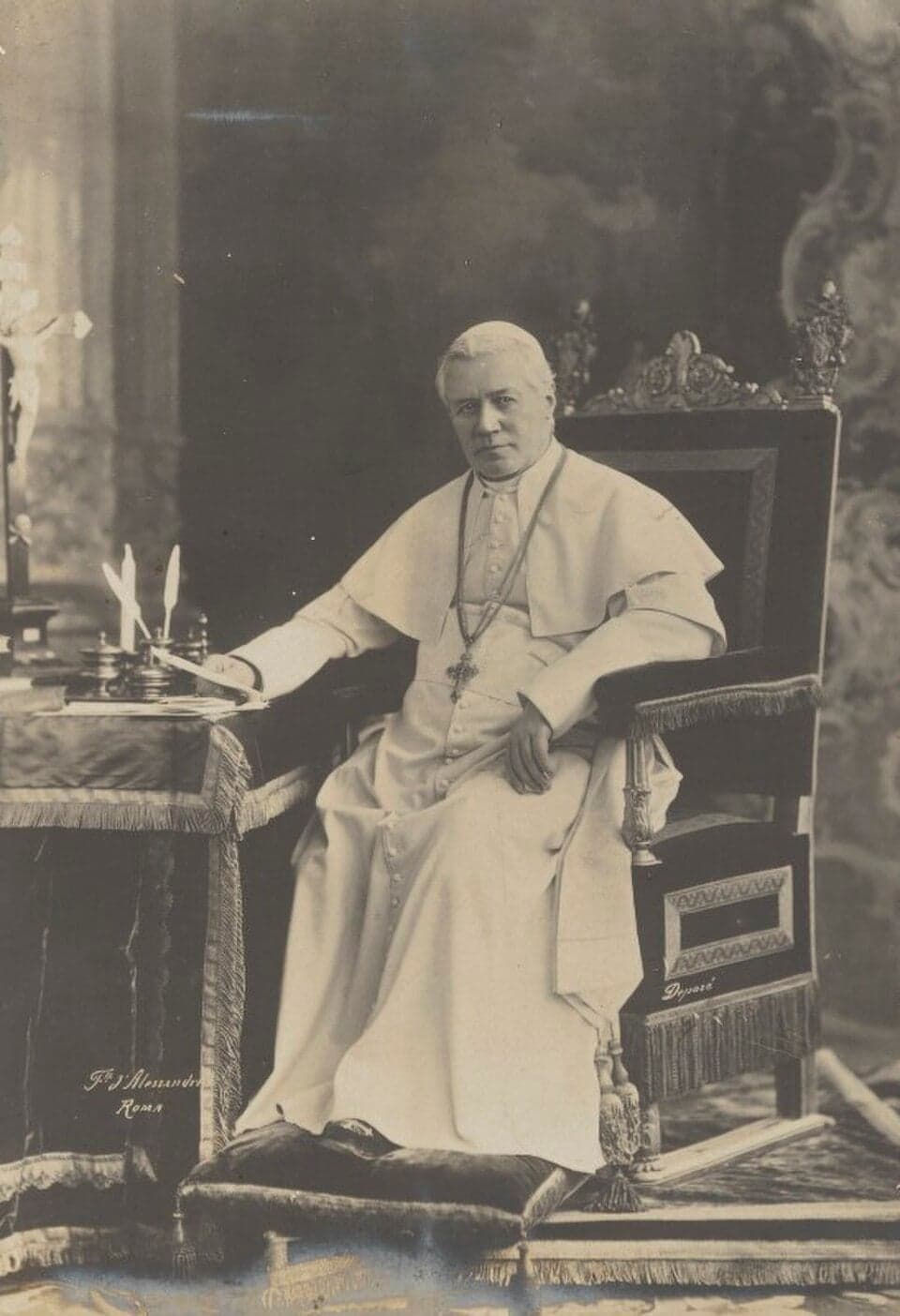
St. Pius X: The Peasant Pope Who Gave Communion Back to Children
1835 – 1914
“Instaurare omnia in Christo — To restore all things in Christ.”
Why He Matters
St. Pius X reshaped ordinary Catholic life more than almost any modern pope by restoring frequent Communion and lowering the age for First Communion, insisting the Eucharist is medicine for the weak rather than a reward for the already-holy.
Virtue for Today
Humility — a peasant's son who never let the papal tiara distance him from ordinary people or their needs.
Try Today
Receive Communion today (or pray for a child preparing for First Communion) with a renewed sense that it is food for your weakness, not a prize for your strength.
A Farm Boy from the Veneto
Giuseppe Melchiorre Sarto was born in 1835 in Riese, a small town in the Veneto countryside of northern Italy, the second of ten children of a village postman and a seamstress. Money was tight enough that Giuseppe walked several miles barefoot each day to school in the neighboring town, carrying his shoes over his shoulder to save the leather for when he arrived. Nothing about his origins suggested he would end his life as Bishop of Rome. That gap — between where he started and where he ended up — never closed in his own mind, and it shaped every year of his priesthood and papacy that followed.
He was ordained in 1858 and spent the next seventeen years in parish work: first as a curate, then as a pastor in the small town of Salzano, where he was remembered for personally teaching catechism to children, sitting with the dying at all hours, and giving away so much of his own modest income to the poor that his sister had to manage what little remained of his salary.
The Bishop Who Slept on a Cot
Rome noticed him anyway. He became Bishop of Mantua in 1884 and Patriarch of Venice in 1893 — and at each promotion, colleagues who expected the honors to change him were disappointed, in the best sense: as Patriarch of Venice, a position with a grand episcopal residence, he reportedly still slept on a simple cot and kept the same plain habits of a country pastor. He never entirely lost the accent, the manner, or the instincts of Riese, and he seems to have made no effort to.
From Patriarch of Venice to the Chair of Peter
Sarto was elected pope in 1903, reportedly against his own wishes — he is said to have wept when the result was announced and initially wanted to decline. He took the name Pius X and chose as his papal motto Instaurare omnia in Christo — "To restore all things in Christ," a line from St. Paul's letter to the Ephesians (1:10). It was not a vague slogan. Over the next eleven years, it became the working plan for nearly everything he did.
Restoring All Things in Christ: Communion for Children
The single reform most identified with Pius X touched millions of Catholic families directly and still does. By the customs that had developed over centuries, First Communion was commonly delayed until around age twelve or later, often bound up with an assumption that children needed near-adult theological understanding before receiving the Eucharist. In 1910, Pius X issued the decree Quam Singulari, lowering the expected age of First Communion to what the Church calls the "age of reason" — roughly seven — insisting that a basic grasp of the difference between ordinary bread and the Eucharist was sufficient, not a theologian's command of doctrine.
He pushed the same instinct further with the 1905 decree encouraging frequent, even daily, Communion for all the faithful in a state of grace — at a time when many devout Catholics still received only a few times a year, out of an exaggerated sense of unworthiness that had built up over the centuries following the Jansenist controversies. Pius X's consistent argument was that the Eucharist is medicine for the weak, not a reward reserved for the already-strong. Restoring frequent Communion to ordinary Catholic life, and restoring it to children years earlier than custom allowed, is arguably the single most consequential change any modern pope made to how Catholics actually practice their faith week to week.
Guarding the Faith Against Modernism
Pius X's reign fell during a period of intense theological upheaval, as some Catholic scholars began adapting Church teaching to contemporary philosophy and historical-critical method in ways he judged corrosive to the faith itself. In 1907, he issued the encyclical Pascendi Dominici Gregis, condemning what he grouped together under the label "Modernism," and later required clergy to take an "Oath Against Modernism." Historians still debate how precisely targeted and how bluntly broad this campaign was in practice, and some legitimate theological work was caught up in the resulting caution. What is not in dispute is Pius X's own motive: an unwavering conviction, formed in a country parish rather than a university seminar room, that the faith handed to ordinary believers had to remain solid ground under their feet.
Ordering the Law and the Liturgy
Alongside these better-known reforms, Pius X quietly began one of the largest institutional projects in the Church's history: the codification of a unified Code of Canon Law, work that would not be completed and promulgated until 1917, three years after his death. He also issued Tra le sollecitudini in 1903, restoring Gregorian chant and genuinely sacred music to the center of the liturgy and pushing back against the more operatic, theatrical church music that had become fashionable in some places. Both projects shared the same underlying impulse as his work on Communion: strip away what had accumulated as mere custom, and get back to something closer to the actual substance of the faith.
A Humble Death, A Rapid Cause
Pius X died on August 20, 1914, weeks after the outbreak of the First World War, which he had tried and failed to avert and which is said to have hastened his final decline. He left behind almost no personal wealth — famously observing, near the end, "I was born poor, I have lived poor, I wish to die poor." He was beatified in 1951 and canonized in 1954 by Pope Pius XII, the first pope to be declared a saint since Pius V nearly four hundred years earlier. His feast is kept on August 21, the day after his death, since August 20 already belongs to St. Bernard of Clairvaux on the General Roman Calendar.
Helper
Reflection Questions:
- Pius X insisted the Eucharist is "medicine for the weak," not a reward for the already-strong. Does the way you approach Communion reflect that, or have you absorbed a quieter sense that you need to be more "ready" than you actually do?
- He never let the papal court change the plain habits he brought from a poor country parish. What outward comfort or status in your own life would be hardest to hold loosely the way he did?
- His reforms were often about removing centuries of accumulated custom to get back to something simpler and more original. Is there a practice in your own faith life that has grown more complicated than it needs to be?
- He wept when elected pope, not wanting the honor. Where in your life have you been given responsibility you didn't seek — and how did you respond to it?
Short Prayer
“St. Pius X, you who restored the Eucharist to the young and the weary, obtain for me a hunger for Communion that never mistakes unworthiness for an excuse to stay away. Amen.”
Prayer to St. Pius X
St. Pius X, poor man's son and Vicar of Christ, you carried the simplicity of Riese all the way to the Chair of Peter, and spent your reign restoring what centuries of custom had buried — the Eucharist as daily bread for ordinary sinners, not a distant reward for the perfect. Obtain for me your same hunger for the sacraments and your same refusal to let honor or comfort change who I really am. Teach me to seek, in every state of life, only to restore all things in Christ. Amen.
Grow closer to God.
Agnioz is here to walk with you.
Register for FREE and unlock more Catholic content, prayers, and reflections to help you become a more enlightened Catholic — FREE FOREVER.


Let's grow together in faith, hope, and love. 🙏