
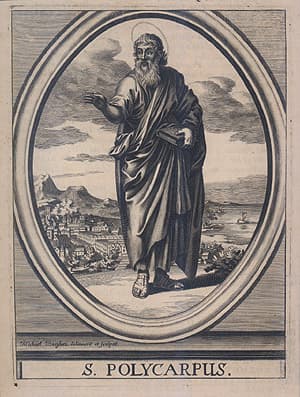
St. Polycarp
of Smyrna: Eighty-Six Years in Christ's Service
69 – 155
“Eighty-six years I have served him, and he never did me any wrong. How can I blaspheme my King who saved me?”
Saint Polycarp, Bishop of Smyrna, engraving by Michael Burghers, 17th century, from "The Life of S. Polycarp Bishop of Smyrna" · Public Domain (PD-old-100-expired)
Why He Matters
Polycarp personally connects the apostolic Church to the second century — he had known the Apostle John — and his martyrdom account is the earliest surviving eyewitness record of a Christian dying for the faith outside the New Testament. He matters because his final words show what faith looks like when it is not a single dramatic decision but eighty-six years of consistency, tested at the very end and found unshaken.
Virtue for Today
Steadfast Loyalty
Try Today
Name one commitment of faith you made years ago, and recommit to it today, deliberately and specifically.
A Living Link to the Apostles
Polycarp served for decades as bishop of Smyrna, a major city on the coast of Asia Minor (modern-day Izmir, Turkey). What makes him historically singular is a direct personal connection to the apostolic generation: according to Irenaeus of Lyon, who as a young man heard Polycarp preach and later wrote about it, Polycarp had been personally instructed by the Apostle John and had known others who had seen Jesus in the flesh. Through Irenaeus's own later writing, Polycarp forms a documented, unbroken chain of memory connecting the second-century Church directly back to eyewitnesses of Christ.
Guardian of Apostolic Teaching
Polycarp corresponded with the wider Christian world of his time, including a personal letter he received from Ignatius of Antioch as Ignatius was being marched to his own martyrdom in Rome. Polycarp's own surviving Letter to the Philippians — one of the earliest patristic texts outside the New Testament — reflects a bishop deeply concerned with preserving the teaching he had received unaltered, and he was known during his lifetime as a vigorous opponent of early heresies, particularly various forms of Gnosticism that denied Christ's true humanity. Late in his life, he traveled to Rome to meet with Pope Anicetus to discuss differing regional customs for calculating the date of Easter — a sign of both his stature and his commitment to unity even amid disagreement.
Arrested at Eighty-Six
During a local wave of persecution, Roman authorities sought out Polycarp, by then a very old man. According to The Martyrdom of Polycarp — a letter written by the church of Smyrna to other Christian communities shortly after the events it describes, and widely regarded as the earliest genuine account of a Christian martyrdom to survive outside the New Testament — the proconsul urged him repeatedly to swear by the emperor's fortune and curse Christ, promising his freedom if he complied.
"How Can I Blaspheme My King?"
Polycarp's reply became one of the most quoted lines from the early Church: "Eighty-six years I have served him, and he never did me any wrong. How can I blaspheme my King who saved me?" It was not a rhetorical flourish; it was a plain statement of fact from a man old enough to have lived nearly his entire life within the faith he refused to abandon, even under direct threat of death.
Fire and Faithfulness
Refusing to recant, Polycarp was sentenced to be burned alive. The account describes the crowd gathering wood, Polycarp praying aloud with gratitude even as the pyre was prepared, and the flames reportedly forming around him "like a ship's sail filled by the wind" without immediately harming him — so that, according to the account, he was finally killed by a dagger thrust when the fire failed to consume him quickly. He died around AD 155–156, one of the earliest bishops of the sub-apostolic age whose martyrdom was carefully documented and circulated by his own community soon after it happened.
Faithfulness Measured in Decades
Polycarp's story is remarkable less for a single dramatic act than for the sheer span of consistency behind his final words — eighty-six years of a life he could describe, without hesitation, as one in which God had never once failed him.
Helper
Reflection Questions:
- Polycarp could say, after eighty-six years, that God had never done him wrong. Could you honestly say the same about your own life so far, even including its hardships?
- He was offered an easy way out — a simple oath — and refused it without hesitation. What "easy way out" of a difficult commitment are you currently being tempted by?
- He had learned the faith directly from someone who had known the apostles, and spent his life guarding that teaching carefully. How carefully are you passing on what you've received to the people who come after you?
- He traveled to resolve a disagreement about Easter's date in person rather than let it fracture the wider Church. Is there a disagreement in your own community you're avoiding addressing directly?
- His community wrote down his martyrdom almost immediately so others could learn from it. Whose story of faith have you witnessed that deserves to be remembered and retold?
Short Prayer
“St. Polycarp, pray for us — that our faith may grow only steadier with age, as yours did. Amen.”
Prayer to St. Polycarp of Smyrna
Prayer to St. Polycarp of Smyrna St. Polycarp, you carried the faith you received from those who had known Christ himself through decades of quiet, faithful service, and when you were finally forced to choose between denying him and dying, you did not hesitate. You told your judges plainly that in eighty-six years, God had never once done you wrong. Pray for us when we are tempted to trade our convictions for comfort or safety. Help our own faith deepen with time rather than erode, so that whatever we are eventually asked to answer for, we can answer as clearly and as peacefully as you did. St. Polycarp, pray for us. Amen.
The Martyrdom of Polycarp (2nd-century eyewitness account, church of Smyrna); Irenaeus of Lyon, Against Heresies, Book III; Catholic Encyclopedia (New Advent), "St. Polycarp"
Grow closer to God.
Agnioz is here to walk with you.
Register for FREE and unlock more Catholic content, prayers, and reflections to help you become a more enlightened Catholic — FREE FOREVER.


Let's grow together in faith, hope, and love. 🙏